
Wells
Well Water Treatment: Match It to Your Test
Well water treatment starts with a lab report: each problem it shows, from sand and hardness to arsenic or nitrate, has its own fix, and no single unit handles them all.
Disclosure: SoftPro Water Systems, a store owned by the same team as this site, sells the softeners, filters and well-water equipment we link to. Our water pages follow the water suppliers' latest consumer confidence reports and federal, state and county agency guidance, checked October 2026. Store descriptions are reported as the store's own claims. Ownership disclosure
View at SoftPro Water Systems
On this page
Key takeaways
- University of Nebraska-Lincoln Extension says to know which contaminants are present, and at what levels, before choosing any equipment; a yearly lab test supplies that.
- A softener does not remove bacteria, nitrate, lead, silt or sand, per UNL Extension NebGuide G1491, and the State Water Board treats arsenic and nitrate as health contaminants that need a device certified for them.
- Groundwater hardness in local supplier reports runs from 140 mg/L (8.2 gpg) in Littlerock-area wells to a 247 mg/L average in Cal Water's Leona Valley wells (2025 reports).
- For arsenic, EPA's listed best technologies, reverse osmosis among them, are rated for arsenic V; arsenic III may need to be oxidized first.
- California keeps a searchable list of registered treatment devices that can be filtered by contaminant.
- Retest after installing anything: a before-and-after sample is how you know it works.
Well water numbers to know
- 247 mg/LAverage hardness of Cal Water's Leona Valley wells, 14.4 gpg (2025 report)Cal Water
- 140 mg/LAverage hardness, District 40 wells serving Littlerock, Pearblossom and Sun Village (2025 data)LA County Waterworks District 40
- 0.3 mg/LIron level above which reddish stains on fixtures and laundry show up (secondary standard)UNL Extension EC703
- 24 mg/LHighest nitrate (as N) the State Water Board generally considers treatable with a home deviceState Water Board
What well water treatment do you need?
The well water treatment you need is whatever your lab report calls for, and nothing more. UNL Extension's guide to softening puts it plainly: know which contaminants are present, their concentrations and the reason for removing them "prior to selecting treatment methods or equipment". Its treatment overview adds that "No one piece of treatment equipment manages all contaminants." A sales test done at the kitchen sink is not a substitute for a certified lab panel.
Sort the results into two piles. Comfort problems (sand, hardness, iron stains, odor) affect fixtures, appliances and taste; you treat them if they bother you. Health problems (bacteria, nitrate, arsenic, uranium, hexavalent chromium) are judged against legal limits, and the State Water Board says a well owner should treat a result over a primary limit seriously and not drink the water "until appropriate actions are taken".
| Lab result | Problem type | Treatment that fits | What will not fix it |
|---|---|---|---|
| Sand, silt, cloudiness | Comfort | Spin-down or cartridge sediment filter | Softener |
| Hardness over about 120 mg/L (7 gpg) | Comfort | Ion-exchange water softener | Sediment or carbon filter |
| Dissolved iron over 0.3 mg/L | Comfort (stains) | Oxidizing iron filter, or a softener rated for the level | Sediment filter alone |
| Total coliform or E. coli present | Health | Find the source, shock chlorinate, then UV or continuous chlorination | Softener, carbon filter |
| Nitrate over 10 mg/L as N | Health | Reverse osmosis, ion exchange or distillation | Softener, carbon, boiling |
| Arsenic over 10 µg/L | Health | Reverse osmosis, adsorptive media or distillation certified for arsenic | Softener, carbon, boiling |
Do you need a sediment filter for well water?
You need a sediment filter for well water if the water carries sand, silt or grit, or if anything downstream (a softener, carbon tank or reverse osmosis unit) would be clogged by it. UNL Extension's NebGuide G1492 says sediment filters remove "sand, silt, loose scale, clay, or organic material" and are used as pretreatment for carbon and RO "to increase their effectiveness".
There are limits. The same guide says sediment filters do not remove nitrate, heavy metals or pesticides, are not generally recommended for microbes, and that very fine "flour sand" and clay can pass through ordinary cartridges. Check the micron rating: UNL notes that many cartridges trap only particles 20 microns or larger, while sand runs from about 50 microns up.
For sand from a well pump, a spin-down separator in front of the house is the simplest step. The SoftPro Spin-Down Sediment Filter & Sand Separator (sold by SoftPro Water Systems, a store we own) uses centrifugal force and a 60-mesh screen, according to the store; its listed price in October 2026 was $95 for the 3/4-inch size and $117 for 1-inch.
Should you use a water softener for well water?
Use a water softener for well water when the lab shows hardness high enough to cause scale and spotting you want gone. The USGS calls water over 120 mg/L (7.0 gpg) "hard" and over 180 mg/L "very hard". Several groundwater sources in local supplier reports land in those classes: one District 40 well serving Lancaster tested at 320 mg/L, the single Rock Creek well at 260 mg/L, and the Leona Valley wells run by Cal Water at 247 mg/L on average. A private well can be higher or lower; only the test shows it.
According to UNL's softening NebGuide (G1491), an ion-exchange unit takes out close to all of the calcium and magnesium and may take out up to 5 to 10 mg/L of iron and manganese, depending on the softener's rating. The same NebGuide lists what ion exchange leaves behind: bacteria, sand and silt, lead, nitrate and pesticides among them. It adds about 8 mg/L of sodium per grain of hardness removed, which is why many homes keep a cold line to the kitchen tap that bypasses the softener.
If hardness is your issue, a well-water softener such as the SoftPro ECO Well Water Softener (sold by SoftPro Water Systems, a store we own) is one option; its listed price in October 2026 ran from $947 (32,000-grain, softener only) to $2,977 (with an iron filter). For city water the picture is different, as the softener decision guide explains: there it is a comfort choice. The how a water softener works page covers regeneration and sizing.
When does a whole house filter for well water help?
A whole house filter for well water helps with taste, odor and some chemicals across every tap, once the lab shows what is there. UNL Extension's EC703 lists activated carbon for several odor and organic chemical problems, and pairs it with chlorination for some iron and bacteria issues. Carbon does not remove nitrate, and on its own it is not a treatment for arsenic.
The SoftPro Catalytic Whole House Carbon Filter for Well Water (sold by SoftPro Water Systems, a store we own) is described by the store as reducing chlorine, chloramines, VOCs and other chemicals, with a backwashing valve; its listed price in October 2026 was $1,310 to $1,850 by size. This guide found no NSF or WQA certification listing for it, so for a health-related contaminant on your report, choose a product whose certification covers that exact contaminant.
How are arsenic and nitrate treated?
Arsenic and nitrate are treated with a device certified for that contaminant, usually at the kitchen tap. EPA's arsenic rule lists reverse osmosis, ion exchange, activated alumina and other methods as best available technologies, and EPA's training material notes that all of them are rated for arsenic V; "Pre-oxidation may be required to convert arsenic III to arsenic V." The State Water Board warns that many devices certified for arsenic V give "a minimal reduction of Arsenic 3". The arsenic in well water page goes deeper.
For nitrate, UNL Extension lists reverse osmosis and distillation, and the CDC adds ion exchange. The State Water Board says home treatment is generally suitable up to 24 mg/L of nitrate as N, needs at least 40 psi of supply pressure, and should be checked with periodic lab tests. Because softeners, sediment filters and carbon do not remove either one, a well with high arsenic or nitrate needs its own stage regardless of what else is installed.
In what order do treatment stages go?
Treatment stages go from coarse to fine: sediment first, iron next, softening after that, and a drinking-water device such as reverse osmosis last, at the tap. UNL Extension describes sediment filters as pretreatment for carbon and RO, and says iron above a softener's rating calls for pretreatment such as a greensand filter "to increase the lifespan of the softener". Disinfection for bacteria is planned around the source of the contamination, so it is chosen with whoever finds that source.
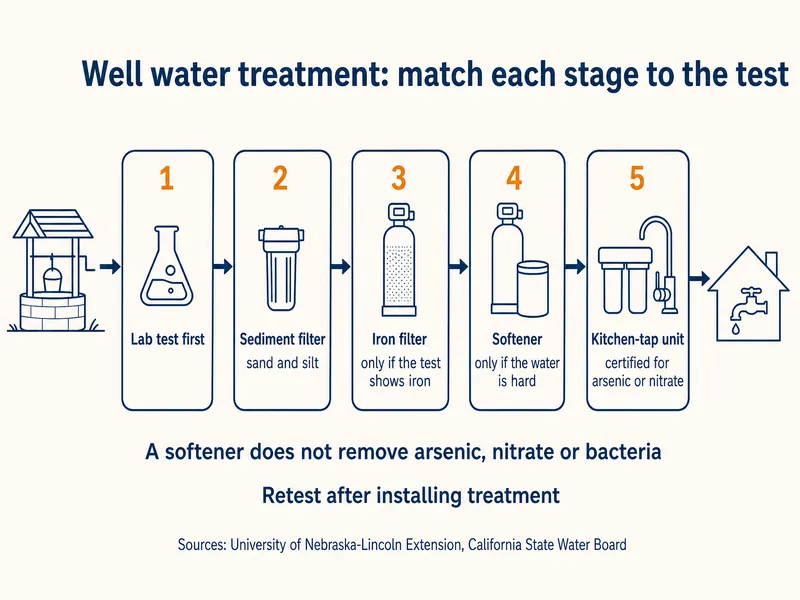
Two practical checks finish the job. Sample before and after the equipment at your next yearly test, which is what the State Water Board recommends for any device. And check that the pump and pressure tank can supply the flow the equipment needs; the well pressure tank and pump page covers how that system works. The full list of topics is on the guides page.
For hard well water
SoftPro ECO Well Water Softener
Private wells and some Antelope Valley groundwater run hard to very hard. Test the well first at a state-certified lab, then size a well-water softener to the result; a softener does not treat arsenic or nitrate. Check sizes and current prices at SoftPro Water Systems. See what to test first.
View at SoftPro Water SystemsSoftPro Water Systems, a store owned by the same team as this site, sells the softeners, filters and well-water equipment we link to. Ownership disclosure
How we put this page together
What this page draws on: Nebraska Extension (UNL) publications G1491 (water softening, revised 2014), G1492 (sediment filtration, revised 2013) and EC703 (treatment overview, revised 2014); EPA's arsenic rule training material on mitigation strategies; the State Water Board's device registration page (last updated June 2025) and its GAMA domestic well page; the CDC's chemical contaminants page (January 30, 2025); the USGS hardness scale; and hardness figures from the District 40 reports published in 2026 for 2025 and Cal Water's 2025 reports. SoftPro product details and prices were read from the store's product listings on October 26, 2026. Checked in October 2026. Left out: installation prices for iron filters, UV units and RO systems (no primary source), and any product removal claims beyond what the store states.
Common questions
Can one system treat everything in an Antelope Valley well?
No. UNL Extension says no one piece of equipment manages all contaminants, and most wells that need treatment end up with two or three stages chosen from the lab report.
Does a water softener remove arsenic from well water?
No. A softener exchanges calcium and magnesium for sodium; UNL Extension lists arsenic treatment as reverse osmosis, distillation or iron-based adsorptive media, and the device should be certified for arsenic.
Will a sediment filter stop the pump from pulling sand?
No. A sediment filter or spin-down separator catches sand after it leaves the well, protecting fixtures and treatment equipment. Sand coming from the well itself is a question for a C-57 licensed well contractor.
Should drinking water bypass the softener?
Many homes run a separate cold line to the kitchen that skips the softener, as UNL Extension describes, because softening adds about 8 mg/L of sodium per grain of hardness removed. People on restricted-sodium diets are told to consult their physician.
How can a homeowner check that a treatment device is certified?
California's State Water Board keeps a searchable database of registered residential devices, filterable by contaminant, system type and maker. Look up the exact model and confirm the contaminant on your report is listed.
Is UV enough for a well with bacteria?
UV is one of the disinfection methods UNL Extension lists, but it works on clear water and does not fix the cause. Find out why bacteria are getting in, shock chlorinate as needed, then retest before relying on any device.
Does well water treatment need a permit in LA County?
Permit rules for treatment equipment were not confirmed for this page. Ask the building department for the home's city or for unincorporated LA County or Kern County before work that changes plumbing or adds a drain connection.
More on wells
More help: see our guide to Antelope Valley home water.