
Tap water
Antelope Valley Water Hardness by Water System
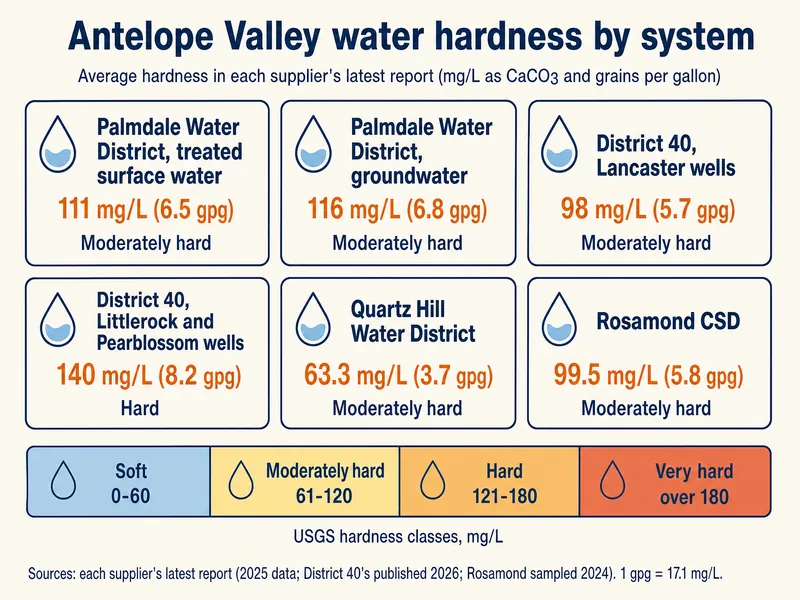
Antelope Valley water hardness on the city and district systems is moderate: averages for 2025 run from 63.3 mg/L in Quartz Hill to 116 mg/L for Palmdale groundwater, while some wells run far harder.
On this page
- How hard is Antelope Valley water?
- How hard is Palmdale Water District water?
- How hard is Lancaster's District 40 water?
- Why are Littlerock and Pearblossom wells harder?
- How hard is private well water in the valley?
- What do mg/L and grains per gallon mean?
- How do you look up water hardness by zip code?
- Common questions
Key takeaways
- Palmdale Water District's 2025 report (2025 data) puts treated surface water at 6.5 gpg (111 mg/L) and groundwater at 6.8 gpg (116 mg/L).
- District 40's Lancaster wells (Regions 4 and 34) averaged 98 mg/L (5.7 gpg) in 2025, but single results ran from 30 to 320 mg/L.
- In District 40's 2026 report, the wells serving Littlerock, Pearblossom and Sun Village came in at an average of 140 mg/L (8.2 gpg): "hard" on the USGS scale.
- Quartz Hill Water District reported 63.3 mg/L (3.7 gpg) and Rosamond CSD 99.5 mg/L (5.8 gpg).
- The USGS calls 61 to 120 mg/L moderately hard, so most city water in the valley sits in that class.
- No utility report covers a private well: only a lab test shows its hardness.
Hardness in the latest reports
- 140 mg/LDistrict 40 Regions 24, 27 and 33 wells, Littlerock and Pearblossom, average (2025 data)LA County Waterworks District 40
- 17.1 mg/LEquals one grain per gallon (gpg) of hardnessUSGS Water Science School
- 111 mg/LPalmdale Water District treated surface water, average 6.5 gpg (2025 data)Palmdale Water District 2025 CCR
- 98 mg/LDistrict 40 Regions 4 and 34 wells, Lancaster, average (2025 data)LA County Waterworks District 40
How hard is Antelope Valley water?
Antelope Valley water hardness on the public systems is moderate: the averages in the 2025 reports run from 63.3 mg/L (3.7 gpg) in Quartz Hill up to 116 mg/L (6.8 gpg) for Palmdale's wells. On the USGS hardness scale, 61 to 120 mg/L is "moderately hard", 121 to 180 is "hard" and anything over 180 is "very hard". So the typical Lancaster or Palmdale tap lands in the middle class, not at the top.
The reason is the mix. Much of the valley's piped water is State Water Project water from the California Aqueduct, treated by the Antelope Valley-East Kern Water Agency (AVEK) or by Palmdale Water District. AVEK's 2025 report for its LA County system lists 100 mg/L at its Acton and Eastside plants and 95 mg/L at Quartz Hill. Local wells are blended in, and that is where the numbers spread out.
| System and area | mg/L | gpg | USGS class | Report (data year) |
|---|---|---|---|---|
| Palmdale Water District, treated surface water | 111 | 6.5 | Moderately hard | 2025 CCR (2025) |
| Palmdale Water District, groundwater (range 32 to 257) | 116 | 6.8 | Moderately hard | 2025 CCR (samples 2024 to 2025) |
| District 40 Regions 4 and 34 wells, Lancaster (range 30 to 320) | 98 | 5.7 | Moderately hard | 2026 report (2025) |
| AVEK Quartz Hill plant (blended into Lancaster and Quartz Hill) | 95 | 5.6 | Moderately hard | AVEK 2025 report, LA County system |
| District 40 Regions 24, 27 and 33 wells, Littlerock and Pearblossom (range 110 to 160) | 140 | 8.2 | Hard | 2026 report (2025) |
| Quartz Hill Water District | 63.3 | 3.7 | Moderately hard | 2025 CCR (2025) |
| Rosamond CSD, Kern County | 99.5 | 5.8 | Moderately hard | 2025 CCR (sampled 2024) |
| Cal Water, Lancaster system wells (range 61 to 140) | 101 | 5.9 | Moderately hard | 2025 CCR (2023 to 2025) |
| Cal Water, Leona Valley wells (range 84 to 370) | 247 | 14.4 | Very hard | 2025 CCR (2020 to 2025) |
How hard is Palmdale Water District water?
Palmdale Water District water is moderately hard: its 2025 Consumer Confidence Report gives treated surface water an average of 6.5 gpg (111 mg/L), with a range of 5.6 to 7.4 gpg. Its groundwater averaged 6.8 gpg (116 mg/L), ranging from 1.9 to 15 gpg depending on the well. The district prints hardness in grains per gallon rather than mg/L, so the mg/L figures here are converted at 17.1 mg/L per grain.
About 71% of what the district delivered in 2025 was surface water and 29% came from its 22 wells. The two sources are close in average hardness (6.5 and 6.8 gpg), but individual wells ranged from 1.9 to 15 gpg, so a home that gets mostly well water can see harder or softer water than the averages. The Palmdale water quality page walks through the rest of that report.
How hard is Lancaster's District 40 water?
Lancaster's main supplier, LA County Waterworks District 40 (Regions 4 and 34), reported District wells averaging 98 mg/L (5.7 gpg) in its 2026 report on 2025 data. Single well results ranged from 30 to 320 mg/L, so a home near one high well can see water above the "very hard" line of 180 mg/L while the average stays moderate. The AVEK water blended in from the Quartz Hill plant measured 95 mg/L.
In 2025 about 53% of that system's water was treated or banked surface water and 47% came from District wells. Parts of Lancaster are served by Cal Water or by small mutual water companies instead, and their reports differ: Cal Water's Lancaster wells averaged 101 mg/L (5.9 gpg). The Lancaster water quality page sorts out who serves which area.
Why are Littlerock and Pearblossom wells harder?
Those wells are harder because they draw on local groundwater: in 2025 the District 40 wells for Littlerock, Pearblossom and Sun Village ranged from 110 to 160 mg/L, for an average of 140 mg/L (8.2 gpg), which the USGS scale calls "hard". That is harder than the AVEK water those communities also receive: AVEK's Eastside plant measured 100 mg/L (5.8 gpg). About 65% of that region's supply came from AVEK and 35% from wells, according to District 40's Regions 24, 27 and 33 report.
Hardness is calcium and magnesium picked up from rock and soil, so groundwater usually carries more of it than aqueduct water that started as Sierra snowmelt. Further out, the pattern is sharper. District 40's Rock Creek well (Region 39) measured 260 mg/L in 2025, and the Lake Los Angeles wells (Region 38) measured 180 mg/L when last sampled in 2023.
How hard is private well water in the valley?
Nobody can say from a report, because private wells are not in any utility's water quality report. The public-system wells show how wide the range can be: 30 to 320 mg/L in Lancaster, 247 mg/L on average for Cal Water's Leona Valley wells, and 260 mg/L at Rock Creek. A private well a mile from any of them can be softer or harder.
The State Water Board's GAMA domestic well page recommends testing a well every year and puts basic sampling at "$100 to $400". Hardness is cheap to add to that list, alongside the health tests that matter more in this valley, such as arsenic and nitrate. The well water testing guide covers what to ask a lab for.
What do mg/L and grains per gallon mean?
Both measure the same thing: how much dissolved calcium and magnesium the water carries, expressed as calcium carbonate. Milligrams per liter (mg/L, the same as parts per million or "ppm" in many reports) is the unit water suppliers and the USGS use. Grains per gallon (gpg) is the unit softener makers use for sizing, and 1 gpg equals 17.1 mg/L.
So 120 mg/L, the top of the moderately hard class, is about 7.0 gpg, and 180 mg/L is about 10.5 gpg. To convert a report's mg/L into gpg, divide by 17.1; to go the other way, multiply.
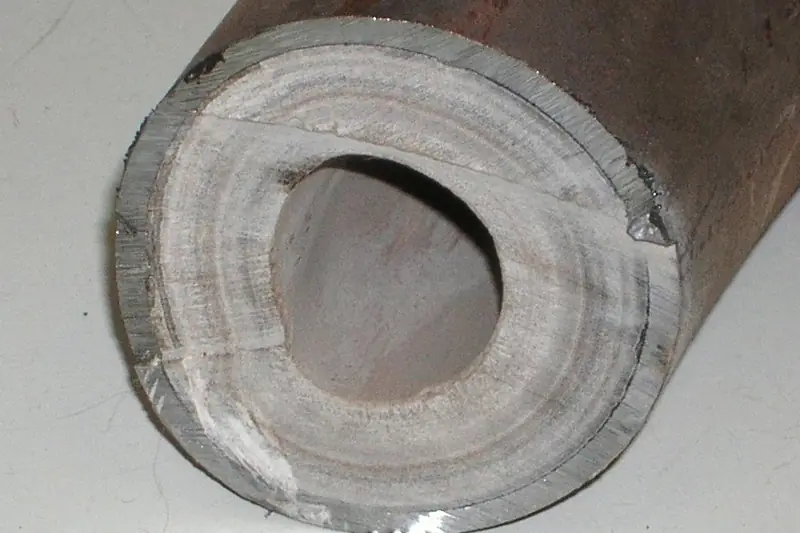
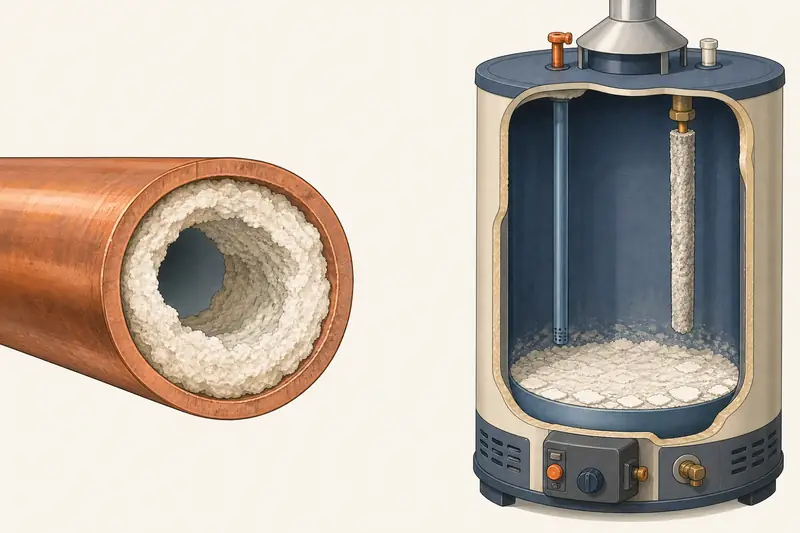
Hard water is a scale and soap issue, not a health one. Cal Water's 2025 Lancaster report puts it plainly: "Hard water is generally not a health concern", though it affects how well soap lathers. On moderately hard city water, a softener is a comfort choice; the guide to whether you need a water softener weighs it, and the page on hard water stains covers cleanup.
How do you look up water hardness by zip code?
Zip codes don't line up with water systems in the Antelope Valley, so the reliable lookup is by supplier, not by zip. A single Lancaster zip code can include District 40, Cal Water and a mutual water company. Your water bill names the supplier; the State Water Board's service area lookup tool shows which system boundary an address falls in.
Once you know the supplier, open its latest report and find "hardness" or "total hardness". It is often listed under "additional constituents" or "unregulated" substances, because hardness has no health limit. The guide to who supplies your water lists each supplier's report, and how to read a water quality report explains the table.
How we put this page together
This page is based on the latest consumer confidence reports, opened on October 26, 2026: the Palmdale Water District report for 2025; LA County Waterworks District 40 reports published in 2026 for Regions 4 and 34, 24, 27 and 33, 38 and 39 (2025 data unless the report dates a sample earlier); AVEK's 2025 LA County system report; the 2025 reports of Quartz Hill Water District, Cal Water and Rosamond CSD. Classes follow the USGS Water Science School scale, and gpg values are converted at 17.1 mg/L per grain. Values were read from the report tables themselves. Left out: hardness figures from store pages, aggregator sites and maps that don't name a report, mutual water company figures (their reports were not reviewed), and any claim about a specific street or zip code.
Common questions
Is Antelope Valley water harder than Los Angeles water?
This guide compares Antelope Valley systems only and has not reviewed Los Angeles city reports, so it makes no comparison. Within the valley, city and district averages run from 63.3 mg/L in Quartz Hill to 116 mg/L for Palmdale groundwater, all moderately hard on the USGS scale.
Why does my hardness test show more than the report?
A report gives an average across many samples and wells, while your tap gets whatever blend reaches your street that week. District 40's Lancaster wells ranged from 30 to 320 mg/L in 2025, so a single reading well above the 98 mg/L average is possible.
Does hardness change with the seasons?
It can, because suppliers shift the share of aqueduct water and well water during the year. Palmdale Water District's surface water ranged from 5.6 to 7.4 gpg in 2025; reports show the range, not a month-by-month figure.
Is 6.5 gpg water hard enough for a softener?
At 6.5 gpg (111 mg/L) water is moderately hard on the USGS scale. A softener there is a comfort choice for spotting and scale, a preference rather than a requirement.
What hardness is Quartz Hill water?
Quartz Hill Water District's 2025 report lists hardness at 63.3 mg/L on average, a range of 60 to 67 mg/L. That is about 3.7 gpg, at the soft edge of the moderately hard class.
Is Rosamond water hard?
Rosamond CSD's 2025 report lists 99.5 mg/L (5.8 gpg) from a 2024 sample, which is moderately hard on the USGS scale.
Does boiling water remove hardness?
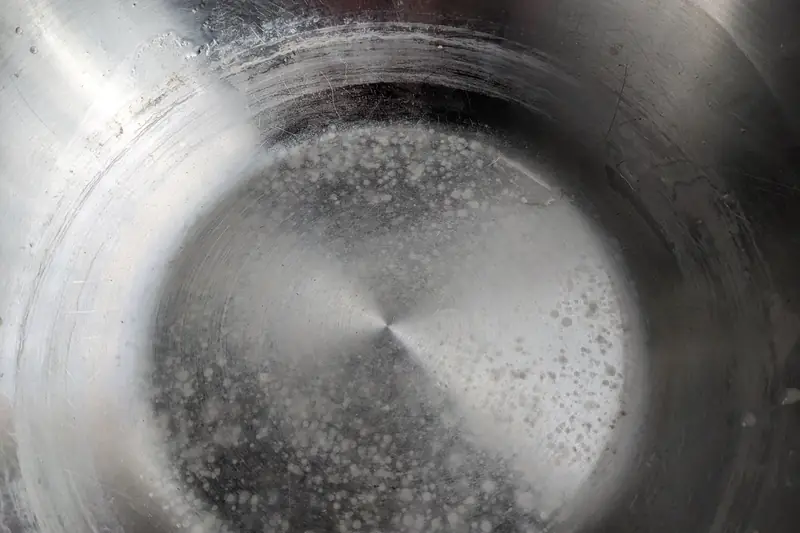
Boiling drives some calcium out as scale, which is the white crust in kettles and pots, but it does not soften a home's supply. Scale on heating elements is the everyday cost of hard water.
Related guides
More help: see our home water guide for the Antelope Valley.