
Water heaters
No Hot Water? What to Check First
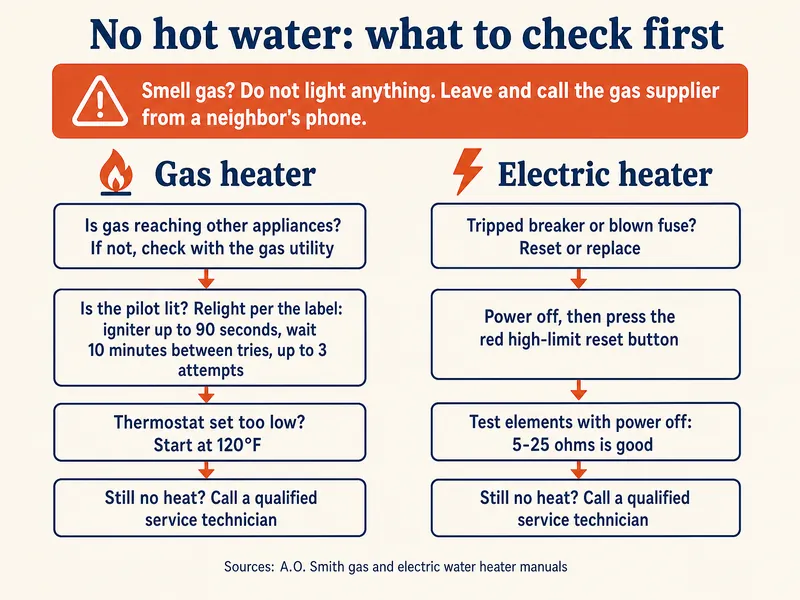
No hot water? Check the energy supply first: on a gas heater, the gas valve and the pilot; on an electric heater, the breaker and the red high-limit reset button. Those cover the commonest causes in the makers' charts.
On this page
Key takeaways
- A.O. Smith's gas troubleshooting chart lists a pilot that is not lit, a thermostat set too low and no gas as the first causes of a burner that will not ignite (manual 326940).
- Its electric chart starts with no power, then an open high-temperature limit switch, then a failed upper thermostat or element (manual 321249).
- Relighting a pilot on that A.O. Smith gas model means clicking the igniter for up to 90 seconds, with a 10-minute wait between tries and no more than three attempts.
- An electric heater's high-limit switch cuts power if the water passes 170 °F; if it keeps tripping, A.O. Smith says to get a qualified person.
- A good heating element reads between 5 and 25 ohms on a multimeter, per A.O. Smith's electric use and care guide.
- If gas can be smelled, do not relight anything: leave the house and call the gas supplier from a neighbor's phone.
Numbers from the makers' manuals
- 90 secondsLongest to keep clicking the igniter while lighting the pilot, per attemptA.O. Smith gas manual 326940
- 10 minutesWait between pilot lighting attempts on that model's gas valveA.O. Smith gas manual 326940
- 170 °FWater temperature at which a standard A.O. Smith electric heater's high-limit switch shuts off the elementsA.O. Smith electric manual 321249
- 5–25 ohmsResistance range of a good heating elementA.O. Smith electric use and care guide
Why is there no hot water?
No hot water almost always means the heater has stopped making heat, and the cause is usually its energy supply or a safety control that has shut it off. The two A.O. Smith charts below are typical of tank heaters; other makers list similar causes, so keep the heater's own manual nearby, usually in a pocket on the side of the tank.
| Heater | Possible cause | What the chart says to do |
|---|---|---|
| Gas | Pilot not lit | Light the pilot |
| Gas | Thermostat set too low | Turn the dial to the desired temperature |
| Gas | No gas | Check with the gas utility |
| Gas | Defective thermopile or gas control | Replace the part |
| Electric | No power to the heater | Turn on the switch; check for blown fuses or a tripped breaker |
| Electric | High temperature limit switch open | Reset; find and correct the cause |
| Electric | Failed upper thermostat or element | Replace the thermostat or element |
One check comes before all of them. If there is any smell of gas near the heater, the A.O. Smith lighting label is plain: do not try to light any appliance, do not touch electric switches or use a phone in the building, and call the gas supplier from a neighbor's phone. If the heater has been under water, the same label says not to try repairing it: a qualified installer or service agency should replace it.
What should you check on a gas water heater?
On a gas water heater, check that gas is reaching it, then that the pilot is lit. If the stove or furnace also has no gas, the problem is the supply, not the heater; the A.O. Smith chart's answer is to check with the gas utility. If other gas appliances work, make sure the manual shutoff valve on the heater's gas supply pipe is open.
Then the pilot. The gas valve on A.O. Smith's model in manual 326940 has a status light, and the pilot is lit with a push-button spark igniter. Its lighting steps: turn the control knob to OFF and wait 10 minutes, turn it to PILOT, press the knob in and hold it while clicking the igniter about once a second for up to 90 seconds, until the status light blinks. If it does not light after three attempts, waited out 10 minutes apart, the label says to turn the knob to OFF and call a qualified service technician or the gas supplier.
A pilot that lights but will not stay lit points to parts the chart lists: a failed thermopile, a clogged pilot line, a blocked vent or air intake, or a gas control whose built-in overheat switch has opened. Those are repairs for a technician. The thermostat dial is worth a look too; A.O. Smith gives 120 °F as the preferred starting point.
What should you check on an electric water heater?
On an electric water heater, check the power first: a tripped breaker, a blown fuse or a switched-off disconnect. A.O. Smith's electric chart lists "no power to heater" as the first cause of no hot water, and its newer use and care guide says no hot water "is often cause[d] by a problem with the home's electrical wiring or circuit breakers". A.O. Smith's manual covers 120/240-volt models; if a breaker trips again after being reset, leave it off and have the circuit checked.
If power is on, the high-limit switch may have tripped. The A.O. Smith manual says it cuts power to the elements if the water passes 170 °F, and it resets by firmly pushing the red button on the upper thermostat. To reach it: switch off the power at the breaker, remove the access cover, fold back the insulation without removing the plastic safety cover, press the button, then put everything back before restoring power. If the switch keeps shutting the heater off, A.O. Smith says to contact a qualified person; its newer guide adds that the cause of the overheating should be found and repaired before the power goes back on.
Check the thermostat settings while the cover is off. A.O. Smith's manual says the upper and lower thermostats must be set to the same temperature.
How do you test and replace a water heater element?
Test an element with the power off and a multimeter set to read resistance. A.O. Smith's electric use and care guide says to confirm the power is off at the thermostat's terminals with a non-contact tester, remove the two wires from the element, and measure across its two screw terminals: a good element reads between 5 and 25 ohms. Outside that range, replace it. The upper and lower elements should read about the same.
Replacing one means draining the tank, at least below the element. The A.O. Smith steps: power off, drain, unscrew the old element, clean the gasket seat (and scoop out sediment from the tank bottom if replacing the lower one), and fit an element with the same voltage and wattage as the rating plate, with a new gasket. Then close the drain and refill completely, running a hot faucet for 3 minutes after steady flow, before reconnecting the wires and power. Powering an element that is not under water destroys it, and A.O. Smith does not cover elements damaged that way.
This is work on a 240-volt appliance. Anyone not comfortable confirming the power is off with a tester should leave it to a licensed contractor; state license lookups are covered in the hiring guide.
Why does hot water run out fast?
Hot water that runs out fast usually means the heater is only partly working or is losing capacity. On an electric tank, A.O. Smith's chart ties insufficient hot water to a failed lower element or thermostat, and slow recovery to a failed upper or lower element. On gas and electric tanks alike, the charts also list a thermostat set too low, sediment or lime in the tank, a heater too small for the household, a cracked dip tube, and a plumbing crossover that mixes cold water into the hot lines.
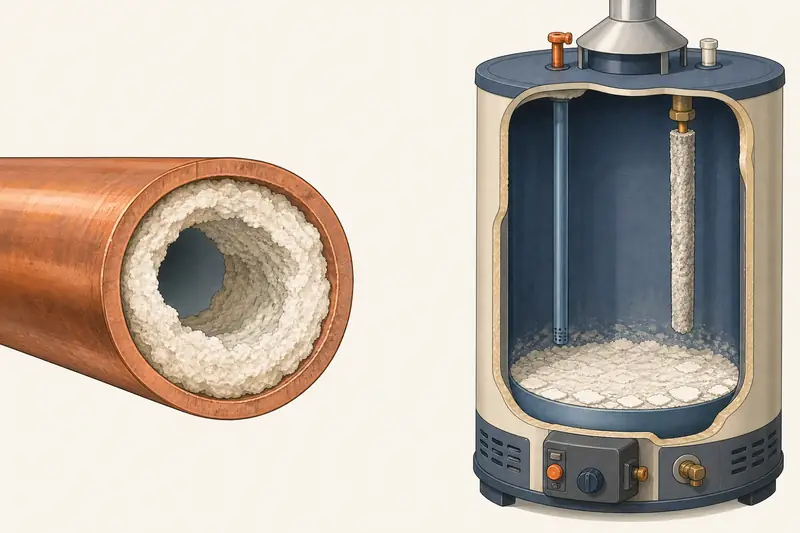
Sediment is the one Antelope Valley homes can do most about. City water in Lancaster and Palmdale averaged 98 to 116 mg/L hardness in the 2025 supplier reports (District 40 and Palmdale Water District), moderately hard on the USGS scale, and well water can run far harder; the hardness page lists every system. Regular flushing keeps the layer down, and the flushing guide has the steps. The dip tube is the inlet tube that carries incoming cold water down into the tank; the A.O. Smith charts list "leaks or cracks in dip tube" as a cause, with the correction to check it and replace it if faulty.
When is a no-hot-water problem a job for a pro?
Call a licensed professional when the fix involves gas, repeated safety shutoffs, or the tank itself. That covers any smell of gas, a pilot that will not light after three tries, a failed gas control or thermopile, an electric high-limit switch that keeps tripping, and water leaking from the tank body. A.O. Smith's manuals send each of these to a qualified service technician or the gas supplier.
Age is the other signal. Rheem's repair-or-replace guidance says repairs make sense on a heater under 6 to 8 years old with no tank corrosion, while units over 10 are more likely to fail again soon after a fix. The lifespan guide shows how to read the age from the serial number, and the replacement cost page covers what a new heater involves. A tankless heater shows error codes instead; its manual lists what each one means.
How we put this page together
These checks are drawn from A.O. Smith's manual 326940 for gas tanks (lighting instructions, temperature regulation and troubleshooting chart), its residential electric manual 321249 (safety shut-off, thermostat adjustment, element replacement and troubleshooting chart) and its electric use and care guide (element resistance test and high-limit reset), plus Rheem's lifespan article (March 2026) and the 2025 Antelope Valley supplier hardness figures. Each source was checked in October 2026. Not covered here: brand-specific error codes, repair prices, and any check that means opening the gas control or working on live wiring.
Common questions
Why is there hot water in one bathroom but not another?
If one fixture runs cold while others are hot, the heater is working and the problem is likely that fixture's valve or the piping to it. The A.O. Smith charts also list plumbing crossovers that mix cold water into hot lines.
How long does a gas water heater take to heat up after relighting?
It depends on the heater's size and input, and on how cold the incoming water is. A.O. Smith's flushing steps end by letting the heater run several heating cycles to confirm it works.
Is it safe to relight a pilot more than three times?
A.O. Smith's label says that if the pilot does not light after three attempts, waiting 10 minutes between them, to turn the knob to OFF and call a qualified service technician or the gas supplier.
What does it mean when the red reset button keeps popping?
The high-limit switch is shutting the heater off because the water is overheating, often from a failed thermostat. A.O. Smith says a switch that keeps tripping needs a qualified person.
Can a cold snap cause no hot water?
Frozen supply pipes can stop water reaching the heater. In NOAA's 1991–2020 normals, the low at Fox Field in Lancaster drops to freezing on 67.9 nights in a typical year, and the frozen pipe guide covers prevention.
Do both electric elements need to be tested?
A.O. Smith's guide tests the upper element first, then says to repeat the same check on the lower one if it is in question. A.O. Smith says the two should show the same resistance range.
Should the thermostat be turned up to get more hot water?
Turning it past 120 °F raises the scald risk, A.O. Smith warns. If hot water runs short at a normal setting, look for sediment, a failed element or a cracked dip tube first.
Next steps
More help: see our Antelope Valley water, wells and septic guide.