
Hard water & softeners
Reverse Osmosis vs Water Softener: Which Do You Need?
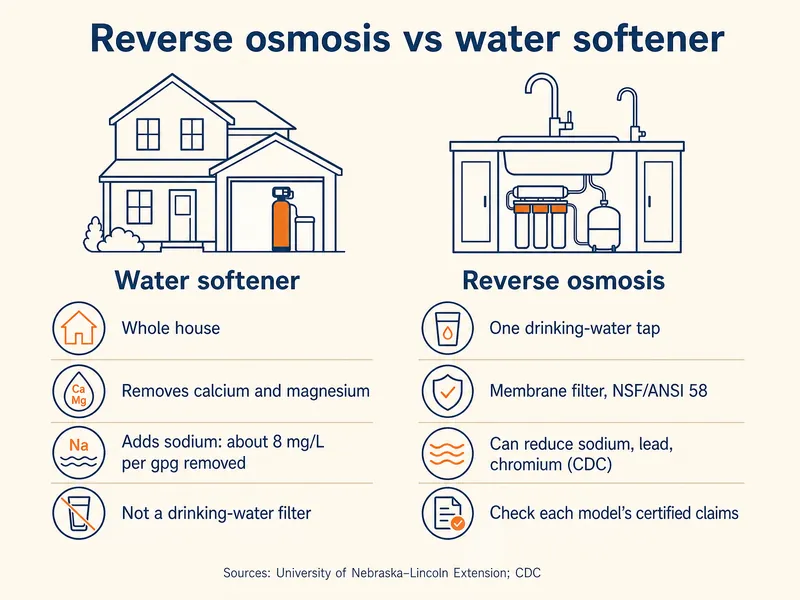
Reverse osmosis vs water softener comes down to scope: a softener removes calcium and magnesium for the whole house, while reverse osmosis filters drinking water at one tap and removes far more.
Disclosure: SoftPro Water Systems, a store owned by the same team as this site, sells the softeners, filters and well-water equipment we link to. Our water pages follow the water suppliers' latest consumer confidence reports and federal, state and county agency guidance, checked October 2026. Store descriptions are reported as the store's own claims. Ownership disclosure
View at SoftPro Water Systems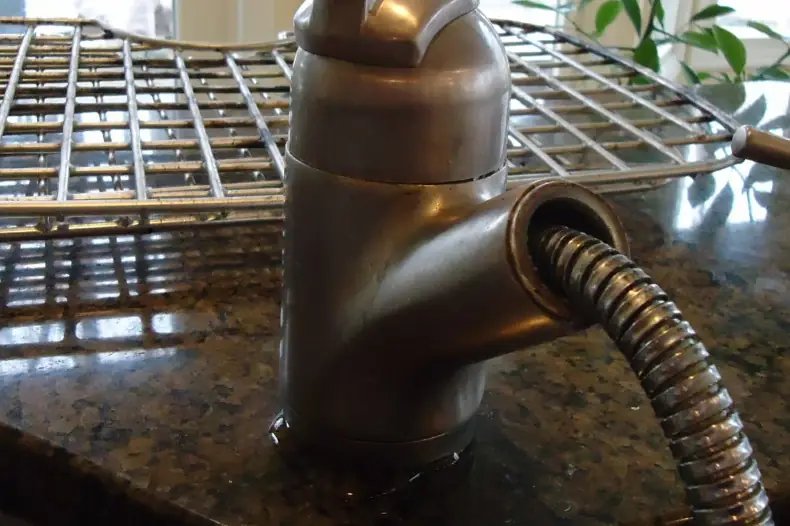
On this page
Key takeaways
- A softener swaps calcium and magnesium for sodium across the whole house; it does not remove bacteria, nitrate or lead (University of Nebraska–Lincoln Extension).
- The CDC says reverse osmosis filters remove some chemicals, "including lead, copper, chromium, chloride, and sodium", and tells buyers to check the label for what a model is certified to remove.
- NSF/ANSI 58 is the reverse-osmosis standard; certification is model by model.
- California's limit for hexavalent chromium is 10 µg/L (State Water Board), and the Board keeps a list of certified home devices for it.
- Rosamond CSD's September 2026 notice reported running annual averages of 14 and 15 µg/L at two wells; Quartz Hill Water District reported a 12 µg/L average that exceeds the limit ahead of its 2027 compliance date.
- SoftPro Water Systems listed the Waterdrop G3P600 under-sink RO system at $429 on October 26, 2026.
Softener and RO by the numbers
- ~8 mg/LSodium a softener adds per gpg of hardness removedUniversity of Nebraska–Lincoln Extension
- 10 µg/LCalifornia maximum contaminant level for hexavalent chromium, effective October 1, 2024State Water Board
- 10 µg/LFederal and California limit for arsenicUS EPA
- 1 tapTypical reach of an under-sink RO system, versus the whole house for a softenerCDC
What is the difference between reverse osmosis and a water softener?
The difference is what each treats and where: a water softener removes hardness from all the water entering the house, and reverse osmosis filters a small stream of drinking water at one tap. A softener uses ion exchange, swapping calcium and magnesium for sodium on resin beads, as how a water softener works explains. Reverse osmosis pushes water through a membrane that holds back most dissolved substances.
The Water Quality Association's glossary describes reverse osmosis as using "pressure to force the water molecules through a semipermeable membrane", and says RO "removes ionized salts, colloids, and organic molecules". Under-sink systems usually pair the membrane with carbon and sediment cartridges, a small storage tank or tankless pump, and a separate drinking faucet. The membrane's reject water goes to the drain.
| Feature | Water softener | Under-sink reverse osmosis |
|---|---|---|
| Where it treats | Whole house, at the main line | One drinking-water tap |
| Main job | Removes calcium and magnesium (hardness) | Reduces a wide range of dissolved chemicals |
| Hardness | Brought below 1 gpg by WQA's definition of a softener | Reduced in the filtered water |
| Sodium | Raised roughly 8 mg/L for each gpg taken out (Nebraska Extension) | Can reduce sodium (CDC) |
| Lead, chromium | Not a treatment (Nebraska Extension) | Can reduce them; check the model's certified claims (CDC) |
| Standard to look for | NSF/ANSI 44 | NSF/ANSI 58 |
| Upkeep | Salt, brine valve and float, hardness setting | Cartridge and membrane changes on the maker's schedule (CDC) |
| SoftPro listing, October 26, 2026 | $967 and up (ECO City softener) | $429 (Waterdrop G3P600) |
What does reverse osmosis remove?
Reverse osmosis removes many dissolved chemicals from drinking water, but exactly which ones depends on the certified model. The CDC says RO filters "will remove some types of chemicals from water, including lead, copper, chromium, chloride, and sodium", may also reduce arsenic, fluoride and other substances, and adds that buyers should check the label for specifics. Its advice is to look for NSF certification on the label and to look products up in the NSF database.
RO also lowers total dissolved solids, which is what most people notice as taste. Palmdale Water District's 2025 report lists total dissolved solids averaging 250 mg/L in its surface water and 254 mg/L in its wells, well under California's secondary standard of 1,000 mg/L, so on city water RO is mostly a taste and preference choice. CCRs print these values in "ppm" and trace metals in "ppb"; ppm equals mg/L and ppb equals µg/L.
Upkeep is part of the deal. The CDC says any filter must be maintained "to keep it working properly and prevent germs from growing in it", which means changing filters on the maker's schedule and washing hands when doing it. A neglected RO unit is not doing what its label says.
What does a water softener do that RO can't?
A water softener protects the whole plumbing system from scale, which an under-sink RO unit cannot do. Showers, the water heater, the dishwasher and the washing machine all get softened water, so scale on fixtures and inside the heater slows. Nebraska Extension notes that heat drives scale buildup in water heaters, which "can then slow the heating process and increase energy usage".
On Antelope Valley city water that benefit is moderate, because the supply is moderately hard: Palmdale Water District reported 6.5 gpg for treated surface water in 2025, and Lancaster's District 40 well average was 5.7 gpg (98 mg/L). A softener there is a comfort and scale choice, as the softener decision guide explains. On a well with very hard water, the whole-house benefit is larger.
Do you need both?
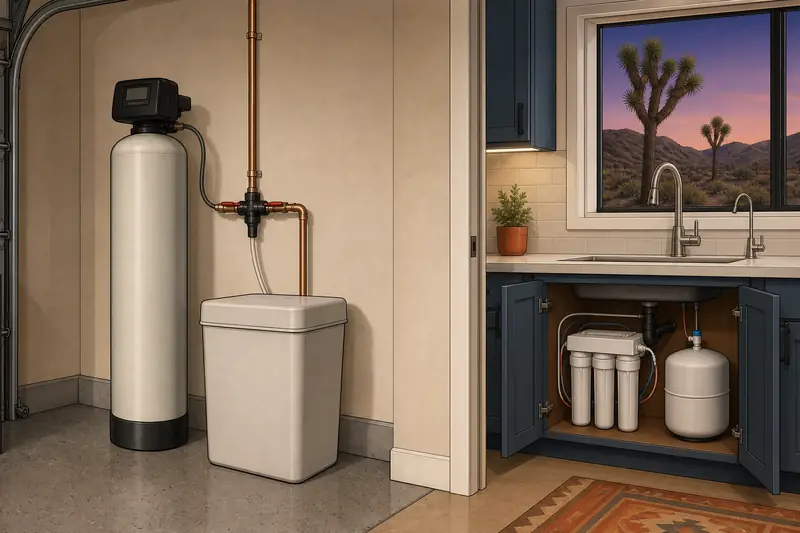
Most city-water homes need neither, and some choose one; both make sense mainly where hardness is high and there is a specific drinking-water concern. A common pairing is a softener for the house and an RO tap in the kitchen, which also takes out much of the sodium the softener adds. Nebraska Extension notes the alternative of leaving the kitchen cold line unsoftened.
The order of decisions matters more than the equipment. On a private well, start with a lab test from a state-accredited (ELAP) lab covering hardness, iron and the health items, then treat what the results show; see testing a well and then treating well water. On city water, start with your supplier's latest report and decide whether hardness, taste or a specific contaminant is the issue.
Does reverse osmosis remove arsenic and chromium 6?
Some reverse osmosis systems are certified to reduce arsenic or hexavalent chromium, but only a specific model's certification tells you whether that one does. The State Water Board names reverse osmosis among the best available technologies for hexavalent chromium and keeps a list of certified residential point-of-use and point-of-entry devices for it; the CDC lists RO among treatments for arsenic and says to find a system certified to remove it. A softener is not a treatment for either.
Locally, each system says something different. Rosamond CSD's notice distributed in September 2026 says "Our water system recently violated a drinking water standard", reporting running annual averages of 14 and 15 µg/L at wells 8 and 9, and adds that customers "do not need to use an alternative water supply". Quartz Hill Water District reported hexavalent chromium averaging 12 µg/L (11 to 13) and says a system of its size has until after October 1, 2027 before the limit counts as a violation. Cal Water's Lancaster system reported its wells between 6.1 and 11 µg/L (8.7 on average), with blending treatment planned before its 2028 date. The hexavalent chromium guide and the arsenic in well water page cover the details.
The Waterdrop G3P600 (sold by SoftPro Water Systems, a store we own) is an option for drinking-water taste and dissolved solids. Waterdrop states the G3P600 is certified by IAPMO R&T to NSF/ANSI 58 for the reduction claims on its performance data sheet, which lists hexavalent chromium. That test's pass level for hexavalent chromium is 0.1 mg/L (100 µg/L), far above California's 10 µg/L limit, so the listing does not show the unit brings water under the state limit. The data sheet makes no arsenic claim. For either contaminant, choose from the State Water Board's certified device list and confirm with a lab test afterward.
What does each cost to own?
A softener costs more to buy and run; an under-sink RO unit costs less up front but needs regular cartridge and membrane changes. SoftPro listed its ECO City Water Softener from $967 (32,000-grain, softener only) and the Waterdrop G3P600 at $429 on October 26, 2026; installation is extra for both. The store's listing describes the G3P600 as producing two parts filtered water to one part drain water; that ratio is the store's and maker's figure.
Running costs differ in kind. A softener uses salt and about 50 gallons of water per regeneration (Penn State Extension), plus yearly brine valve and float care; the water softener cost page goes through those drivers. RO running costs are replacement cartridges on the maker's schedule; this guide did not find a sourced yearly figure and does not estimate one.
For drinking water at one tap
Waterdrop G3P600 Under-Sink Reverse Osmosis System
An under-sink reverse osmosis system treats the water you drink and cook with. Before you buy, check the maker's certification listing for the exact contaminants you care about; a store listing is not a certification, and arsenic or chromium 6 need a system certified for them. See current prices at SoftPro Water Systems. See how arsenic is tested and treated.
View at SoftPro Water SystemsSoftPro Water Systems, a store owned by the same team as this site, sells the softeners, filters and well-water equipment we link to. Ownership disclosure
How we put this page together
Softening facts come from Nebraska Extension's NebGuide G1491 and from Penn State Extension; the CDC's About Choosing Home Water Filters (April 2024) and Chemicals That Can Contaminate Tap Water (January 2025) pages; the Water Quality Association glossary; the State Water Board's chromium 6 web page and public FAQ; EPA's drinking water regulations; the 2026 District 40 report covering Lancaster, Palmdale Water District's 2025 CCR, Quartz Hill Water District's and Cal Water Lancaster's 2025 reports, and Rosamond CSD's September 2026 hexavalent chromium notice; Waterdrop's G3P600 performance data sheet (version V005, maker-hosted); and SoftPro's product listings on October 26, 2026. Checked October 2026. Left out: cartridge cost per year, health claims beyond the agencies' own words and any removal claim not on a certification.
Common questions
Does reverse osmosis remove hardness?
Yes, in the water it filters: the membrane holds back dissolved minerals, including calcium and magnesium. It only treats the drinking tap, though, so showers, appliances and the water heater still get hard water.
Is RO water from a softened house high in sodium?
Less so. The CDC lists sodium among the chemicals RO filters remove, so an RO tap fed by softened water delivers much less sodium than the softened water itself.
Can a whole-house reverse osmosis system replace a softener?
Whole-house RO systems are sold, but this guide found no primary source comparing them with softeners, so it makes no claim either way. For scale control alone, a softener or regular cleaning is the usual route; get certification details for any exact system before comparing.
Does the Waterdrop G3P600 meet California's chromium 6 limit?
Its certification does not show that. Waterdrop's data sheet lists hexavalent chromium under NSF/ANSI 58, where the pass level is 100 µg/L, ten times California's 10 µg/L limit; use the State Water Board's certified device list for that purpose.
Should RO water be remineralized?
That is a taste preference; none of the agencies cited here calls for adding minerals back.
How often do RO filters need changing?
Follow the maker's schedule for each cartridge and the membrane. The CDC says regular changes keep a filter working and stop germs from growing in it.
Will an RO unit work on well water?
It can treat a well's drinking water, but test the well first at an ELAP-accredited lab. Bacteria, iron, sediment and very hard water may need treatment ahead of an RO unit, and the model's certifications should match what the test found.
Related guides

More help: see our home page on Antelope Valley home water.