
Septic
Antelope Valley Septic Tank Pumping: How Often and Cost
Septic tank pumping for an Antelope Valley home is typically needed every three to five years, according to the EPA, sooner when sludge or scum creeps close to the tank's outlet.
On this page
Key takeaways
- The EPA says household tanks are typically pumped every 3 to 5 years and inspected at least every 3 years.
- Pump when the scum bottom is within 6 inches of the outlet, the sludge top is within 12 inches, or the two layers fill more than 25% of the liquid depth (EPA).
- LA County Public Health treats more than 2 pumpings in 6 months as a sign of a failing system, not routine upkeep (DPH LAMP FAQ).
- EPA puts routine maintenance at $250 to $500 every three to five years, a national figure rather than an Antelope Valley quote.
- In the LA County part of the valley, pumped septage is received at the Lancaster Water Reclamation Plant (LA County LAMP, 2018).
- Keep each service report with the measured sludge and scum depths; the trend sets the next date better than a calendar rule.
Pumping numbers from EPA and LA County
- 3–5 yearsUsual gap between pumpings for a home's tankEPA SepticSmart
- 25%Sludge plus scum share of liquid depth that signals pumping is dueEPA SepticSmart
- 12 inPump when the sludge top rises this close to the tank outletEPA SepticSmart
- 2 in 6 monthsPumping more often than this is read as a failing system in LA CountyLA County Public Health LAMP FAQ
How often should a septic tank be pumped?
Most household septic tanks need pumping every three to five years, the interval the EPA's SepticSmart care page gives as typical. The real interval depends on four things the EPA lists: how many people live in the house, how much wastewater they send down the drains, how much of it is solids, and how big the tank is. A two-person household on a large tank can stretch the interval; a full house with a garbage disposal will shorten it.
LA County's own program document says much the same. The county's onsite wastewater plan (the LAMP, approved in 2018) notes that a properly sized tank "can be expected to operate effectively for more than five years without needing pumping" under normal conditions, and the county's LAMP FAQ says systems "typically only require pumping to remove solids every 3 to 5 years."
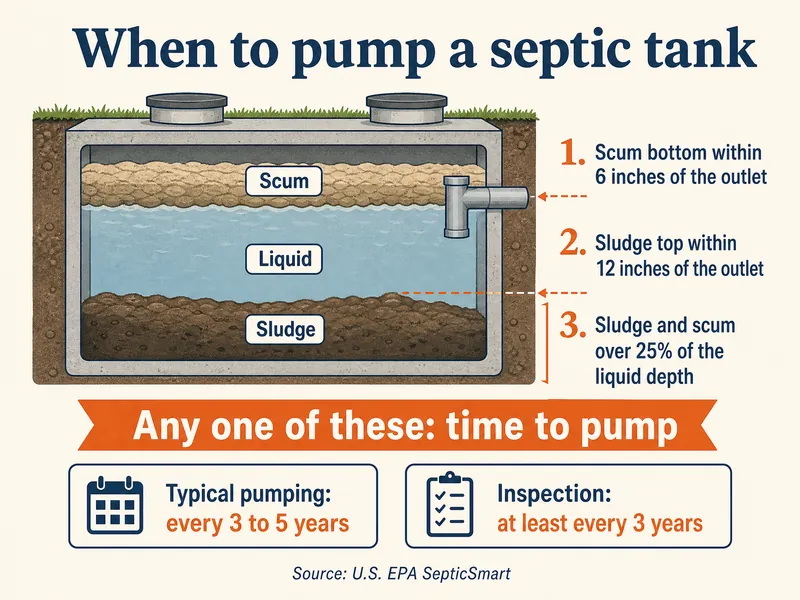
The better trigger is a measurement. The EPA says to pump when the bottom of the floating scum layer is within 6 inches of the bottom of the outlet, when the top of the settled sludge is within 12 inches of the outlet, or when sludge and scum together take up more than 25 percent of the liquid depth. A service provider measures both layers each visit, and those numbers tell you whether the next pumping is two years away or five.
What does septic tank pumping cost?
No Antelope Valley agency publishes a pumping price, so this guide does not print a local figure. The only government number found is national: the EPA's page on why to maintain a septic system says regular maintenance fees of $250 to $500 every three to five years are "a bargain" next to repairing or replacing a failed conventional system, which it puts at $5,000 to $15,000.
What moves a real quote is easier to pin down. Tank size sets the volume hauled, and a tank that has gone years past its interval holds more solids and takes longer. Lids buried under soil or concrete add digging time, while risers brought up to grade remove it. Ask for a written quote that lists the gallons pumped, any digging, an effluent filter cleaning if the tank has one, and whether a written report with layer depths is included.
What happens during septic tank pumping?
A pumper opens the tank, measures the layers, and vacuums the sludge, scum and liquid into a tank truck. The EPA says the service provider should also check for leaks and examine the scum and sludge layers, then note the tank's condition and any repairs in a service report. Tanks with an effluent filter at the outlet need that filter cleaned as part of the visit.
The load then has to go somewhere licensed. In California, septic pumpers and haulers register with the local jurisdiction under Health and Safety Code sections 117400 to 117450, and the LA County LAMP lists the Lancaster Water Reclamation Plant as the receiving site for the north county. LA County Public Health's onsite wastewater program also inspects and permits septic tank pumping vehicles.
A pumping is not a full inspection. If the hauler sees water running back into the tank from the outlet side, staining above the outlet, or a low liquid level, ask about a separate septic inspection of the whole system.
How do you find the septic tank lid?
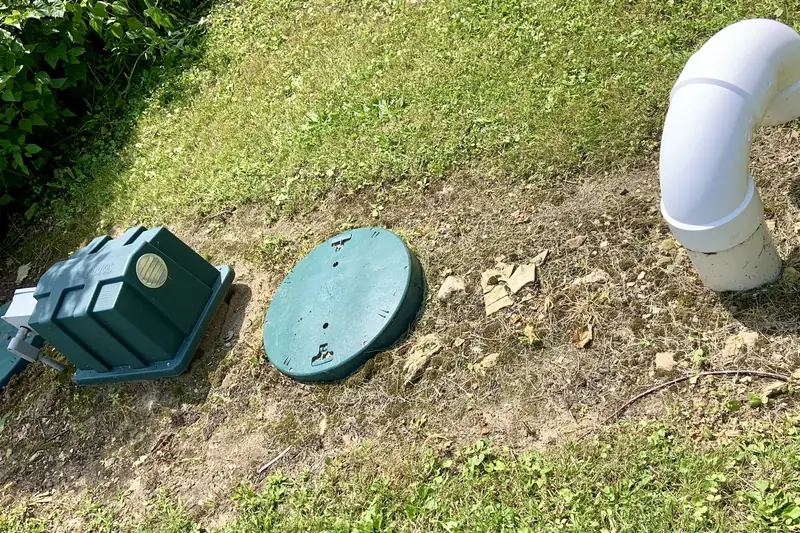
Start with the paperwork, then follow the sewer pipe. The EPA's septic FAQ suggests asking the local permitting authority for the property's "as-built" drawing and permits; in the LA County part of the valley that is the Department of Public Health's onsite wastewater program. The same EPA page says that if you follow the plumbing outlet from the house you may find an access riser, a black or green disc, usually about 10 feet from the building.
Newer installations are easier. LA County's LAMP requires every septic tank access point on new work to have a watertight riser whose top sits no more than 6 inches below grade, and openings at or above grade must be locked or secured. Older desert tanks may sit deeper under packed soil or caliche, which is where a probe or a professional locate saves digging in the wrong spot. Once found, a riser to grade makes every later pumping faster.
What shortens the time between pumpings?
Extra solids and extra water both shorten the interval. The EPA says a garbage disposal means the tank "will need to be pumped more frequently," because food waste accumulates as scum and sludge. Grease, wipes, paper towels, coffee grounds and cat litter belong in the trash, not the toilet or sink.
Water volume matters because every gallon passes through the tank. The EPA notes that a single leaking or running toilet can add as much as 200 gallons a day, and that doing all the laundry on one day does not give the tank time to settle solids. Spreading loads through the week and fixing leaks protect the drainfield as well as the tank; the septic system basics page explains why the soil side is the expensive part.
Additives do not replace pumping. The EPA says bacterial and enzyme additives "are not necessary for a septic system to function properly" with household wastewater and can even harm the drainfield.
| Source | What it says about pumping | Notes |
|---|---|---|
| U.S. EPA, SepticSmart care page (updated Aug 17, 2026) | Typically every 3 to 5 years; inspect at least every 3 years | Alternative systems with pumps or floats: inspect about once a year |
| U.S. EPA, septic FAQ | Pump when solids reach two-thirds of the tank volume, as a rule of thumb | Lists the 6-inch, 12-inch and 25% triggers on the care page |
| LA County Public Health, LAMP FAQ (updated Sept 19, 2018) | Systems typically need pumping every 3 to 5 years | More than 2 pumpings in 6 months signals a failed system |
| LA County LAMP, section 4.6 (May 2018) | A properly sized tank can work more than 5 years without pumping | Interval varies with tank size and load |
What records should you keep?
Keep every service report, with the date, gallons removed, and the sludge and scum depths the pumper measured. The EPA tells owners to write down those layer levels so the next pumping can be timed from real numbers, and to keep the maintenance records for the life of the system.
Those records matter more in LA County than in many places. The LAMP FAQ says Public Health reviews pumper service logs and flags systems serviced more than twice in a 6-month period, because pumping that often to keep sewage from surfacing or backing up can mean the soil below the leach field or seepage pit has clogged. A file showing normal three- to five-year intervals is the simplest proof a system has been cared for, which buyers and lenders tend to ask about.
Add the permit and as-built drawing, the tank size, the lid locations measured from a corner of the house, and the contractor's license number. If the home also has a private well, keep those lab reports in the same folder; the well water testing page covers what to test.
How we put this page together
This page is based on the U.S. EPA SepticSmart pages "How to Care for Your Septic System" (updated August 17, 2026), "Frequent Questions on Septic Systems" and "Why Maintain Your Septic System"; the LA County Department of Public Health LAMP FAQ (updated September 19, 2018) and Onsite Wastewater Treatment Program page; and the LA County Local Agency Management Program (May 2018) attached to the Los Angeles Regional Water Quality Control Board's approval letter of May 21, 2018. All were checked in October 2026. The EPA cost range is a national figure without a stated year. Left out: local pumping prices from contractor sites or cost surveys, Kern County rules for Rosamond (not verified), and forum advice.
Common questions
Can a septic tank be pumped too often?
Routine pumping is not the concern; in LA County a pattern of more than two pumpings in six months is treated as a sign the system has failed. If the tank keeps filling that fast, the problem is usually the leach field or seepage pit not taking water, and pumping only buys time.
Does a two-person household still need pumping every three years?
Not always. The EPA says very low water use and a large tank can keep solids at a workable level for longer, though it calls that rare. Measure the sludge and scum at an inspection and let those depths set the date.
Should the tank be pumped before selling a house in LA County?
LA County has no rule requiring a septic evaluation at sale, according to its LAMP FAQ, but some lenders require one. Buyers often ask for a pumping and inspection as a condition of the offer.
Is a tank that has never been pumped a problem?
It can be. The EPA lists three explanations for a tank that has gone years without trouble: very light use, a leak that sends wastewater into the ground instead of the drainfield, or solids slowly migrating toward the drainfield, which can end with replacing it. An inspection tells which one applies.
Do septic tank additives mean less pumping?
No. The EPA says additives are not needed for a household system and can be ineffective or harmful. Pumping on the measured schedule is still the maintenance step that counts.
What happens to the waste from Antelope Valley septic tanks?
Registered haulers take it to an approved receiving plant. For the north part of LA County, the county's LAMP lists the Lancaster Water Reclamation Plant, operated by the County Sanitation Districts.
Does a home with a NOWTS treatment unit follow the same schedule?
No. LA County's LAMP FAQ says owners of non-conventional systems must have them inspected every year, by a contractor certified by the system's maker, and the EPA says alternative systems generally need yearly inspection.
Related guides
More help: see our Antelope Valley home water guide.