
Hard water & softeners
Water Softener Maintenance: A Yearly Checklist
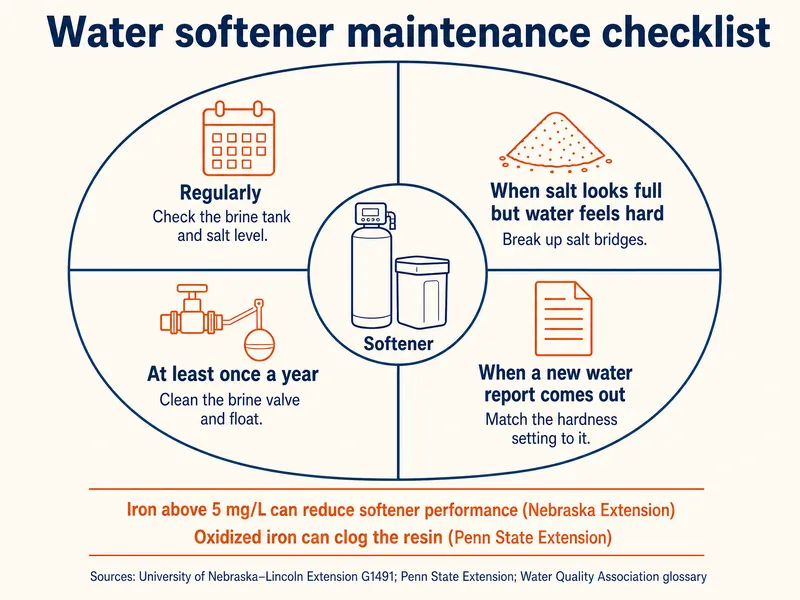
Water softener maintenance comes down to keeping the right salt in the brine tank, breaking up salt bridges, cleaning the brine valve and float yearly and setting hardness to your water report.
On this page
Key takeaways
- University of Nebraska–Lincoln Extension says the brine valve and float should be cleaned and inspected at least once a year.
- Use the salt type the softener's maker specifies; Nebraska Extension says most softeners are designed for compressed pellets, and rock salt only if the maker allows it and it averages under 1 percent impurities.
- A salt bridge is a hard crust that keeps water from dissolving the salt below, so the resin does not get enough brine (Water Quality Association glossary).
- Potassium chloride works in many softeners but can cost more and is needed in larger amounts per regeneration (Nebraska Extension).
- Iron above 5 ppm can reduce a softener's effectiveness (Nebraska Extension), and oxidized iron "will clog the resin", says Penn State Extension.
- Set hardness from your supplier's report: District 40's Lancaster wells averaged 5.7 gpg in 2025, Palmdale Water District 6.5 to 6.8 gpg, Quartz Hill 3.7 gpg.
Maintenance numbers
- 1 yearLongest interval between cleanings and inspections of the brine valve and floatUniversity of Nebraska–Lincoln Extension
- 5 ppmIron level above which a softener's effectiveness can dropUniversity of Nebraska–Lincoln Extension
- <1%Impurities for rock salt to be acceptable, where the maker allows itUniversity of Nebraska–Lincoln Extension
- 5.7 gpgHardness to set for Lancaster's District 40 well water (98 mg/L average, 2025 data)LA County Waterworks District 40
What water softener maintenance is needed?
A water softener needs four routine jobs: keeping salt in the brine tank, watching for salt bridges, cleaning the brine valve and float at least once a year, and checking that the hardness setting matches the water. Nebraska Extension puts it plainly: "the softener must be kept regenerated to avoid hard water flowing into pipes and appliances". Everything on this page serves that one goal.
How often the brine tank itself needs cleaning "depends on the type and amount of salt and characteristics of the water being treated", Nebraska Extension says, and it advises inspecting the tank for scale buildup. Backwashing also matters: on units with an adjustable backwash, the cycle should run until the drain water comes out clear. If an automatic or demand-initiated unit "appears to use more salt than expected or water is not softened", the same publication suggests having a service provider check the settings.
For homes on the valley's city systems a softener is optional comfort equipment; the guide on whether a softener is needed covers that choice. Once one is installed, though, skipped upkeep means paying for a machine that lets hard water through.
| Task | How often | Why | Source |
|---|---|---|---|
| Check the brine tank and salt level | Regularly, and whenever water feels hard again | No brine means no regeneration | Nebraska Extension G1491 |
| Break up salt bridges or mushy salt | When the salt looks full but water is hard | A crust keeps water from making brine | WQA glossary |
| Clean and inspect brine valve and float | At least once a year | Keeps brine draw and refill working | Nebraska Extension G1491 |
| Clean the brine tank | As salt type and water require; inspect for scale | Sludge and scale build up | Nebraska Extension G1491 |
| Check the hardness setting | When a new supplier report comes out, or after a well test | Setting drives capacity and salt use | Supplier report or lab result |
| Resin cleaning or replacement | When iron or manganese reduces capacity | Iron fouling cuts capacity | Penn State and Nebraska Extension |
Which water softener salt should you buy?
Buy the salt type your softener's maker specifies; for most units that means compressed salt pellets. Nebraska Extension notes that softeners "are designed to use specific types of salt", and that compressed salt, sold as pellets, nuggets or beads, is what "the majority of softeners are designed for". Products made to handle iron may include food-grade additives such as citric acid.
Other forms come with conditions. Salt blocks belong only in units designed for them, and must be high-grade evaporated salt without additives, not livestock blocks, which "may contain additives incompatible with water softener units". Rock salt may carry impurities that "significantly reduce the effectiveness of the regeneration process and plug valves", so Nebraska Extension says to use it only if the maker suggests it and only grades averaging under 1 percent impurities. The Water Quality Association also lists solar salt, made by evaporation in shallow ponds, as a softener regenerant.
Is potassium chloride a good substitute?
Potassium chloride is a workable substitute in many softeners, mainly for households that want to avoid adding sodium. The Water Quality Association describes potassium chloride as a regenerant for cation exchange softeners, in which potassium becomes the exchangeable ion instead of sodium. A sodium-based softener adds about 8 mg/L of sodium for each gpg removed, per Nebraska Extension, so at Lancaster's 5.7 gpg that is roughly 46 mg/L.
The trade-offs are cost and quantity. Nebraska Extension says potassium chloride "can be more costly and more difficult to obtain", and since it binds to the resin more tightly than sodium, a unit may need more of it per regeneration. That publication suggests consulting a water treatment professional before switching, and the softener's manual may require a different salt setting. The reverse osmosis vs water softener page covers another way to keep sodium out of drinking water.
What is a salt bridge and how do you break it?
A salt bridge is a hard crust of salt that forms in the brine tank and leaves a gap underneath, so the water below never becomes saturated brine. The Water Quality Association defines bridging as salt that sticks together "to form one large solid mass of pellets" or cakes in a dry-salt brine tank, with the result that there is "insufficient salt in the regenerant solution to properly regenerate the cation resin". The softener goes through its cycle, but hard water follows.
The giveaway is a tank that looks full of salt while the water turns hard again. Mushing is the related problem: the WQA describes it as pellets breaking down into crystals, and says both bridging and mushing "prevent proper circulation of salt in the unit and require that the brine system be cleaned". To clear a bridge, follow the maker's manual; the usual approach is to put the softener on bypass, gently break the crust from above with a broom handle without hitting the tank walls or the float, and remove any sludge layer. If the salt has mushed, scoop it out, rinse the tank and refill with the salt the maker specifies.
When should softener resin be cleaned or replaced?
Softener resin needs cleaning when iron or manganese has built up on it, and replacement when cleaning no longer restores capacity. The WQA defines iron fouling as iron accumulating "on or within an ion exchange resin bed" until its capacity is reduced. Penn State Extension says red, oxidized iron "will clog the resin", that "commercial cleaners are available" once it has, and that filtering oxidized iron before the softener keeps it out.
Nebraska Extension adds that hydrogen sulfide, or more than 5 ppm of iron, can make a softener less effective, and that resin exposed to high iron or manganese can eventually need cleaning or replacing. It recommends consulting a water treatment professional on that work. On city water with little iron, resin trouble is less common than on wells; private well owners should know their iron level from a lab test before blaming the resin. The well water treatment guide covers iron filters ahead of a softener.
How do you check the hardness setting?
Check the hardness setting by comparing it with the most recent figure for your water, in grains per gallon. Water reports print hardness in mg/L (or "ppm"); divide by 17.1 to get gpg. Palmdale Water District prints gpg directly: 6.5 for treated surface water and 6.8 for groundwater in its 2025 report.
Local figures from the latest reports: District 40's Lancaster wells averaged 98 mg/L, or 5.7 gpg, in 2025; 3.7 gpg for Quartz Hill (63.3 mg/L); 5.8 gpg for Rosamond's community services district (99.5 mg/L, sampled 2024); Cal Water's Lancaster wells 101 mg/L (5.9 gpg). Single wells vary widely, so a home near a harder well may need a higher setting; a home test strip or the supplier's customer service can narrow it down. The Antelope Valley water hardness page lists every system and the guide to water quality reports shows where hardness appears.
The Water Quality Association also describes "compensated hardness", a calculated figure that adjusts total hardness for iron, manganese and sodium because they reduce a softener's capacity. On well water with iron, follow the maker's manual for how much to add to the setting. Setting it too low lets hard water through; too high wastes salt and regeneration water, which the water softener cost page puts in context.
How we put this page together
This page is based on University of Nebraska–Lincoln Extension NebGuide G1491 (salt types, brine tank and float care, backwash, iron and resin), Penn State Extension's Water Softening article (iron fouling and cleaners), the Water Quality Association's glossary (bridging, mushing, iron fouling, compensated hardness, potassium chloride, solar salt) and the 2025-data hardness figures in the District 40, Palmdale Water District, Quartz Hill Water District, Rosamond CSD and Cal Water reports. Checked October 2026. Left out: brand-specific cleaning products, salt prices, resin lifespans in years (no primary source found) and forum tips.
Common questions
How often should salt be added to a water softener?
It depends on hardness, water use, the salt setting and tank size, so there is no single interval. Check the level on a regular routine and top up before the salt drops below the water line; a demand-initiated unit uses salt only when it regenerates.
Can table salt or ice-melt salt go in a softener?
No. Use the softener salt the maker specifies; Nebraska Extension warns that impurities and additives can weaken regeneration and plug valves, and ice-melt and table salt are not sold for this use.
Why is the brine tank full of water?
Some water in the tank is normal, since salt dissolves into it to make brine. A tank that keeps filling toward the top points to the brine valve or float, which Nebraska Extension says to clean and inspect yearly.
Should a softener be put on bypass during a vacation?
That is a choice, not a requirement. A demand-initiated unit uses little salt when no water is used; check the maker's manual before leaving a unit on bypass for long periods.
How long does softener resin last?
No primary source gives a dependable lifespan in years. What is documented is that iron and manganese fouling cut resin capacity, so watch for hard water returning after a normal regeneration and have the unit checked.
Does a softener need a professional service visit?
Not routinely. Nebraska Extension suggests a service provider when salt use looks too high or water is not softened, and a water treatment professional for resin cleaning or replacement.
Related guides
More help: see our home water guide for the Antelope Valley.