
Pipes & leaks
Drain Cleaning: From Plunger to Hydro Jetting
Drain cleaning starts with the simplest tool that reaches the clog: a plunger or hand auger for one fixture, a cable machine or hydro jetting for a main line, and a camera when clogs keep coming back.
On this page
Key takeaways
- LA County exempts unclogging work from plumbing permits, provided nothing (pipe, trap or valve) gets swapped out (County Code Title 28, Section 103.7).
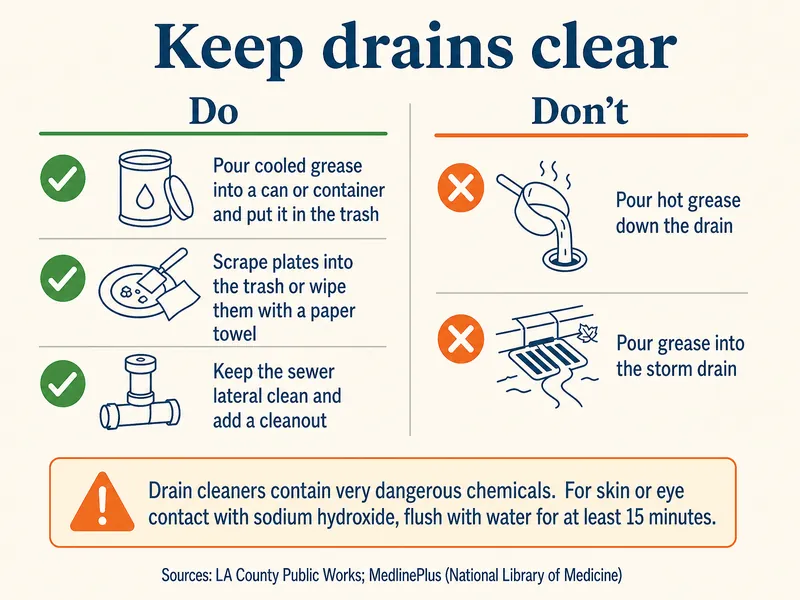
- LA County Public Works says fats, oils and grease "harden and stick to the inside of the sewer pipes" and can eventually block them (LA County homeowner page).
- MedlinePlus, from the National Library of Medicine, warns that drain cleaners contain very dangerous chemicals, and that sodium hydroxide on skin or in eyes calls for flushing with water for at least 15 minutes.
- In LA County's sewer maintenance district, the owner is responsible for the whole sewer lateral to the main, so a main line clog on the owner's side is the owner's to clear.
- No agency publishes drain cleaning prices; this guide explains what drives them.
Drain facts from the agencies
- 15 minutesMinimum time to flush skin or eyes after drain cleaner contact, with at least 2 quarts of waterMedlinePlus (NLM)
- 4–6 inTypical diameter of a house sewer lateral in LA County's districtLA County Public Works
- 1Service charges allowed on a service and repair contract, trip or inspection fee includedCSLB
What drain cleaning can you do yourself?
Most single-fixture clogs can be cleared at home with a plunger, a hand auger (a small drain snake), or by cleaning the trap and stopper. Start with the least force that works, and stop if water is backing up into other fixtures, because that points to a main line problem.
A practical order for one slow sink, tub or toilet:
- Pull and clean the stopper or hair catcher; bathroom sinks and tubs clog mostly with hair and soap within the first few inches.
- Plunge with the right plunger: a flat cup for sinks and tubs, a flanged one for toilets. Cover the sink's overflow hole so the pressure reaches the clog.
- Remove and clean the P-trap under a sink, with a bucket underneath.
- Run a hand auger through the drain or trap arm to break up or pull out the blockage.
Enzyme or bacterial drain products work slowly on organic buildup and are a maintenance option rather than a fix for a full clog. Follow the label, and don't combine them with chemical cleaners.
Do chemical drain cleaners damage pipes?
Chemical drain cleaners can harm older or damaged pipes and finishes, and they are hazardous to people, so they are a last resort for a home user. This guide found no agency study measuring pipe damage, so the practical rule is the product label: it states which pipe materials the product is safe for and how long to leave it.
The health risk is documented. MedlinePlus says drain cleaners "contain very dangerous chemicals that can be harmful to your health if you swallow them, breathe them in (inhale), or if they come in contact with your skin and eyes." For sodium hydroxide on the skin or in the eyes, it says to flush with at least 2 quarts of water for at least 15 minutes and get medical help, and to contact Poison Control for any exposure. Never plunge or snake a drain that still holds chemical cleaner, because the water can splash back, and tell anyone working on the drain what was poured in.
Snaking or hydro jetting: which drain cleaning works?
Both work, on different problems: a cable machine (snake) bores through a blockage and cuts roots, while hydro jetting scours the whole pipe wall with high-pressure water and removes grease and sludge that a cable leaves behind. A snake opens the line; jetting cleans it.
| Method | What it does | Best for | Watch for |
|---|---|---|---|
| Plunger | Pushes and pulls water to dislodge a clog | Single sink, tub or toilet | Cover overflows; stop if other drains back up |
| Hand auger | Small cable fed by hand | Hair and soap in sink and tub drains | Can scratch fixture finishes |
| Cable machine (snake) | Powered cable with a cutting head | Main line clogs, roots at joints | Opens a hole through grease rather than removing it |
| Hydro jetting | High-pressure water scours the pipe | Grease buildup, sludge, root debris after cutting | Needs pipe in sound condition; camera first if in doubt |
| Camera inspection | Video of the pipe's inside | Repeat clogs, roots, suspected breaks | Diagnosis only; clears nothing |
If roots keep returning at the same joints, the clog is a symptom of a cracked or separated pipe. LA County runs its own CCTV inspections on public sewers for the same reason; the sewer line replacement guide covers what the camera shows and when a repair or replacement is due.
How do you tell a main line clog from a fixture clog?
A fixture clog affects one drain; a main line clog shows up in several fixtures at once, usually the lowest ones first. If flushing a toilet makes the tub gurgle or back up, or running the washing machine floods a floor drain or shower, the blockage is below where those drains join, in the main line or the sewer lateral.
Signs of a main line clog:
- More than one fixture is slow, especially on the lowest floor.
- Water rises in the tub or shower when a toilet is flushed.
- Gurgling from drains when another fixture runs.
- Water or sewage at the cleanout or a floor drain.
A main line clog is cleared through the cleanout with a cable machine, not through a toilet or sink. In LA County's sewer maintenance district, the owner is responsible for the lateral from the house to the main, including the part under the street. Homes on septic have a different system entirely: slow drains everywhere can mean a full tank, which the septic tank pumping guide covers.
What does drain cleaning cost?
Drain cleaning cost depends on where the clog is, the method, how easy the cleanout is to reach, and whether a camera inspection is added; this guide found no agency that publishes prices, so it gives none. A single fixture cleared through the trap is a small job; a main line cleared through a buried or missing cleanout, followed by jetting and video, is a much larger one.
Before work starts, ask for:
- A written price, and whether it is per fixture, per hour, or flat.
- Whether a trip or service charge is included. CSLB's Contracting for Success guide says that on a service and repair contract (one the customer requested, $750 or less, with nothing paid until the work is done), the customer may be charged only one service charge, "including any trip charge or inspection fee."
- The method (cable, jetting) and why.
- Whether a camera inspection and video file are included.
- What happens if the line can't be cleared, and whether the charge still applies.
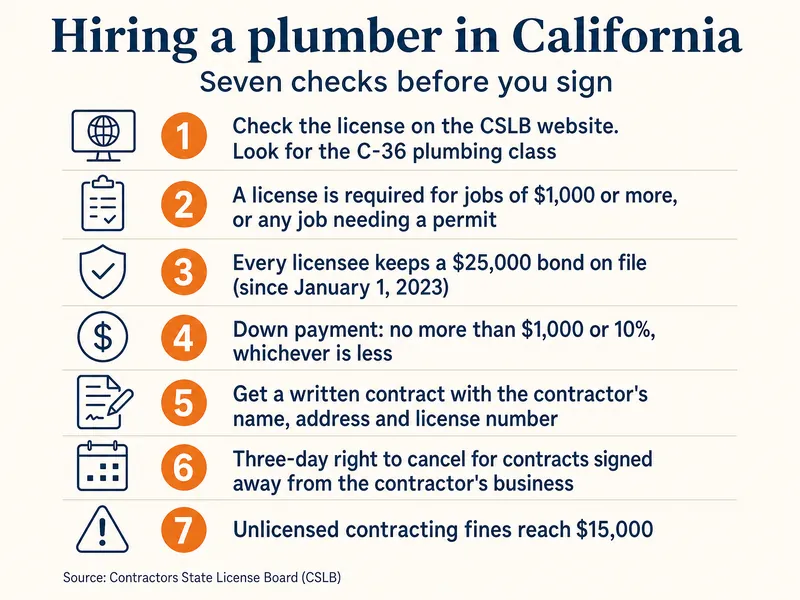
Clearing a stoppage needs no permit in LA County, but replacing a trap or pipe does. Any job of $1,000 or more needs a licensed contractor; the hiring guide covers license checks.
How do you keep drains clear?
The most effective habit is keeping fats, oils and grease out of drains. LA County Public Works' guidance is specific: pour cooled grease into a can or other container and put it in the trash, or absorb it with paper towels; scrape plates over the trash can or wipe them with a paper towel; and never pour grease into the storm drain.
Other habits that help:
- Strainers in tub, shower and kitchen drains to catch hair and food.
- Only toilet paper in toilets, whatever a wipe's packaging says.
- A cleanout on the sewer lateral, which LA County recommends, so a main line can be cleared without pulling a toilet.
- A backwater valve, if the house's lowest drain sits below the upstream sewer manhole; LA County notes these need regular maintenance.
Mineral spots around sinks and tubs are a separate, cosmetic issue; the hard water stains guide covers cleaning them.
How we put this page together
Drawn from the sewer maintenance pages and Title 28 permit exemptions published by LA County Public Works, MedlinePlus (National Library of Medicine) on drain cleaner poisoning, and CSLB's Contracting for Success guide to home improvement and service and repair contracts. Checked in October 2026. Left out: drain cleaning and hydro jetting prices (no agency source), product recommendations, and claims about how fast chemical cleaners damage specific pipe materials.
Common questions
Is hydro jetting safe for old pipes?
Jetting uses high-pressure water, so pipe that is cracked, collapsed or badly corroded can be damaged further. A camera inspection first shows whether the pipe can take it.
How often should a main line be cleaned?
Only as often as it clogs, unless roots or grease make it a known recurring problem. Repeat root clogs at the same spot point to a broken joint that cleaning won't fix.
Do flushable wipes clog drains?
They can, because they don't break up the way toilet paper does. Putting only toilet paper in toilets is the safer habit.
Can baking soda and vinegar clear a clog?
They may freshen a slow drain, but there is little reason to expect them to clear a solid blockage. A plunger or hand auger is the better first step.
Who pays if the clog is in the city sewer?
In LA County's sewer maintenance district, the district maintains the public mainline and the owner maintains the lateral. If neighbors' drains are backing up too, report it to the sewer agency for the address.
Does a drain cleaning visit need a permit?
No, not in LA County, as long as no pipes, traps or valves are replaced. Replacing any of them makes it permitted plumbing work.
More on pipes and drains
More help: see our Antelope Valley water, wells and septic guide.