
Tap water
Hexavalent Chromium in Drinking Water Explained
Hexavalent chromium in drinking water is limited to 10 µg/L in California since October 1, 2024; several Antelope Valley systems report results near or above it, with compliance dates set by each system's size.
On this page
- What is hexavalent chromium?
- Where does chromium 6 in water come from?
- What is California's hexavalent chromium limit?
- How much chromium 6 is in Antelope Valley water?
- Is chromium 6 in tap water a health risk?
- Which filters reduce hexavalent chromium?
- How do you test a private well for chromium 6?
- Common questions
Key takeaways
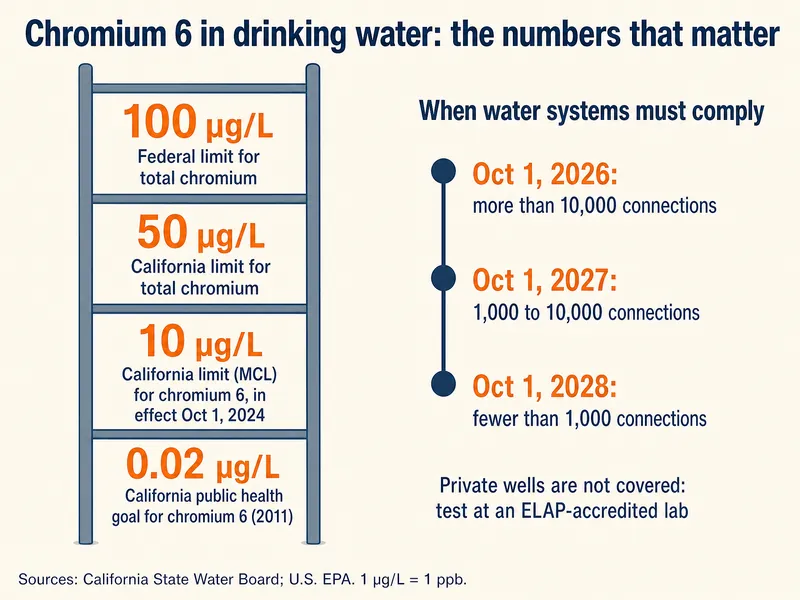
- California's hexavalent chromium (chromium 6) limit is 10 µg/L, in effect since October 1, 2024, according to the State Water Board.
- The public health goal is far lower, 0.02 µg/L, set in 2011.
- Systems with more than 10,000 connections had to comply by October 1, 2026; smaller systems have until 2027 or 2028.
- Rosamond CSD reported a violation in September 2026; Quartz Hill Water District and Cal Water's Lancaster system report results above 10 µg/L inside their compliance periods, and District 40, whose date was October 1, 2026, lists Lancaster wells up to 18 µg/L.
- Palmdale Water District's wells ran 0.5 to 9 µg/L in 2025, and AVEK's treatment plants about 0.1 µg/L.
- The federal government has no separate chromium 6 limit; the EPA caps total chromium at 100 µg/L.
What is hexavalent chromium?
Hexavalent chromium, or chromium 6, is one of the two common forms of the metal chromium; the other is trivalent chromium (chromium 3). The State Water Board's chromium 6 FAQ describes chromium as an odorless and tasteless heavy metal found throughout the environment. Because it has no taste, smell or color in tap water, only a lab test shows it.
The number in the name refers to the atom's electron state, and atoms can convert between the two forms. That matters because the forms behave differently: the FAQ calls trivalent chromium the less toxic form, while long-term exposure to water contaminated with the hexavalent form may harm the liver and cause cancer.
Where does chromium 6 in water come from?
Much of the chromium 6 in California's drinking water is natural, coming from the erosion of chromium-bearing rock, according to the State Water Board. Industrial pollution adds to it in some places: the FAQ names textile dye manufacturing, wood preservation, leather tanning and anti-corrosion coatings, where contaminated waste reached groundwater. Palmdale Water District's report also lists the natural conversion of trivalent chromium to the hexavalent form.
The State Water Board says San Bernardino, Los Angeles and Fresno counties have the most water sources above the limit. In the Antelope Valley, chromium 6 shows up mainly in well water; treated State Water Project water carries very little. AVEK's 2025 report lists 0.079 to 0.14 µg/L at its treatment plants.
What is California's hexavalent chromium limit?
California's hexavalent chromium limit, its maximum contaminant level (MCL), is 10 µg/L (10 parts per billion), effective October 1, 2024. The State Water Board adopted it in April 2024. The state also keeps a separate limit of 50 µg/L for total chromium, set in 1977, and the FAQ notes California is the only state with its own total chromium MCL.
Water systems got time to comply based on size: more than 10,000 service connections had to comply by October 1, 2026; 1,000 to 10,000 by October 1, 2027; and fewer than 1,000 by October 1, 2028. The rule applies to public water systems, not private or domestic wells. Federally, the EPA regulates chromium 6 and chromium 3 together under a total chromium standard of 100 µg/L; that figure is for total chromium, not chromium 6.
How much chromium 6 is in Antelope Valley water?
Chromium 6 in Antelope Valley water ranges from barely detectable in treated aqueduct water to above the 10 µg/L limit in some wells. Each system's own report states its position, and the table quotes them with their years. Three systems describe results over 10 µg/L as exceedances: Rosamond CSD, Quartz Hill Water District and Cal Water's Lancaster system. District 40's Lancaster wells also reached 18 µg/L.
Rosamond's September 2026 notice gives running annual averages of 14 and 15 µg/L at wells 8 and 9 and states, "Our water system recently violated a drinking water standard." It adds that this is not an emergency, that customers do not need bottled water, and that it expects to resolve the problem by October 1, 2027. Quartz Hill and Cal Water say their exceedances are not violations until after October 1, 2027 and October 1, 2028 respectively, because of their size. Their reports are not fully consistent on this. Quartz Hill's results table marks chromium 6 "Violation: Yes", while its text says the district is not considered in violation until after October 1, 2027. Cal Water's report says chromium 6 was detected above the limit in its Lancaster wells and that blending is planned before October 1, 2028, while its general chromium 6 section says treatment is installed and the water served meets the standard.
| System | Chromium 6 result | What the report says |
|---|---|---|
| Rosamond CSD | 2025 average 12; running annual averages 14 and 15 at two wells (August 2026 samples) | Violation notice, September 2026; fix expected by October 1, 2027 |
| Quartz Hill Water District | 2025 average 12 (range 11 to 13) | Table marks "Violation: Yes"; text says it exceeds the MCL but is not considered a violation until after October 1, 2027; new wells and treatment planned |
| Cal Water, Lancaster system | Wells 6.1 to 11, average 8.7 (2025) | Footnote says it exceeds the MCL, not a violation until after October 1, 2028, blending planned; general text says treatment is installed and the water meets the standard |
| District 40, Regions 4 and 34 (Lancaster) | Wells ND to 18 (2025) | Listed under other parameters; compliance date was October 1, 2026; the report does not discuss chromium 6 compliance |
| District 40, Region 38 (Lake Los Angeles) | Well 9.6 (2025) | All health-based standards met |
| District 40, Regions 24, 27 and 33 (Littlerock, Pearblossom) | Wells 2.8 to 3.9, average 3.4 (2025) | All health-based standards met |
| Palmdale Water District | Wells 0.5 to 9, average 4; surface water ND (2025) | 100% regulatory compliance in 2025 |
| AVEK treatment plants | 0.079 to 0.14 (2025) | Wholesale water bought by the retail systems |
District 40's Lancaster figure is quoted as a range only. District 40 is far bigger than 10,000 connections (it supplies most Lancaster homes), so the state schedule put its deadline at October 1, 2026, a date now past. Its newest report shows Lancaster wells as high as 18 µg/L yet says nothing about chromium 6 compliance, so District 40 is the one to ask. For each supplier's full picture, see Lancaster water quality, Palmdale water quality and who supplies your water.
Is chromium 6 in tap water a health risk?
Chromium 6 is a long-term health concern rather than a short-term one: the State Water Board says chronic exposure to contaminated water may cause liver toxicity, gastrointestinal tumors and liver cancer. At the 10 µg/L limit, it puts the risk at "a one-in-two-thousand chance of developing cancer during a lifetime (70 years) of exposure." The public health goal of 0.02 µg/L is the level below which there is no known or expected risk to health, as set by the California EPA.
Rosamond's notice uses the standard state wording: some people who drink water above the limit "over many years may have an increased risk of getting cancer." The same notice tells customers they do not need an alternative supply, and the State Water Board notes that bottled water is not tested for chromium 6, so it is not a recommended way to cut exposure. Anyone with a specific health concern should ask a doctor.
Which filters reduce hexavalent chromium?
Only a device certified for chromium 6 reduction should be relied on, and the State Water Board publishes a searchable directory of registered residential treatment devices, filterable by contaminant. For water systems, the board names three best available technologies: ion exchange, reduction-coagulation-filtration and reverse osmosis.
At home, the board says point-of-use devices such as pitcher filters are far more common for chromium 6 than whole-house units, and that removal claims "may vary by device". Read the performance data sheet for the exact model: it states the percentage removed and the test level, and a certification to NSF/ANSI 58 (the reverse osmosis standard) or 53 (health effects) covers only the claims listed on it. A water softener on its own is not a chromium 6 treatment. The page on reverse osmosis vs a water softener explains what each type does.
How do you test a private well for chromium 6?
Test a private well for chromium 6 through a lab holding ELAP accreditation for that analysis; the Environmental Laboratory Accreditation Program page has a map of accredited labs. The state limit does not apply to private wells, but the State Water Board's GAMA program recommends testing a domestic well every year and observing the same limits as public systems.
Ask the lab specifically for hexavalent chromium, not only total chromium. In the Antelope Valley it makes sense to run it with the other well tests the region calls for, such as arsenic, nitrate and bacteria; GAMA puts basic sampling at $100 to $400. The well water testing guide and arsenic in well water cover the rest of the list.
Chromium 6 limits and local results
- 10 µg/LMCL for chromium 6 in California, in force since Oct 1, 2024State Water Board
- 0.02 µg/LPublic health goal (PHG) for chromium 6, set in 2011State Water Board
- 1 in 2,000Lifetime (70-year) cancer risk at the 10 µg/L MCLState Water Board chromium 6 FAQ
- 15 µg/LRunning annual average at one Rosamond CSD well, August 2026 samplesRosamond CSD notice, September 2026
How we put this page together
This page is based on the State Water Board's hexavalent chromium page (updated September 1, 2026) and public FAQ (updated November 2024), its residential treatment device registration page, EPA's chromium in drinking water page, and the latest reports of Rosamond CSD (its 2025 report plus the September 2026 notice), Quartz Hill Water District, Cal Water's Lancaster system, District 40's 2026 regional reports for Lancaster, Littlerock and Pearblossom, and Lake Los Angeles, Palmdale Water District and AVEK, all opened on October 26, 2026. Left out: the District 40 Lancaster average (misprinted in its report), Quartz Hill's printed public health goal (it differs from the state's 0.02 µg/L), product removal claims not on a certification listing, and health advice beyond the agencies' wording.
Common questions
Is chromium 3 regulated in drinking water too?
Yes, through total chromium limits: California's 50 µg/L total chromium MCL covers both forms, and so does the federal 100 µg/L standard. The 10 µg/L limit applies to hexavalent chromium alone.
Does boiling water remove chromium 6?
No agency source reviewed for this page recommends boiling for chromium 6. The State Water Board points instead to residential devices certified to reduce it.
Why did California set its own chromium 6 limit?
California regulates chromium 6 separately because the federal rule covers only total chromium at 100 µg/L. The state's FAQ says each MCL above its public health goal is reviewed every five years under state law.
What does it mean that Quartz Hill exceeds the MCL but is not in violation?
The rule gave systems time to comply by size. Quartz Hill Water District's results average 12 µg/L, and its report text says a system of its size is not considered in violation until after October 1, 2027, though the same report's table marks the result "Violation: Yes". The district says it is working on new wells and treatment.
How do you find chromium 6 results for your own water?
Suppliers must report chromium 6 detections in their annual consumer confidence report. Find your supplier on the who supplies your water page and look for "hexavalent chromium" or "chromium-6" in its tables.
Does a whole-house filter treat chromium 6?
Point-of-entry devices exist, but the State Water Board says point-of-use units are much more common for chromium 6. Whatever the type, check that the exact model is listed for chromium 6 reduction in the state's device directory.
Is Palmdale water over the chromium 6 limit?
Not in its 2025 report: Palmdale Water District's wells ranged from 0.5 to 9 µg/L, and none was detected in its treated surface water.
Related guides
More help: see our Antelope Valley home water guide.