
Water heaters
Water Heater Expansion Tank and Relief Valve
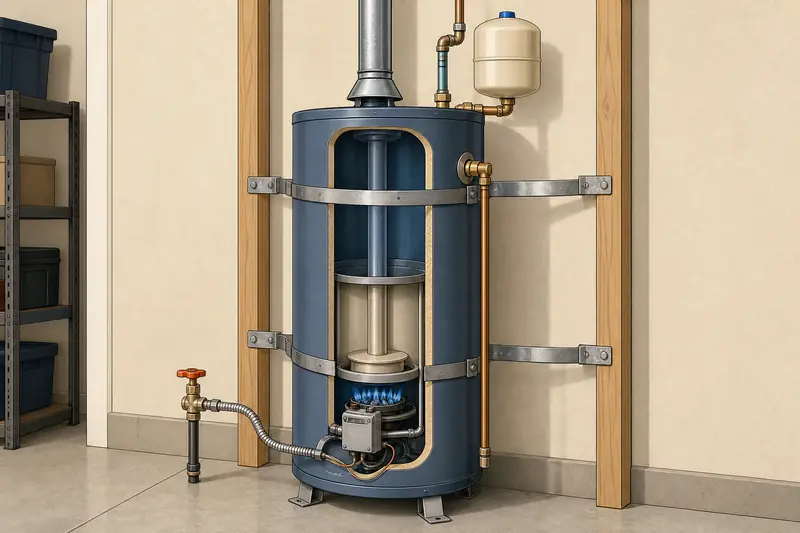
A water heater expansion tank holds the water that grows as it heats, about half a gallon in a 50-gallon tank warmed from 55 to 120 °F, and California's plumbing code requires one on every closed system.
On this page
Key takeaways
- California Plumbing Code 608.3 requires an expansion tank on any closed system, one where a device such as a check valve keeps heated water from pushing back to the street main (San Bernardino County excerpts).
- A.O. Smith's sizing chart calls for a 2-gallon expansion tank on 30- to 50-gallon heaters and a 5-gallon tank on 80 gallons and up.
- Its tanks ship pre-charged to 38 psi; the air charge "must be adjusted to match the incoming water pressure".
- A.O. Smith recommends household inlet pressure of 60 psi or less and requires a pressure reducing valve above 80 psi.
- The temperature-pressure relief valve is rated to the tank's 150 psi working pressure; A.O. Smith says excessive pressure is the most common reason it leaks.
- Test the relief valve at least once a year and check the expansion tank's air charge every 6 months, per A.O. Smith.
Expansion tank and relief valve figures
- 1/2 gallonApproximate growth of water in a 50-gallon heater warmed from 55 °F to 120 °FA.O. Smith expansion tank sizing chart
- 38 psiFactory air pre-charge of A.O. Smith's 2- and 5-gallon thermal expansion tanksA.O. Smith expansion tank manual
- 150 psiHydrostatic working pressure a replacement relief valve's set pressure must not exceed, on A.O. Smith residential gas heatersA.O. Smith gas manual 326940
- 60 psiRecommended maximum household inlet water pressureA.O. Smith expansion tank manual
What does a water heater expansion tank do?
A water heater expansion tank gives heated water somewhere to go. Water expands as it warms: A.O. Smith's expansion tank sizing chart puts the extra volume at about half a gallon when a 50-gallon heater takes incoming water from 55 °F to 120 °F. Water cannot be squeezed, so in a sealed system that half gallon shows up as pressure.
Inside the tank, a diaphragm separates a cushion of compressed air from the house water. A.O. Smith's expansion tank manual describes it as a pre-charged diaphragm tank that "stores the expanded hot water then returns water to the system when the temperature drops". Without one, the gas manual warns, thermal expansion can cause premature tank leaks, which its limited warranty does not cover, and can make the relief valve discharge on its own.
When is an expansion tank required?
An expansion tank is required whenever the plumbing is a closed system. California Plumbing Code section 608.3, as reprinted in San Bernardino County's water heater handout, says a water system with "a check valve, backflow preventer, or other normally closed device that prevents dissipation of building pressure back into the water main" must have an approved, listed and adequately sized expansion tank or similar device, installed on the building side of that device and sized to the maker's instructions.
A.O. Smith's gas water heater manual explains what creates a closed system: pressure-reducing valves, check valves and backflow preventers, installed because of code or high line pressure. Many homes have one of these at the meter or the house inlet. A backflow preventer, in Palmdale Water District's words, lets water flow "in one direction only", which is exactly what traps expanding hot water inside the house. A home with a water pressure regulator is the common case: A.O. Smith lists pressure-reducing valves among the devices that make a system closed. If unsure, a licensed plumber can tell from the fittings at the meter and the main shutoff.
The tank sits on the cold water line. A.O. Smith's manual says to mount it at least 18 inches from the heater's cold inlet, supported by the piping in a vertical position, indoors where it will not freeze and where a leak will not damage anything. A water heater replaced under permit is checked for it, along with the other code items on the replacement cost guide.
How do you size a water heater expansion tank?
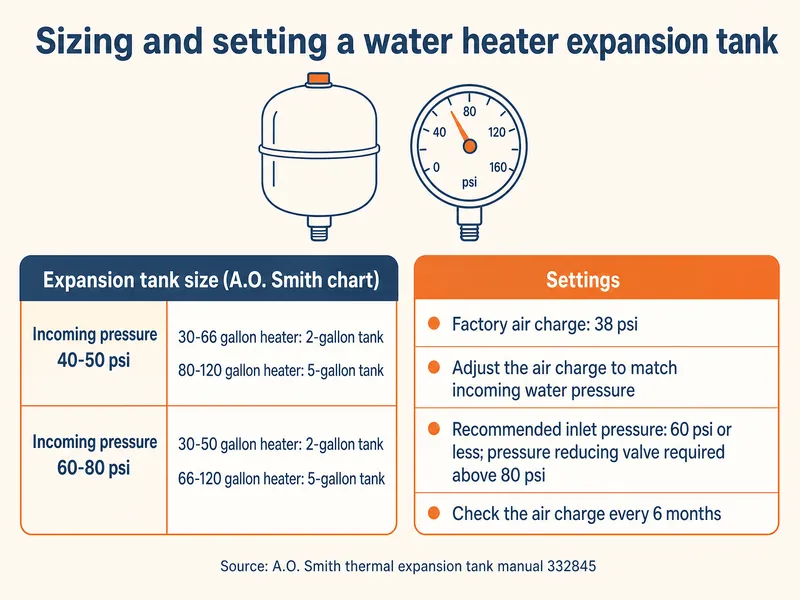
Size it from the heater's capacity and the home's incoming water pressure, using the expansion tank maker's chart, as CPC 608.3 requires. A.O. Smith's chart for its own thermal expansion tanks assumes a maximum of 140 °F and 150 psi, and needs only two sizes for typical homes.
| Incoming water pressure | 30 gal heater | 40 gal | 50 gal | 66 gal | 80 gal | 100 gal | 120 gal |
|---|---|---|---|---|---|---|---|
| 40 psi | 2 gal | 2 gal | 2 gal | 2 gal | 5 gal | 5 gal | 5 gal |
| 50 psi | 2 gal | 2 gal | 2 gal | 2 gal | 5 gal | 5 gal | 5 gal |
| 60 psi | 2 gal | 2 gal | 2 gal | 5 gal | 5 gal | 5 gal | 5 gal |
| 70 psi (use a pressure reducing valve set at 60 psi) | 2 gal | 2 gal | 2 gal | 5 gal | 5 gal | 5 gal | 5 gal |
| 80 psi (use a pressure reducing valve set at 60 psi) | 2 gal | 2 gal | 2 gal | 5 gal | 5 gal | 5 gal | 5 gal |
So a 40- or 50-gallon heater, the usual size in a house, takes the small tank at any pressure on the chart. Other makers' charts differ, and the expansion tank must be certified for drinking water: A.O. Smith's are certified to NSF/ANSI 61 and rated to 150 psi, and its manual warns "DO NOT USE A STANDARD TANK".
How do you set the air pressure?
Set the expansion tank's air charge to match the home's incoming water pressure, checked with the water pressure off the tank. A.O. Smith's steps: shut off the main cold water supply, open a nearby faucet until the water stops so the pressure is relieved, then check the tank's air valve with a tire gauge. Its tanks leave the factory at 38 psi, and the manual says the charge "must be adjusted to match the incoming water pressure".
The house pressure comes from a gauge. A.O. Smith's manual calls for a pressure gauge on the cold line between the pressure reducing valve and the expansion tank, recommends inlet pressure of 60 psi or less, and says a pressure reducing valve is required when incoming pressure exceeds 80 psi. Add or let out air at the tank's valve until its reading matches the house pressure, then reopen the main; the manual's own example is a home at 50 psi getting a tank filled with 50 psi of air.
Check it again every six months. The manual says the pre-charge must be checked at least once every 6 months with the tank isolated and empty of water, and the tank inspected for damage or corrosion., and A.O. Smith says the tank must be replaced if it has deteriorated badly. Its manual adds that an expansion tank, like any tank, will eventually leak.
What does the pressure relief valve do?
The temperature-pressure relief valve, or T&P valve, opens to dump water if the tank gets too hot or the pressure climbs too high. It is the last line of defense against a tank failure. A.O. Smith's manual says a replacement valve must meet ANSI Z21.22-CSA 4.4 and ASME requirements, be set no higher than the heater's marked working pressure of 150 psi, and be rated for at least the heater's Btu input.
The discharge pipe matters as much as the valve. Under California Plumbing Code 608.5, that drain must exit the building and be at least as large as the valve's outlet. A.O. Smith adds that the pipe must not be plugged, capped or reduced, must have no valve between it and the tank, must drain completely, and should end within 6 inches of a floor drain or outside; more than 30 feet of pipe or more than four elbows can restrict it.
| Check | How often or what to look for | Source |
|---|---|---|
| Lift the T&P valve lever | At least once a year; it should seat and stop | A.O. Smith gas manual 326940 |
| T&P discharge pipe | Runs to the outside, full size, no valve, not capped | CPC 608.5; A.O. Smith |
| Expansion tank air charge | Every 6 months, tank isolated and empty, equal to supply pressure | A.O. Smith tank manual 332845 |
| Household water pressure | 60 psi or less recommended; reducing valve required above 80 psi | A.O. Smith tank manual 332845 |
| Expansion tank body | Every 6 months for damage or corrosion | A.O. Smith tank manual 332845 |
Why is the relief valve dripping?
A dripping relief valve usually means pressure, not a bad valve. A.O. Smith's gas manual says "excessive water pressure is the most common cause" of T&P leakage, most often caused by thermal expansion in a closed system, and that the valve "is not intended for the constant relief of thermal expansion". Its expansion tank brochure notes it takes extreme pressure, 150 psi or more, to make a T&P valve drip or run.
Work through the causes in A.O. Smith's order: the valve may be worn or clogged with lime and need replacing; inlet pressure may be above the recommended 60 psi; or the expansion tank's air charge may not match the incoming pressure. If the valve keeps releasing water after its lever is lifted and let go, the gas manual says to close the cold water inlet, drain the heater and replace the valve with a properly rated one. Never cap or plug a dripping relief line; that removes the tank's protection. The no hot water guide covers other heater faults, and the earthquake straps page covers the bracing a new tank install also needs.
How we put this page together
This page is based on A.O. Smith's thermal expansion tank owner's manual 332845 (printed June 2015) and expansion tank sizing brochure, the A.O. Smith gas heater manual, number 326940 (closed systems, thermal expansion and relief valve sections), and the California Plumbing Code sections 608.3 and 608.5 in San Bernardino County's water heater handout, revision dated January 2020. Sources were reviewed in October 2026. Left out: other makers' sizing charts, installed prices, and California Plumbing Code pressure limits for regulators, which this site has not loaded from the code itself.
Common questions
Does a home without a pressure regulator need an expansion tank?
Only if something else closes the system, such as a check valve or backflow preventer at the meter. California Plumbing Code 608.3 ties the requirement to any normally closed device that keeps pressure from going back to the main.
Can an expansion tank go on the hot side?
A.O. Smith's manual places it on the cold water line, at least 18 inches from the heater's cold inlet, with a pressure gauge and the pressure reducing valve after it in sequence. Follow the tank maker's instructions.
How can a homeowner tell the expansion tank has stopped working?
A relief valve that starts dripping again is one clue, since A.O. Smith lists a wrong air charge among the causes. Check the charge with the tank isolated and empty; if it will not hold air, or the tank shows corrosion, replace it.
Why does the house pressure matter for the air charge?
A.O. Smith says the air charge must match the incoming water pressure, and that failing to size the tank and set the pre-charge properly shortens its life, can void its warranty and leads to early failure.
Is a dripping relief valve dangerous?
The drip itself is the valve doing its job, but it signals pressure that is too high or a worn valve. A.O. Smith says a valve that keeps discharging after being operated should be replaced.
Does a tankless water heater need an expansion tank?
CPC 608.3 applies whatever type of water heater is used, so a closed system needs thermal expansion control with a tankless heater too. Ask the installer what the heater's maker specifies.
Can the relief valve drain pipe end in the garage?
California Plumbing Code 608.5 calls for the drain to run to the outside of the building. A.O. Smith also allows a floor drain within 6 inches; the local inspector has the final word.
Water heater guides
More help: see our Antelope Valley home water guide.