
Hard water & softeners
How Does a Water Softener Work?
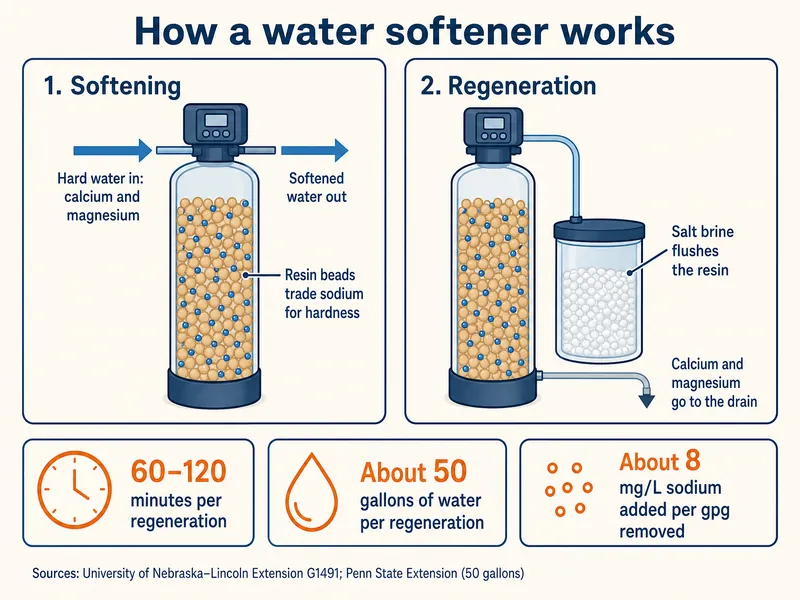
How does a water softener work? Hard water flows through resin beads that hold sodium; the beads grab calcium and magnesium and release sodium, then a salt brine flush recharges them.
On this page
Key takeaways
- Household softeners are ion exchange units: resin beads, usually sulfonated polystyrene, trade loosely held sodium for calcium and magnesium (University of Nebraska–Lincoln Extension G1491).
- Regeneration flushes the beads with brine; it generally takes 60 to 120 minutes, and Penn State Extension estimates about 50 gallons of water per cycle.
- The Water Quality Association defines a water softener as a device that brings hardness below 1 gpg.
- Capacity is counted in grains: Penn State Extension's example softener holds 20,000 grains and lasts about 6 to 7 days for four people on 10 gpg water.
- Sodium rises by roughly 8 mg/L for every gpg removed; potassium chloride can replace salt in many units.
- Softening does not remove bacteria, nitrate, lead, sand or pesticides, and it is not a treatment for arsenic or hexavalent chromium.
Ion exchange in numbers
- 60–120 minTypical time for brine to pass through and flush the tank during regenerationUniversity of Nebraska–Lincoln Extension
- ~8 mg/LSodium added for each grain per gallon of hardness removedUniversity of Nebraska–Lincoln Extension
- <1 gpgHardness a device must reach to count as a water softenerWater Quality Association glossary
- 17.1 mg/LOne grain per gallon of hardness, expressed as calcium carbonateUSGS Water Science School
How does a water softener work?
A water softener works by ion exchange: as water passes through a tank of resin beads, calcium and magnesium stick to the beads and sodium (or potassium) comes off in their place. The water leaving the tank has almost no hardness, so it no longer leaves scale or soap film. When the beads are full of calcium and magnesium, the unit recharges them with a salt brine and sends the hardness down the drain.
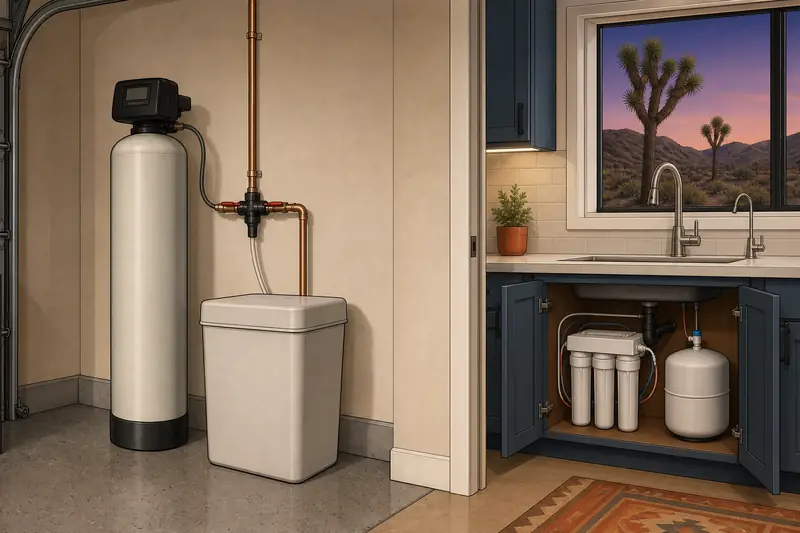
A typical home system has two tanks. The tall mineral tank holds the resin and a control valve on top that routes water and runs regeneration. The shorter brine tank holds salt or potassium chloride dissolved in water. A bypass valve on the main line lets water skip the unit during service. The University of Nebraska–Lincoln Extension calls ion exchange "the most commonly used technique for managing hard water in residential settings".
Hardness itself is a nuisance, not a health issue. Nebraska Extension says removing hardness ions "isn't necessary for health reasons", and in the Antelope Valley the city systems average 63 to 116 mg/L, moderately hard. Whether softening is worth it there is covered in whether you need a softener; this page explains the machine.
What is ion exchange?
Ion exchange is a swap of charged particles between water and a solid resin. Calcium and magnesium dissolve from rock as positively charged ions; the softener's resin is a bed of microporous beads, "usually sulfonated polystyrene beads that are supersaturated with sodium", in Nebraska Extension's words. The beads hold calcium and magnesium more strongly than sodium, so as hard water passes, the hardness ions attach and the "loosely held sodium is released from the resin into the water".
The Water Quality Association describes the spots on each bead where this happens as exchange sites: in softening, sodium at those sites "is exchanged for calcium, magnesium, iron, or other polyvalent cations". That is why a softener can also take out small amounts of dissolved iron and manganese, up to the maker's rating. Nebraska Extension puts that at "as much as 5-10 ppm" for some units, with pretreatment needed above it.
What happens during regeneration?
Regeneration is the recharge cycle: the control valve backwashes the resin, draws brine from the salt tank through the bed, rinses it and refills the brine tank. Sodium in the brine pushes the calcium and magnesium off the beads, and that hard rinse water goes to the drain. Nebraska Extension says "sixty to 120 minutes generally are required" before soft water is available again, which is why timer units usually regenerate between midnight and 4 a.m.
How often it happens depends on "the hardness of the water, the amount of water used, size of the softener, and capacity of the resins". Each cycle uses about 50 gallons of water, Penn State Extension estimates, roughly one load of laundry in an older washing machine by Nebraska Extension's comparison. Backwashing matters too: Nebraska Extension advises running it long enough "to produce clear water in the drain" so the bed stays loose and clean.
Controls come in four kinds, by Nebraska Extension's count. Semi-automatic units need the owner to start regeneration. Automatic units run on a timer. Demand-initiated units count gallons or sense the resin's condition and regenerate only when needed, which "may lead to less overall usage of salt and water". Off-site units are rental tanks swapped out and recharged elsewhere.
| Control type | What starts regeneration | Salt and water use | Owner's job |
|---|---|---|---|
| Semi-automatic | The owner | Depends on the owner's timing | Start each cycle, add salt |
| Automatic (timer) | A clock, usually at night | Same amount every cycle, used or not | Set the timer, add salt |
| Demand-initiated (DIR) | Gallons used or a change sensed in the resin | Can be lower, since it runs only when needed | Add salt, check settings |
| Off-site regeneration | A service swaps the tank | None in the home | Arrange the exchange |
How is softener capacity measured?
Softener capacity is measured in grains of hardness removed between regenerations. Penn State Extension's worked example takes 75 gallons per person per day at 10 gpg for four people, or 3,000 grains a day, so a 20,000-grain softener regenerates about every 6 to 7 days. Change the hardness and the interval changes with it.
Applied to Antelope Valley water, the same arithmetic gives very different answers. Lancaster's District 40 wells averaged 5.7 gpg in 2025, so four people would use 1,710 grains a day; Cal Water's Leona Valley wells averaged 14.4 gpg, or 4,320 grains a day. A private well can be anything, which is why the well water testing guide puts the lab test before any equipment.
Rated capacity is not fixed. The Water Quality Association notes that it "will vary, within limits, with the amount of regenerant used", and it measures salt efficiency as grains removed per pound of salt. A softener set to use less salt per cycle gives up some capacity in exchange. The water softener cost page uses these numbers to show what drives running costs, and the maintenance checklist covers setting hardness on the control valve.
Does a softener add sodium to water?
Yes: a sodium-based softener adds sodium in proportion to the hardness it removes, about 8 mg/L for each gpg according to Nebraska Extension. Penn State gives the same rate as 7.5 milligrams per quart per gpg. Water at 10 gpg ends up with about 80 mg/L of added sodium.
Antelope Valley water already carries some sodium before any softening. District 40's 2026 report for Lancaster (Regions 4 and 34) lists sodium in its wells from 17 to 130 mg/L, averaging 71 mg/L, in 2025. Softening that water at 5.7 gpg would add about 46 mg/L more by Nebraska Extension's rate. Cal Water's Lancaster report notes that "people on low-sodium diets should be aware that some water softeners increase the sodium content of the water".
There are two common workarounds. Many homes leave a cold line to the kitchen tap unsoftened for drinking and cooking. And Nebraska Extension notes that potassium chloride "may be used for softener regeneration instead of sodium chloride", though it can cost more, be harder to find and need a larger amount per cycle because it "adheres more strongly to the resin". A reverse osmosis unit at the kitchen sink is another route; see reverse osmosis vs water softener.
What doesn't a water softener remove?
A water softener does not remove most contaminants that matter for health. Nebraska Extension lists "bacteria, hydrogen sulfide, silt or sand, lead, nitrate, pesticides, and many other organic and inorganic compounds" as things softening does not remove. It is not a treatment for arsenic or hexavalent chromium either; those need a device certified for that contaminant, and the State Water Board keeps a searchable database of registered residential treatment devices that can be filtered by the contaminant a device is certified to reduce.
Some things also harm the softener. Nebraska Extension warns that iron above 5 ppm or hydrogen sulfide "can reduce the effectiveness of the water softener" and that sediment can too, so well water may need a filter ahead of it; the well water treatment guide covers those pretreatment steps. A salt-free conditioner is a different device that does not use ion exchange at all; the salt-free water softener page explains the difference.
Certification is voluntary. Nebraska Extension notes that federal, state and local laws "do not regulate water softening home systems"; NSF and the WQA certify softeners to NSF/ANSI 44, the standard for cation exchange softeners. Check a specific model's listing on the NSF or WQA site rather than a logo on a sales page.
How we put this page together
Built from University of Nebraska–Lincoln Extension NebGuide G1491, Drinking Water Treatment: Water Softening (Ion Exchange), revised September 2014; Penn State Extension's Water Softening article (updated September 8, 2025); the Water Quality Association's online glossary; the USGS Water Science School page on hardness; and the 2025-data reports from District 40's Lancaster regions and Cal Water (Lancaster and Leona Valley). Sources checked October 2026. Left out: brand comparisons, maker marketing claims, health claims about soft or hard water and forum advice.
Common questions
Why does my softener run in the middle of the night?
Timer-controlled softeners regenerate when little water is being used, usually between midnight and 4 a.m., because the house gets unsoftened or no water for the 60 to 120 minutes the cycle takes.
Can a softener be rented instead of bought?
Yes, in one form: Nebraska Extension describes off-site regeneration, where rental resin tanks are exchanged in the home and recharged at a central location. Nothing regenerates in the house, so no salt or drain water is used there.
Does a softener remove hardness completely?
Close to it while the resin has capacity. Nebraska Extension reports that the process strips out almost all of the calcium and magnesium, and the Water Quality Association's definition of a softener is one that brings hardness under 1 gpg. Once the resin is exhausted, hard water passes through until the next regeneration.
Can a softener remove iron from well water?
Some can remove small amounts of dissolved iron, up to the maker's rating; Nebraska Extension cites as much as 5 to 10 ppm for some units. Iron that has already oxidized (red or orange) clogs the resin and needs a filter ahead of the softener.
Why is there water in my brine tank?
Salt has to dissolve to make brine, so many brine tanks hold water; the Water Quality Association's glossary also describes dry-salt tanks. Water that keeps rising toward the top points to the float or brine valve, parts Nebraska Extension wants looked over and cleaned every year or sooner.
What does the bypass valve do?
It routes water around the softener so you can service it, or use unsoftened water outside for a while. Remember to switch it back, or the house stays on hard water.
Is a twin-tank softener better?
A twin-tank demand unit can soften from one tank while the other regenerates, so soft water never runs out. Nebraska Extension describes this design under demand-initiated regeneration; it matters most for large households or very hard water.
Related guides
More help: see our Antelope Valley home water guide.