
Water heaters
How Long Do Water Heaters Last?
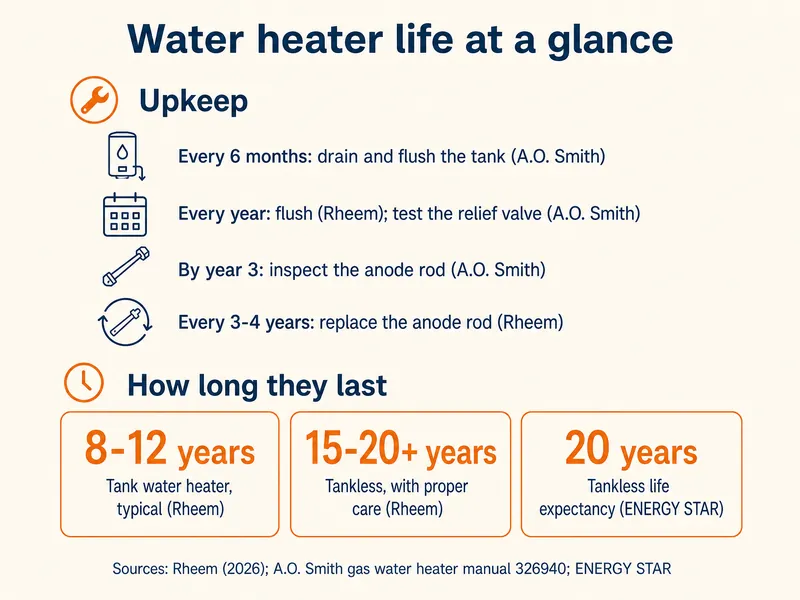
How long do water heaters last? Rheem puts a tank heater at 8 to 12 years and a tankless unit at 15 to 20+ years with care; ENERGY STAR gives tankless models a 20-year life expectancy.
On this page
Key takeaways
- Rheem's lifespan guide (March 2026) says tank water heaters "typically last 8–12 years" and names hard water as one of three things that speed up wear.
- ENERGY STAR says tankless heaters have a life expectancy of 20 years, longer than any conventional tank.
- City water in Lancaster, Palmdale, Quartz Hill and Rosamond averaged 63.3 to 116 mg/L hardness in the 2025 reports: moderately hard, not extreme.
- Some well water runs much harder: single District 40 well results in Lancaster reached 320 mg/L in 2025 (Regions 4 and 34 report).
- A.O. Smith's gas manual says to drain and flush the tank every 6 months and to inspect the anode rod after three years at most.
- On a Bradford White heater, the first two characters of the serial number give the year and month it was made.
Lifespan figures from makers and agencies
- 8–12 yearsTypical life of a tank water heaterRheem
- 20 yearsLife expectancy of a tankless water heaterENERGY STAR
- 3–4 yearsHow often Rheem advises replacing the anode rodRheem
- 320 mg/LHighest single District 40 well hardness result, Lancaster Regions 4 and 34 (2025 data)LA County Waterworks District 40
How long do water heaters last?
A tank water heater typically lasts 8 to 12 years, according to Rheem. That is a maker's average, not a promise: the same article says hard water, heavy household demand and skipped maintenance all shorten it. A family of five running two showers each morning puts more cycles on a tank than one person who travels for work.
Age alone is a signal once a heater passes 10 years. Rheem calls a unit of 10 to 15+ years with recurring problems a strong candidate for replacement, and warns that the risk of leaks and sudden failure rises sharply after the 10-year mark. Planning the swap before the tank fails lets the household choose the model, the fuel and the contractor instead of taking whatever is in stock on a cold morning.
| Item | Expected life or interval | Source |
|---|---|---|
| Tank water heater | 8–12 years | Rheem, March 2026 |
| Tankless water heater | 15–20+ years with proper care | Rheem, March 2026 |
| Gas tankless water heater | 20 years life expectancy | ENERGY STAR |
| Anode rod | Replace every 3–4 years | Rheem, March 2026 |
| Anode rod (gas tank) | Inspect after three years at most, then every year | A.O. Smith manual 326940 |
| Tank sediment | Drain and flush every 6 months | A.O. Smith manual 326940 |
How long does a tankless heater last?
A tankless water heater lasts longer than a tank: ENERGY STAR gives it a life expectancy of 20 years, and Rheem says 15 to 20+ years with proper care. With no tank of stored water, there is no steel shell slowly corroding from the inside, so the heat exchanger and its controls set the limit instead.
Scale is what ends a tankless unit early. Rinnai's installation manual for its RU-series condensing models says that where water is hard, it "must be treated and/or the heat exchanger flushed regularly", and that damage from scale in the heat exchanger is not covered by the warranty. The tankless cost guide covers the descaling routine and what it adds to running costs.
Does Antelope Valley hard water shorten heater life?
It can, though the valley's piped water is only moderately hard. The 2025 reports give averages of 111 mg/L (6.5 gpg) for Palmdale's treated lake and aqueduct water and 116 mg/L (6.8 gpg) for its wells, 98 mg/L (5.7 gpg) for District 40's Lancaster wells, and 63.3 mg/L (3.7 gpg) in Quartz Hill. On the USGS scale, anything from 61 to 120 mg/L counts as moderately hard, so a typical city tap lands mid-scale.
Wells are where hardness climbs. In Lancaster, individual District 40 well samples spanned 30 to 320 mg/L during 2025; Rock Creek's single District 40 well tested at 260 mg/L, and the wells Cal Water uses in Leona Valley average 247. A private well is not in any utility report, so only a lab test tells. The Antelope Valley hardness page lists every system with its report year.
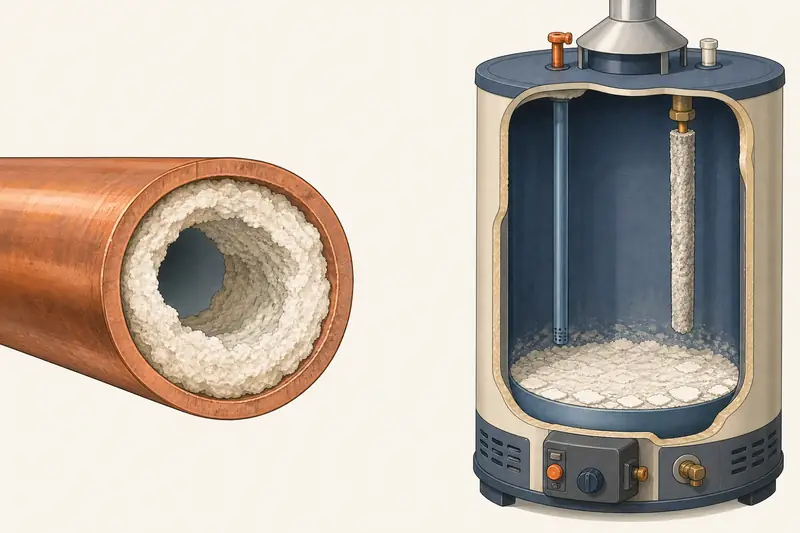
Harder water leaves more mineral sediment on the bottom of a gas tank, where the burner heats it. A.O. Smith's troubleshooting charts list "sediment or lime in tank" as a cause of slow recovery, short hot water and high operating costs, with the fix "drain/flush" and water treatment if needed. On city water, softening is optional, chosen for less scale and spotting; the softener guide weighs it. Note that A.O. Smith also calls artificially softened water corrosive to the anode and says a softener "may decrease the life of the water heater tank", so softened water means checking the anode every year.
How can you tell a water heater's age from its label?
The age is coded into the serial number on the heater's rating plate, the sticker on the side of the tank that also shows the model number, capacity and input rating. Each maker uses its own code. Bradford White says the first two characters of its serial number are the year and the month of manufacture.
Bradford White's year letters repeat every 20 years and skip six letters of the alphabet (O, Q, R, U and V among them); its month letters run A for January through M for December, skipping one letter along the way. So a serial starting "SJ" was made in September 2018, and one starting "CA" in January 2026 (Bradford White lists 2006 as the other possible year). For other brands, look up the serial format on the maker's own site, or ask the maker with the serial number in hand.
| First letter | Year | First letter | Year |
|---|---|---|---|
| L | 2014 | X | 2021 |
| M | 2015 | Y | 2022 |
| N | 2016 | Z | 2023 |
| P | 2017 | A | 2024 |
| S | 2018 | B | 2025 |
| T | 2019 | C | 2026 |
| W | 2020 |
Which warning signs mean replacement is near?
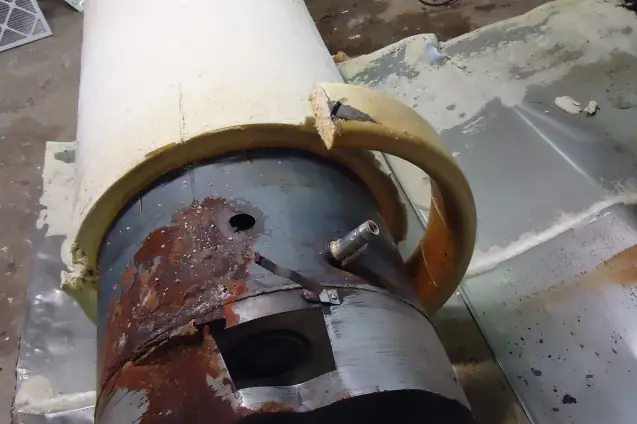
Water leaking from the tank body is the sign that settles it, because a corroded tank cannot be repaired. Rheem lists water at the base of the tank, rusty or discolored hot water, and persistent rumbling or popping from hardened sediment as the clear signs of a heater near its end.
Not every puddle is a failing tank. A.O. Smith's leakage checklist notes that "many suspected 'Leakers' are not leaking tanks": water can come from condensation on a cold tank, a loose pipe fitting, the anode fitting, a drain valve left slightly open, or a relief valve releasing pressure. Check those first. A dripping relief valve usually points to high pressure or thermal expansion, not tank failure. A rotten-egg smell, the manual adds, is usually a reaction between the anode rod and sulfur in the water, and a different anode can help.
What maintenance adds years?
Flushing out sediment and replacing the anode rod are the two jobs that most often stretch a tank's life. Rheem advises flushing the tank once a year and replacing the anode every 3 to 4 years, because once the rod is used up the tank itself starts to rust. A.O. Smith's gas manual is stricter on sediment, recommending a drain and flush every 6 months.
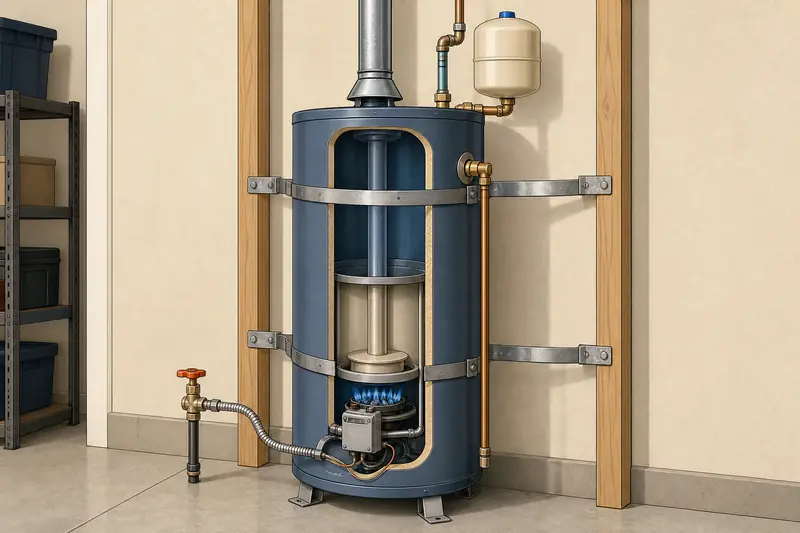
Three smaller habits help. Test the temperature-pressure relief valve once a year, as A.O. Smith directs, by lifting its lever with the discharge line clear. Keep household pressure in check: A.O. Smith says supply pressure "should not exceed 80 psi", and the pressure regulator guide explains the valve that controls it. And on a closed system, make sure the expansion tank still holds its air charge, since A.O. Smith says thermal expansion can cause premature tank failure. The step-by-step routine is on the flushing guide.
How we put this page together
This page draws on Rheem's lifespan article (March 25, 2026), ENERGY STAR's tankless benefits page, A.O. Smith's residential gas water heater manual 326940 (maintenance, troubleshooting and leakage sections), Rinnai's RU-series installation and operation manual, Bradford White's serial number date code chart, and hardness figures from the 2025 water quality reports of Palmdale Water District, LA County Waterworks District 40 (2026 editions, 2025 data), Quartz Hill Water District and Cal Water, as compiled on this site's hardness page. All of it was checked in October 2026. Deliberately left out: lifespan claims from contractor sites, warranty lengths as a stand-in for life, and any claim about desert heat shortening heater life, for which no source was found.
Common questions
Is a 15-year-old water heater worth keeping?
It can keep working, but Rheem says the risk of leaks and sudden failure rises sharply after 10 years. Budgeting for a replacement now, and checking the floor around the tank regularly, beats an emergency swap.
Does a water softener make a water heater last longer?
The makers point both ways. Rheem lists hard water among the things that speed up wear, while A.O. Smith says artificially softened water wears out the anode faster and asks for a yearly anode check on softened water.
What does a rumbling or popping water heater mean?
Rheem ties persistent rumbling or popping to hardened sediment on the tank floor. Flushing may help a younger tank; on an old one it is often a sign the heater is near the end.
How often should the anode rod be checked on Antelope Valley water?
A.O. Smith says to inspect it after three years at most and every year after that, and every year on softened water. Rheem's figure for replacement is every 3 to 4 years.
Does a tankless heater need flushing every year?
Rinnai says to flush its tankless heaters at least once a year, and more often on hard water. Scale damage to the heat exchanger is not covered by its warranty.
What if the serial number letters could mean two different years?
Pick the year that fits the house. A Bradford White "A" means 2004 or 2024; a heater installed when the home was bought in 2010 cannot be from 2024.
Is rusty hot water always a dying tank?
Not always, but Rheem lists rusty or discolored hot water among the signs of a failing heater. If cold water is clear and only the hot is rusty, the tank or its anode is the likely source.
More on water heaters
More help: see our guide to Antelope Valley home water.