
Wells
Well Water Testing: What to Test and Where
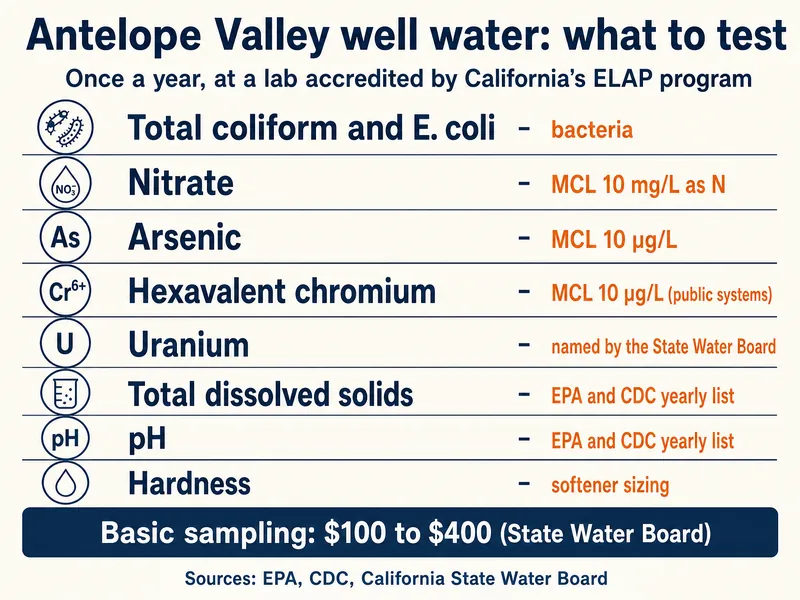
Well water testing in the Antelope Valley means a yearly lab test for bacteria, nitrate, arsenic, hexavalent chromium, uranium, TDS, pH and hardness, done by a lab California accredits.
On this page
Key takeaways
- The EPA and the CDC both say to test a private well once a year for total coliform bacteria, nitrate, total dissolved solids and pH.
- California's State Water Board adds arsenic and uranium to its examples and puts basic sampling at $100 to $400.
- Use a lab accredited by the State Water Board's ELAP program; the board's map lists them by area.
- USGS publication FS 2012-3033 found high arsenic in 28% of the Antelope Valley's primary aquifers and nitrate above benchmarks in some wells.
- California's 10 µg/L hexavalent chromium limit binds public systems, "not private or domestic wells", so a well owner has to test for it by choice.
- No utility report covers a private well, and LA County's Drinking Water Program permits wells but does not run a testing service for owners.
Well testing by the numbers
- 1 a yearHow often EPA, CDC and the State Water Board say to test a private wellEPA private wells
- $100–$400Typical cost of basic well sampling, per the State Water Board (ask for a written estimate)State Water Board GAMA
- 28%Share of Antelope Valley primary aquifers with high arsenic (USGS publication FS 2012-3033)USGS
- 10 mg/LNitrate limit (MCL), measured as nitrogenEPA
Why does well water testing matter?
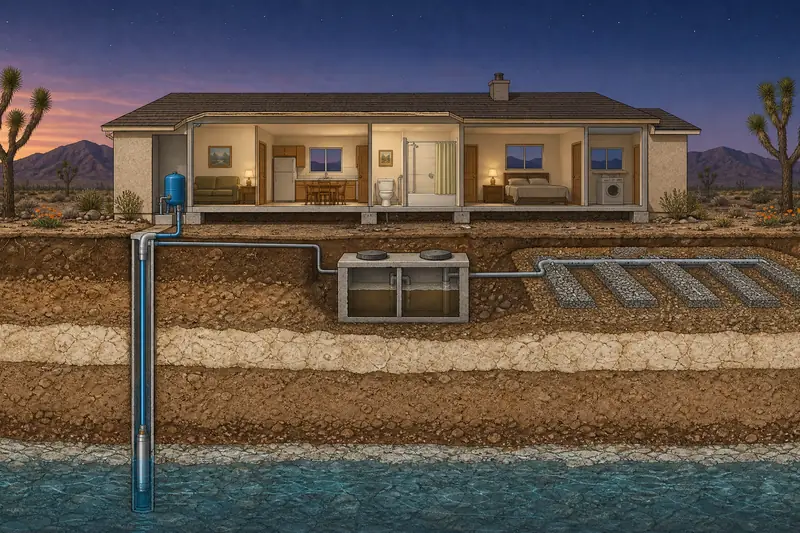
Well water testing matters because nobody else is checking a private well. Public water systems in the Antelope Valley sample their sources on a schedule and publish the results every year; a home well appears in none of those reports. The State Water Board's domestic well page says its drinking water limits "are an enforceable standard for public supply systems" and recommends that well owners "observe the same levels" at home.
The valley's groundwater gives specific reasons to look. The USGS study of the basin, publication FS 2012-3033, found arsenic above health benchmarks in 28% of the primary aquifers, the highest share of any trace element it measured, and found nitrate above benchmarks too. Most of what a well can carry, from bacteria to arsenic, has no taste or smell at the levels that count. A result on paper is the only way to know.
In Los Angeles County, the Department of Public Health's Drinking Water Program reviews and permits wells, and it defines a residential well as one serving a single home or up to four connections. Testing what comes out of that well afterward is up to the owner. In Kern County, around Rosamond, well permits go through Kern County Public Health's Environmental Health Division.
What should you test well water for?
Test an Antelope Valley well for bacteria, nitrate, arsenic, hexavalent chromium, uranium, total dissolved solids, pH and hardness. The first four on the federal list (total coliform, nitrate, TDS and pH) come from the EPA and CDC. Arsenic and uranium are named by the State Water Board, and the USGS basin study is why they matter here. Hexavalent chromium shows up in several local public wells, and hardness tells you whether a softener is worth a look.
| Test | Limit or guide | Why it is on the list here |
|---|---|---|
| Total coliform and E. coli | Should be absent | EPA, CDC and State Water Board all list bacteria first |
| Nitrate (as N) | 10 mg/L MCL | EPA and CDC yearly list; USGS found it above benchmarks in the basin |
| Arsenic | 10 µg/L MCL | USGS: high in 28% of the valley's primary aquifers |
| Hexavalent chromium | 10 µg/L state MCL (public systems) | District 40 Lancaster wells ranged from not detected to 18 µg/L in 2025 |
| Uranium | 20 pCi/L state MCL | Named in State Water Board examples; USGS found moderate levels |
| Total dissolved solids and pH | TDS: 500 mg/L recommended, 1,000 mg/L upper (secondary, taste-based) | EPA and CDC yearly list |
| Hardness | No limit (USGS classes) | Decides whether softening is worth considering |
Public-system results nearby give a hint of what the aquifer holds, but only a hint. District 40's 2026 report for Regions 4 and 34 shows its Lancaster-area wells at not detected to 9.9 µg/L for arsenic in its latest samples, and hexavalent chromium in those wells ranged from not detected to 18 µg/L in 2025. A private well drilled to a different depth can read higher or lower. The arsenic in well water page covers that metal in more depth.
Reports print micrograms per liter as "ppb" and milligrams per liter as "ppm". This guide writes µg/L and mg/L; 1 mg/L equals 1,000 µg/L.
How often should well water be tested?
Test a private well at least once a year. That interval is the same in the EPA's well page, the CDC's testing guidance and the State Water Board's domestic well page. Pick the same month each year so results compare season to season.
Test sooner when something changes. The CDC lists a change in taste, color or smell, flooding or land disturbance near the well, any repair or replacement of part of the well system, and a pregnancy or a child joining the household. The EPA adds that homes with small children or older adults may want to test more often. After a pump or pressure tank job (see the well pressure tank and pump page), a bacteria test is a sensible check.
Lab test or well water test kit?
A lab test is the one to rely on for health-related results. The CDC says plainly: "Use a state-certified laboratory to test your water." Home kits and strips can show hardness, pH or iron at a glance, which helps with routine checks, but they do not give the documented, method-based numbers you need for arsenic, nitrate, uranium or hexavalent chromium.
The State Water Board makes the same point about treatment systems: a maker's home kit can give a rough reading, but "periodic laboratory testing is needed" to confirm that nitrate is really being reduced, according to its residential treatment device page. Treat any kit result as a prompt to order a lab test, not as a substitute for one.
How do you find a certified lab in California?
Find an accredited lab through the State Water Board's Environmental Laboratory Accreditation Program. The ELAP home page links to a map that shows accredited laboratories by location, and the board's hexavalent chromium FAQ points well owners to the same list for chromium 6 testing.
When you call a lab, ask which of the tests above it is accredited for, since accreditation is by method, not blanket. Ask for a written estimate first, as the State Water Board suggests, and ask whether the lab sends bottles, collects the sample itself, or both. The board notes that a lab "will supply the sampling bottles" and can help with sampling.
How do you collect a well water sample?
Collect the sample exactly the way the lab's instructions say, in the bottles it sends, or let the lab take it. Keep fingers off the inside of caps and bottles, and ask how quickly the sample has to reach the lab, because some tests must start within a set time. Plan the collection for a day the bottles can travel straight there.
Most instructions ask for a cold-water tap that does not pass through a softener or filter, so the result reflects the well itself. If you already have treatment, a second sample after the equipment shows whether it is working; the State Water Board recommends exactly that kind of before-and-after check. Note the date, time and tap on the lab form.
When is shock chlorination needed?
Shock chlorination is the usual response when a bacteria test comes back positive, or after a well has been opened for repairs or flooded. Mississippi State University Extension publication P3398 describes the method: unscented household bleach less than six months old, a dose set by water depth and casing diameter, at least 8 hours or overnight of contact, then flushing until the chlorine smell is gone, with the runoff kept away from a septic system and plants.
Shock chlorination is a fix for a one-time contamination, not for a well that keeps testing positive; that points to a construction or wellhead problem. The same publication says the method suits wells with working submersible pumps, not jet pumps or damaged systems, and "Do not drink the water until it has been tested" again by a certified lab. If the well is near a septic system, the septic system basics page explains the parts to keep clear of.
What comes next depends on the numbers. Bacteria or nitrate over the limit is a reason to stop drinking the water and call LA County Environmental Health or Kern County Environmental Health for next steps; the State Water Board advises not drinking water with a result over a primary limit "until appropriate actions are taken". Hardness, iron or sediment are comfort problems, and the well water treatment page matches each one to a type of equipment. All the well, septic and water-heater topics are listed in all guides.
How we put this page together
This page is based on the EPA's private well page (updated February 26, 2026), the CDC's well testing guidance (July 1, 2024), the State Water Board's GAMA domestic well testing page (updated September 15, 2023), its ELAP home page (updated October 20, 2026), its residential treatment device page (updated June 27, 2025) and its hexavalent chromium FAQ, LA County Public Health's well program page, USGS publication FS 2012-3033 and LA County Waterworks District 40's 2026 report for Regions 4 and 34 (2025 data). Shock chlorination steps come from Mississippi State University Extension publication P3398. All were checked in October 2026. Left out: lab price lists, named labs, home test kit comparisons and any free testing program, since none was confirmed for the Antelope Valley.
Common questions
Does LA County test private wells for free?
No county testing service for private wells was found. LA County's Drinking Water Program reviews and permits wells and oversees small water systems with fewer than 14 connections, but well owners arrange their own tests through an ELAP-accredited lab.
Should a new Antelope Valley well be tested before anyone drinks from it?
Yes. A new or newly repaired well should get at least a bacteria test, and a full panel including arsenic, nitrate and hexavalent chromium gives a baseline for later years. The CDC lists repairs and new parts of the well system as reasons to test.
Do I need to test for hexavalent chromium if the well is only for a garden?
For irrigation only, the drinking water panel matters less, though nitrate and TDS still tell you about the aquifer. If the well ever supplies the house, test for hexavalent chromium as well, since California's 10 µg/L limit does not cover private wells and nobody else will check.
What does "ND" mean on a well report?
ND means not detected: the lab did not find the substance above its reporting limit for that method. It does not always mean zero, so compare the reporting limit with the health limit for that contaminant.
How long do well test results take?
It depends on the lab and the test. Bacteria results usually come back in days, while metals and uranium can take longer. Ask the lab for its turnaround when you order.
Is a home test kit enough before buying a softener?
A kit can show hardness well enough to size a softener, but it does not show arsenic, nitrate or bacteria, which a softener would not treat anyway. Get the lab panel first, then choose equipment.
Can a landlord skip testing a domestic well?
Not always. State law AB 2454 (2024) requires owners of domestic wells serving rentals inside a State Water Board funded testing program to test through that program and share the results. Whether such a program covers a given Antelope Valley property was not confirmed; check the State Water Board's domestic well testing page.
More on wells
More help: see our Antelope Valley water, wells and septic guide.