
Pipes & leaks
Repipe Cost: PEX vs Copper and Reroutes
Repipe cost depends on the number of fixtures, the pipe material, how walls are opened and patched, and the permit; no agency publishes a price, so itemized written quotes are the real benchmark.
On this page
Key takeaways
- No government or standards body publishes repipe prices; this guide lists what a quote should break out instead of quoting national averages.
- California licenses repipe work under the C-36 plumbing class, and since 2025 a license is required once a job reaches $1,000 counting labor, materials and everything else (CSLB, AB 2622).
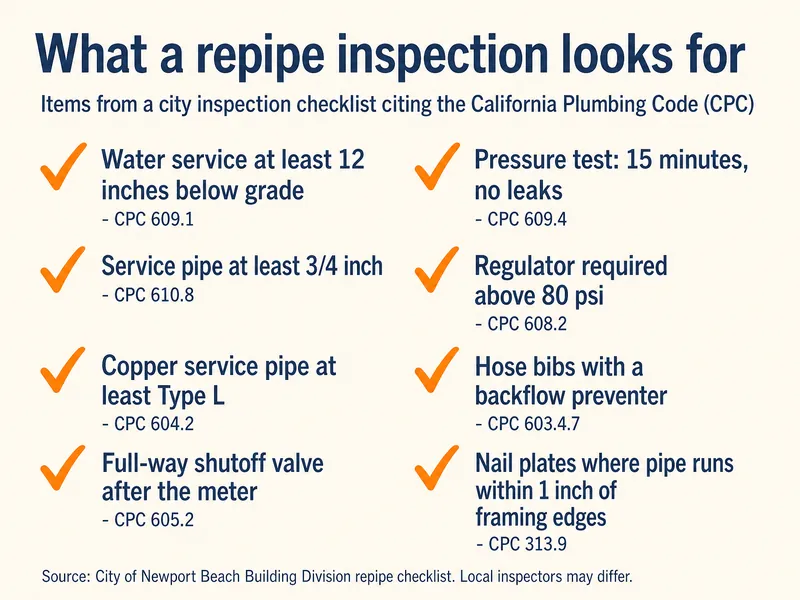
- A City of Newport Beach repipe inspection checklist cites California Plumbing Code rules such as a 15-minute pressure test and a regulator where pressure exceeds 80 psi.
- EPA defines galvanized pipe as iron or steel "dipped in zinc to prevent corrosion and rusting" (EPA's service line inventory summary); lead pipes are most likely in homes built before 1986.
- Under federal law, "lead-free" plumbing has been limited to a 0.25 percent weighted-average lead content since the 2011 Safe Drinking Water Act changes (EPA).
- In LA County, "new, expanded, or replaced plumbing items" need a permit (LA County Public Works).
Rules that shape a repipe
- $1,000Job size (labor, materials and all items) at or above which a California contractor's license is requiredCSLB
- 15 minutesMinimum leak-free pressure test of the new water piping, per the inspection checklistCity of Newport Beach (CPC 609.4)
- 80 psiPressure above which a regulator is required, per the inspection checklistCity of Newport Beach (CPC 608.2)
- 0.25%Maximum weighted-average lead content of "lead-free" pipes and fittingsEPA
What does a whole house repipe cost?
A whole house repipe cost is set by the size of the house, the number of fixtures, the pipe material, and how much wall and ceiling has to be opened and patched; this guide found no agency price to quote. National cost websites publish ranges, but they are averages of unknown jobs, not a price for a 1,600-square-foot slab house in Palmdale with two bathrooms.
The better benchmark is two or three written quotes built on the same scope. Ask each contractor to list:
- Number of fixtures and outlets connected (sinks, toilets, tub and shower valves, washer box, water heater, hose bibs).
- Pipe material and fitting type, with the brand or standard.
- Main line from the meter or house valve: included or not.
- Wall and ceiling openings, who patches drywall, and whether texture and paint are included.
- Permit, inspections, and who schedules them.
- Shutoff valves at each fixture, and a new main shutoff valve.
- Cleanup, debris hauling, and any warranty on labor.
A job of $1,000 or more in labor and materials must be done by a licensed contractor in California, and CSLB caps a sensible down payment at one tenth of the price. The hiring guide covers license checks and contract terms.
PEX vs copper: which is better for a repipe?
Neither PEX nor copper is better for every house: both are used for repipes, and the choice comes down to the route the pipe has to take, the budget, and the installer's experience with each. PEX is flexible plastic tubing joined with crimp, clamp or expansion fittings, so long runs can snake through an attic with few joints. Copper is rigid metal joined by soldering or press fittings, with more joints where it changes direction.
| Point | PEX | Copper |
|---|---|---|
| Form | Flexible plastic tubing on rolls | Rigid metal lengths |
| Joints | Crimp, clamp or expansion fittings | Soldered or press fittings |
| Routing | Bends around framing; fewer fittings on long runs | Needs fittings at most turns |
| Attic runs | Must be protected from damage and supported to code | Same, plus hot lines insulated |
| Lead content | Fittings must meet the federal "lead-free" limit | Solder and fittings must meet the federal "lead-free" limit |
Hardness matters less than people expect for this choice. Antelope Valley city water is moderately hard (roughly 63 to 116 mg/L in the 2025 reports, 3.7 to 6.8 gpg), and EPA notes that metal corrosion is worst in water with "high acidity or low mineral content". The Antelope Valley hardness page lists every system.
When should galvanized pipe be replaced?
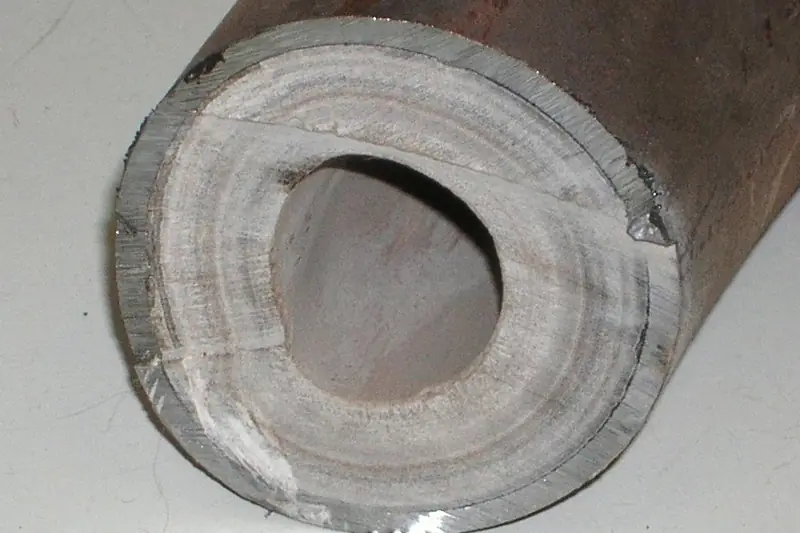
Galvanized pipe should be replaced when it shows the usual signs of age: rusty or brown water from a tap after it sits, falling pressure at fixtures, or leaks at threaded joints. EPA defines a galvanized line as iron or steel that has been dipped in zinc to prevent corrosion and rusting; as the zinc wears, the steel underneath rusts and scale builds up inside.
There is also a lead question. Under the federal Lead and Copper Rule Improvements, a galvanized service line that "currently is or ever was downstream of a lead service line" must be replaced by the water system, because it can hold lead. EPA's lead sources page says lead pipes "are more likely to be found in older cities and homes built before 1986." Antelope Valley systems reported low lead results in their latest reports (for example, Palmdale Water District's 90th-percentile result was not detected across 50 sites in 2024), but a house's own plumbing is not in those numbers. EPA puts a home lead test at $20 to $100.
What is polybutylene pipe and is it a problem?
Polybutylene is a flexible plastic water supply pipe, usually gray, that is no longer installed in new homes, and its reputation for leaking at fittings is the reason it comes up in home sales. This guide found no current agency publication on its failure rate, so it gives no numbers. Owners who find it often choose to repipe on their own schedule rather than wait for a leak.
A home inspector or licensed plumber can confirm the material from the markings printed on the pipe. If it is present, ask the insurer how it affects coverage before the next renewal; the slab leak guide covers how policies treat sudden versus gradual water damage.
What is a water line reroute?
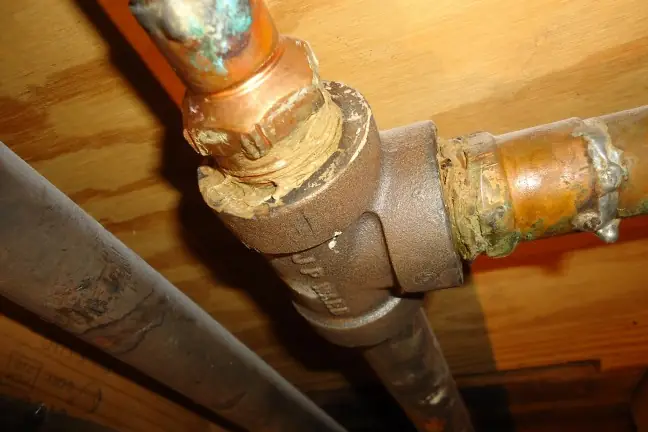
A water line reroute replaces one leaking or failing section of pipe with a new run along a different path, usually up through a wall and across the attic, and caps the old line in place. It is the most common answer to a slab leak under a finished floor, because it avoids breaking concrete.
Attic runs in the high desert face real cold: Lancaster's Fox Field averages close to 68 freezing nights each winter season in NOAA's 1991–2020 normals. Ask how attic lines will be insulated and supported, and where the new line drops into each wall. The frozen pipe guide explains which runs freeze first.
How long does a repipe take?
A repipe takes from a day for a short reroute to several days for a whole house, plus time for inspections and drywall repair. The schedule depends on the number of fixtures, access in the attic, and how quickly the inspection can be booked.
Water is usually shut off only while connections are being made, so a household can often stay in the home during the work. In unincorporated LA County, a permit expires if work has not started within 12 months of issue or stops for more than 180 days, according to LA County Public Works. The California Plumbing Code and permits page explains which office issues permits for Lancaster, Palmdale and unincorporated areas.
How we put this page together
This page is based on CSLB's AB 2622 announcement (December 30, 2024), a City of Newport Beach Building Division copper repipe checklist that cites California Plumbing Code sections, EPA's basic information on lead in drinking water and its October 2024 LCRI service line inventory summary, LA County Public Works permit pages, Palmdale Water District's 2025 CCR (lead result) and NOAA NCEI 1991–2020 normals for Lancaster. Checked in October 2026. Left out: price ranges from cost websites, polybutylene failure statistics (no agency source found), and claims that PEX or copper lasts a set number of years.
Common questions
Can a house be repiped without opening every wall?
Not usually, but the openings can be small. Installers cut access holes where the pipe enters each fixture wall and run lines through the attic, then patch the holes; ask how many openings the quote assumes.
Does a repipe need a permit in the Antelope Valley?
Replacing pipes counts as replaced plumbing, which needs a permit from the building department for the address. Only leak repairs that replace no pipe are exempt under LA County's Title 28.
Is PEX allowed in attics?
PEX is used in attic runs, with support and protection that meet the plumbing code and the maker's instructions. Ask the installer how the runs will be supported and insulated against freezing.
Should the main line from the meter be replaced too?
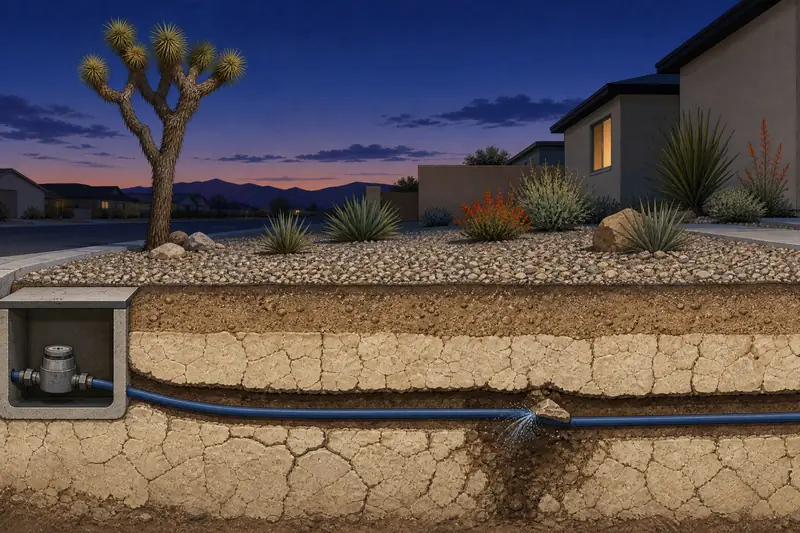
Often it is worth pricing separately, because the main from the meter to the house is a different job from the interior lines. A meter that moves with the house valve closed points to a leak in that main.
Is galvanized pipe dangerous?
Galvanized pipe is not lead, but EPA notes it can hold lead deposits when it sat downstream of a lead service line. A lab test of first-draw water tells more than the pipe's age; EPA puts lead testing at $20 to $100.
How many quotes should a homeowner get?
Two or three itemized quotes on the same scope make the prices comparable. Check each contractor's C-36 license on the CSLB site before signing.
Will a repipe raise water pressure?
It can restore flow lost to scale inside old pipe, but pressure is set by the supply and the regulator. If pressure is still low after a repipe, test it at a hose bib with a gauge.
Related guides
More help: see our Antelope Valley home water guide.