
Water heaters
Water Heater Earthquake Straps: California Rules
Water heater earthquake straps are required by California law on every new or replacement heater, and the plumbing code places one strap in the upper third of the tank and one in the lower third.
On this page
Key takeaways
- California Health and Safety Code sections 19210–19217 require any new or replacement water heater sold on or after July 1, 1991 to be braced, anchored or strapped, as summarized in the State Architect's water heater bracing guidelines.
- A home seller must certify to the buyer in writing that the water heater bracing requirements are met.
- Plumbing code section 507.2 sets one strap in the top third and one in the bottom third, keeping the lower strap 4 or more inches clear of the controls (San Bernardino County excerpts).
- The state guidelines call for at least two sets of straps; heaters of 53 to 75 gallons need a third set at mid-height, and anything over 75 gallons needs local approval.
- The Division of the State Architect "strongly recommends" flexible connectors on the water, gas and electrical lines.
- DSA certifies earthquake-sensitive gas shutoff valves, but installing one is up to local building departments.
California strapping rules in numbers
- July 1, 1991Date from which new and replacement water heaters sold in California must be braced, anchored or strappedDivision of the State Architect
- 2 setsMinimum number of bracing straps under California's building and plumbing codesDivision of the State Architect
- 4 inMinimum gap between the heater's controls and the lower strap (CPC 507.2)San Bernardino County Building and Safety
- 75 gallonsLargest heater the state's standard bracing details cover, with a third strap at mid-heightDivision of the State Architect
Why do California water heaters need earthquake straps?
California water heaters need earthquake straps because an unbraced tank can walk or tip over in strong shaking. The Division of the State Architect's guidelines say that in past earthquakes, unanchored heaters "moved or tipped over", and the movement caused gas line leaks, water line leaks and damaged electrical wiring. A full 40- or 50-gallon tank is heavy, and the pipe feeding it gas is the weak point.
The law applies statewide, high desert included. Homes in Lancaster, Palmdale, Quartz Hill and Rosamond follow the same strapping rules as homes on the coast, and a heater replaced under permit is inspected against them. The replacement cost guide lists the other code items a new install has to meet.
What does California law require for water heater strapping?
California law requires water heaters to be braced, anchored or strapped to resist falling or sideways movement in an earthquake. The State Architect's guidelines summarize Health and Safety Code sections 19210–19217 this way: any new or replacement water heater sold in California on or after July 1, 1991 must be strapped when installed, and the seller of any real property with a water heater must certify in writing to the buyer that the bracing requirements have been met.
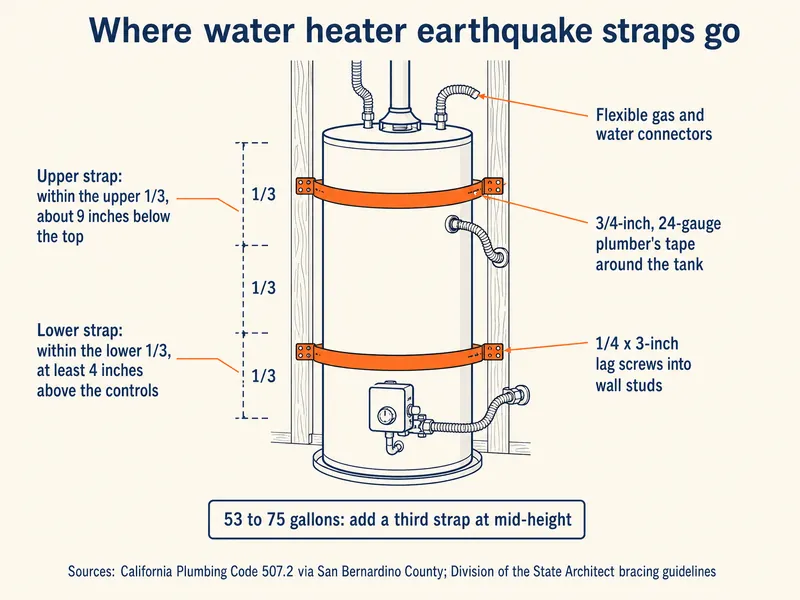
The plumbing code sets where the straps go. California Plumbing Code section 507.2, as reprinted by San Bernardino County's Building and Safety Division, says strapping "shall be at a point within the upper 1/3 and the lower 1/3 of the water heater's vertical dimensions", with at least 4 inches between the controls and the lower strap. The DSA guidelines add that the codes require "a minimum of two sets of bracing straps".
Local departments can add to this. The DSA details cover heaters up to 52 gallons as drawn, up to 75 gallons with a third set of straps at mid-height, and anything larger only with local building department approval. Attic installs and heaters not next to a wall are outside the guidelines entirely. The plumbing code and permits page explains which office covers which address.
Where do the straps go?
The straps go around the tank in its upper third and lower third and anchor into wall studs, not drywall. The DSA plumber's tape method marks the upper strap about 9 inches below the top of the heater and the lower strap 4 inches above the top of the controls, then wraps each with 3/4-inch, 24-gauge perforated steel strapping fixed to studs with 1/4-inch by 3-inch lag screws and washers.
| Detail | Requirement or method | Source |
|---|---|---|
| Strap height | One in the top third of the tank, one in the bottom third | CPC 507.2 |
| Lower strap clearance | 4 inches or more between controls and strap | CPC 507.2 |
| Number of straps | At least two sets; a third at mid-height for 53 to 75 gallons | DSA guidelines |
| Strap material | 3/4-inch, 24-gauge perforated steel (plumber's tape) | DSA guidelines |
| Wood wall fastening | 1/4-inch by 3-inch lag screws with washers, in 3/16-inch pilot holes in studs | DSA guidelines |
| Concrete or block wall | Anchor bolts at least 3/8 inch, 2 inches embedment, never in hollow block cells | DSA guidelines |
| Over 75 gallons | Bracing approved by the local building department first | DSA guidelines |
The geometry matters. In a corner, the guidelines want the line between the two support studs to pass through the tank with at least 7 inches from that line to the front of the heater; on a straight wall the heater must sit at least 2-1/2 inches out, with wood 2x4 ledgers behind the straps. The tape must be pulled taut. Gas heaters in garages usually sit on a platform so the burner is 18 inches off the floor, and DSA recommends securing the heater to the platform and the platform to the floor or walls.
Can you install water heater straps yourself?
Yes, a homeowner can strap an existing water heater; the State Architect's guidelines are written as step-by-step instructions with a materials and tools list, and they note that pre-made strapping kits are sold at hardware and home improvement stores as an alternative. The tools are basic: a drill, a 3/16-inch bit, a stud finder, a tape measure and a wrench.
Two cautions apply. If the heater is being replaced, strapping is part of the permitted job and the inspector will check it, so the contractor doing the swap should include it. And if strapping would mean moving the heater, stop: shifting a tank strains its gas connector, which is the risk covered next. Under the state's small-job law, AB 2622, a licensed contractor is needed for any paid job that requires a permit.
What is a flexible gas connector?
A flexible gas connector is the corrugated metal tube that joins a gas appliance to the fixed gas pipe, letting the heater shift slightly without snapping the line. The DSA guidelines "strongly" recommend code-compliant flexible connectors between the water heater and its water, gas and electrical lines, because rigid connections are what break when a tank moves.
Older connectors can be a hazard on their own. The federal Consumer Product Safety agency, CPSC, warns that some older uncoated brass connectors have end pieces that can separate from the tubing, and that any uncoated brass connector "should be replaced immediately" with a plastic-coated brass or stainless steel one. CPSC also says only a qualified professional should check or replace a connector, that even moving the appliance to look can cause an old one to fail, and that connectors should always be replaced when the appliance is replaced or moved.
Do you need an earthquake gas shutoff valve?
An earthquake gas shutoff valve is optional unless the local building department says otherwise. The Division of the State Architect certifies two kinds for homes, earthquake-sensitive shutoff valves (ESV) and excess flow valves (EFV), but its certification page states that "the installation of gas valves is under the jurisdiction of the local building departments". Its current lists are the 2019 certified ESV list, updated April 29, 2025, and the 2026 certified EFV list, updated October 1, 2026.
An ESV shuts off gas to the whole house when it senses strong shaking; an excess flow valve closes when gas flows faster than it should, as through a broken line. Either goes on the gas piping, so ask the city or county building department whether a permit is needed and use a model from the DSA list. If gas is ever smelled after a quake, CPSC's advice is to leave the house, then call the gas supplier or 911 from a neighbor's house without switching anything on.
How we put this page together
This page is based on the Division of the State Architect's Guidelines for Earthquake Bracing of Residential Water Heaters (revised August 11, 2004, hosted on the state's seismic safety site, ssc.ca.gov), the California Plumbing Code excerpts in San Bernardino County's water heater handout (Rev. 01/20), the DSA gas shutoff valve certification page, a CPSC notice on older gas connectors, and the CSLB notice on AB 2622. Sources were opened in October 2026. Health and Safety Code section 19211 is described through the DSA's summary, because the legislature's site blocked direct access when this page was written. Left out: kit brand recommendations, any city-specific shutoff valve mandate not confirmed in a local code, and strapping costs.
Common questions
Do existing water heaters in older homes have to be strapped?
When a home is sold, the seller must certify in writing that the water heater bracing requirements are met, so an unstrapped heater usually gets strapped before closing. Strapping an older heater is also simple protection whatever the law requires.
Is plumber's tape strong enough?
It is the method the State Architect's guidelines specify: 3/4-inch, 24-gauge perforated steel strapping, two pieces per strap, screwed into studs and pulled taut. Pre-made kits are the alternative.
Can straps be screwed into drywall alone?
No. The DSA methods anchor into wood studs with lag screws, or into concrete or block with anchor bolts at least 3/8 inch across. Drywall will not hold a tank in an earthquake.
What about a tankless heater on the wall?
The DSA bracing guidelines cover tank heaters from 30 to 75 gallons. A wall-hung tankless unit mounts to the wall per its maker's instructions; ask the building department what it checks.
Does a 75-gallon heater need more straps?
Yes. The State Architect's details are drawn for 52 gallons or less; for heaters up to 75 gallons, add a third strap set at mid-height. Above 75 gallons the local building department must approve the bracing.
Should the gas connector be replaced when a heater is strapped?
If it is an old uncoated brass connector, CPSC says to have a qualified professional replace it with a coated brass or stainless steel one. It should always be replaced when the heater is replaced or moved.
Where are the DSA lists of certified gas shutoff valves?
On the DSA's gas shutoff valve certification page, which links the certified earthquake-sensitive valve list (updated April 29, 2025) and excess flow valve list (updated October 1, 2026).
Related reading
More help: see our Antelope Valley home water guide.