
Water heaters
Tankless Water Heater Cost, Pros and Cons
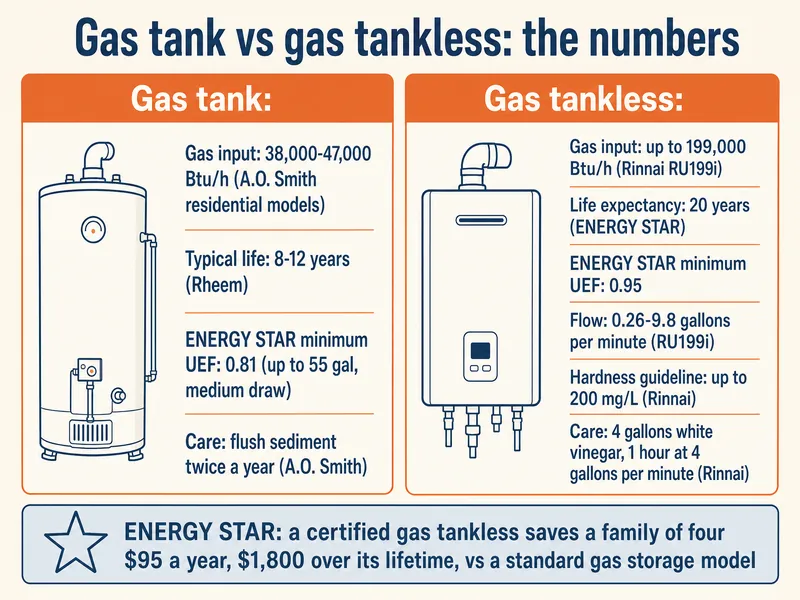
Tankless water heater cost runs above a tank swap mainly because a whole-home gas unit can burn up to 199,000 Btu per hour, roughly four to five times a typical tank, which often means new gas piping and venting.
On this page
Key takeaways
- Rinnai's RU199i is rated for up to 199,000 Btu per hour; A.O. Smith's residential gas tanks in manual 326940 run 38,000 to 47,000.
- ENERGY STAR estimates a certified gas tankless heater saves a family of four $95 a year, or $1,800 over its lifetime, on gas bills compared with a standard gas storage model.
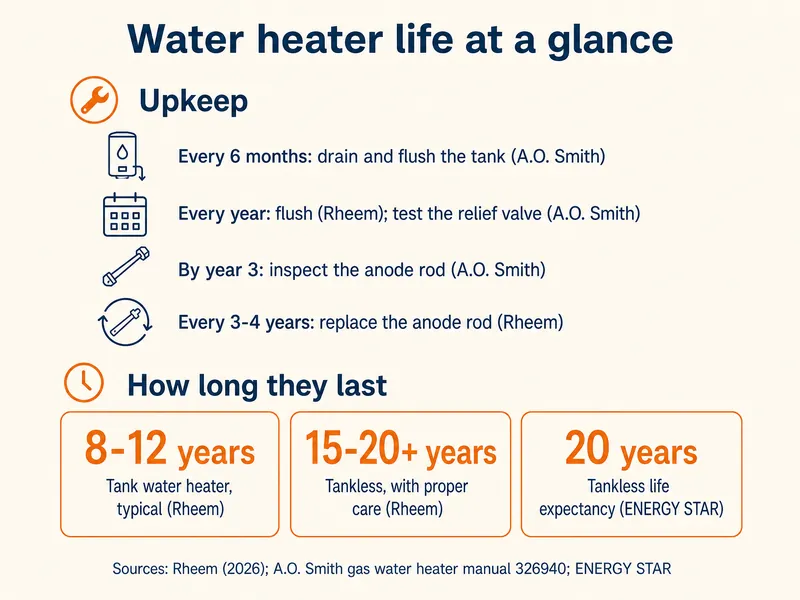
- ENERGY STAR gives tankless heaters a 20-year life expectancy; Rheem puts tanks at 8 to 12 years.
- Rinnai's water quality guideline for these units lists total hardness up to 200 mg/L; some Antelope Valley well results run higher.
- Descaling takes 4 gallons of white vinegar pumped through the heat exchanger for at least an hour, per Rinnai's manual.
- In a power failure on a freezing night, Rinnai says the heater should be drained by hand to prevent freeze damage.
Tankless by the numbers
- 199,000 Btu/hMaximum gas input of Rinnai's RU199i whole-home tankless heaterRinnai installation manual
- $95 a yearGas bill savings ENERGY STAR estimates for a family of four, certified gas tankless vs a standard gas storage heater ($1,800 over its lifetime)ENERGY STAR
- 0.95Minimum uniform energy factor for an ENERGY STAR gas tankless heater (gas storage up to 55 gallons, medium draw: 0.81)ENERGY STAR
- 20 yearsTankless water heater life expectancyENERGY STAR
How much does a tankless water heater cost?
A tankless water heater costs more to install than a like-for-like tank swap, but no agency publishes installed prices for California, so this guide does not quote a range. The price is the unit plus whatever the house needs to feed it: larger gas piping, new venting, a condensate drain, a power outlet, isolation valves and a permit. Ask each contractor to price those lines separately so quotes can be compared.
The permit side is public. LA County Public Works says a permit is required for any water heater installation or replacement, and Palmdale's fee schedule effective July 1, 2025 lists $35.50 to issue a plumbing permit plus a $22.25 per-heater charge. The replacement cost guide covers permits, code items and the repair-or-replace question for any heater type.
Running cost is where tankless earns back some of the difference. ENERGY STAR's estimate is $95 a year, or $1,800 over the heater's lifetime, in gas savings for a family of four with a certified tankless unit compared with a standard gas storage model, and $20 a year compared with a non-certified tankless heater. Actual savings depend on the household's hot water use and gas rates.
Why does tankless installation cost more than a tank?
Tankless installation costs more because the heater burns gas at a much higher rate for short bursts. Rinnai's installation manual lists 130,000 to 199,000 Btu per hour across its RU series, against a range of 38,000 to 47,000 for the A.O. Smith tank models in its residential gas manual. Gas piping sized for a tank often cannot carry that load alongside a furnace, range and dryer.
Rinnai's manual tells installers to size the pipe from the total gas input of every appliance on the line, using the table in the applicable code. In the NFPA 54 example it reprints, a 20-foot run of 1/2-inch natural gas pipe carries 118 cubic feet of gas per hour, while 3/4-inch pipe carries 247. That gap is why many tankless jobs include new gas line work.
Venting and power add more. Condensing models like the RU series vent through PVC or polypropylene and produce acidic condensate that needs a 1/2-inch drain line, with an optional neutralizer; indoor models need a grounded 120-volt outlet. Rinnai also strongly recommends isolation valves so the heat exchanger can be flushed. Each item is labor a tank swap usually skips.
What are the pros and cons of a tankless water heater?
The main pros of a tankless water heater are endless hot water within its flow rating, lower gas use and a longer life; the cons are a higher install cost, a power requirement and regular descaling. The table sets out each point with its source.
| Point | Tankless (gas, condensing) | Gas tank | Source |
|---|---|---|---|
| Life expectancy | 20 years | 8–12 years | ENERGY STAR; Rheem |
| Gas input | Up to 199,000 Btu/h (RU199i) | 38,000–47,000 Btu/h | Rinnai; A.O. Smith 326940 |
| ENERGY STAR efficiency floor (UEF) | 0.95 | 0.81 (up to 55 gal, medium draw) | ENERGY STAR criteria |
| Hot water supply | Continuous up to 9.8 gallons per minute (RU199i) | Limited by tank size and recovery | Rinnai |
| Ignition and power | Grounded 120-volt outlet for indoor models | Push-button spark igniter and a thermopile on the pilot (manual 326940 models) | Rinnai; A.O. Smith |
| Scale care | Vinegar descaling at least yearly | Sediment flush twice a year to once a year | Rinnai; A.O. Smith; Rheem |
A tankless heater also has a minimum flow. The RU-series spec table lists a flow range starting at 0.26 gallons per minute, so a trickle from a faucet may not fire the burner. Hot water is endless only while demand stays under the rated maximum; two showers and a dishwasher at once can exceed what a smaller model delivers.
How does hard water affect a tankless heater?
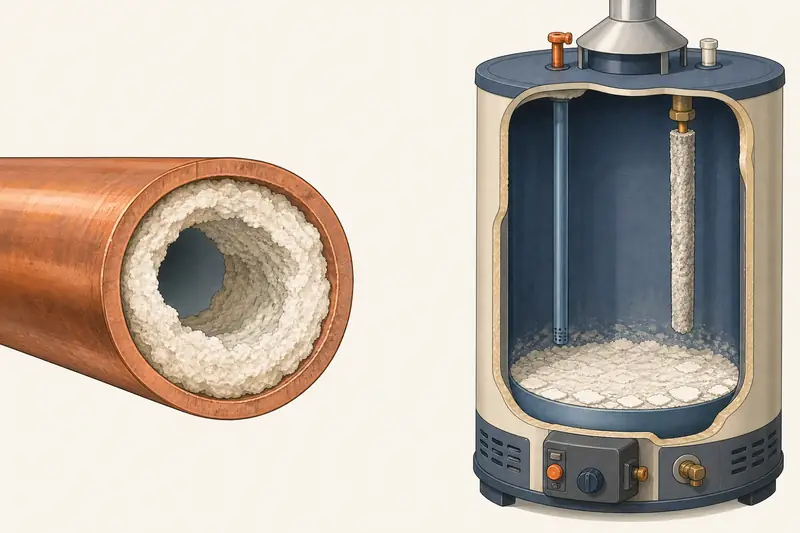
Hard water leaves scale inside a tankless heat exchanger, and the maker treats that as the owner's problem. Rinnai's manual excludes lime build-up damage from the warranty and tells owners in hard-water areas to treat the water, flush the heat exchanger on a schedule, or both. Its water quality table lists total hardness "up to 200 mg/L".
Valley city water sits well under that line. The suppliers' 2025 reports give averages of 63.3 mg/L in Quartz Hill, 98 mg/L for District 40's Lancaster wells and 111 to 116 mg/L for Palmdale Water District, all moderately hard on the USGS scale. Wells are the exception: single District 40 well results in Lancaster reached 320 mg/L (Regions 4 and 34 report, 2025 data), and Leona Valley's Cal Water wells averaged 247 mg/L. A home on a private well should test before choosing tankless; the well testing guide explains how.
Descaling follows Rinnai's routine: close the isolation valves, pump 4 gallons of undiluted white vinegar through the heater for at least an hour at 4 gallons per minute, then rinse for five minutes. Rinnai's consumer flushing page says to do it at least once a year. The flushing guide walks through both tank and tankless methods.
How much energy does tankless save?
Tankless saves energy mainly by not keeping a tank of water hot around the clock. ENERGY STAR's certification criteria show the gap: a certified gas tankless heater must reach a uniform energy factor of 0.95, while a certified gas storage heater of 55 gallons or less needs 0.81 for a medium draw pattern or 0.86 for high draw.
In dollars, ENERGY STAR's estimate is the $95 a year and $1,800 lifetime figure for a family of four against a standard gas tank. This guide makes no payback claim, because the install cost difference varies too much from house to house to set against that figure. A smaller household that uses less hot water saves less.
When is a tank the better buy?
A tank is often the better buy when the gas line, vent path or budget would make a tankless conversion expensive, or when hot water use is low. A like-for-like tank swap reuses the existing gas line, vent and location, which keeps labor and code work down.
Freezing nights matter too. NOAA's 1991–2020 normals for Lancaster's Fox Field show 67.9 nights a year at or below 32 °F on average. Rinnai says its heaters protect themselves from freezing only while connected to 120-volt power, and that if power or gas fails below freezing the heater should be drained by hand, along with its condensate trap and relief valve. Homes with exposed heaters or frequent outages should weigh that; the frozen pipe guide covers the rest of the house.
How we put this page together
This page uses the Rinnai RU-series manual for condensing tankless heaters (specifications, gas sizing, water quality, freeze protection and flushing sections), Rinnai's consumer flushing page, A.O. Smith's residential gas manual 326940, ENERGY STAR's tankless benefits page and residential water heater criteria, Rheem's lifespan article (March 2026), LA County Public Works and City of Palmdale permit pages, NOAA 1991–2020 normals for Lancaster, and the 2025 hardness figures from Antelope Valley suppliers' reports. Each was checked in October 2026. Left out on purpose: installed price ranges from cost surveys and contractor sites, percentage savings claims not tied to a named source, and payback periods.
Common questions
Does a tankless heater need a bigger gas line?
Often. Rinnai sizes gas pipe from the total input of every gas appliance on the line, and its RU199i alone can draw 199,000 Btu per hour. The installer checks the existing pipe against the code table before quoting.
Will a tankless heater work during a power outage?
Indoor RU-series models need a 120-volt outlet to run, so plan on no hot water during an outage. On freezing nights without power, Rinnai says to drain the heater.
Is Antelope Valley city water too hard for a tankless heater?
The 2025 city and district averages, about 63 to 116 mg/L, are under the 200 mg/L in Rinnai's guideline. Regular descaling is still required, and some wells test far harder.
Does tankless installation need a permit?
Yes. LA County Public Works says a permit is required for any water heater installation or replacement, and Lancaster, Palmdale and Kern County run their own permit offices.
How long does a tankless heater last compared with a tank?
ENERGY STAR gives tankless heaters a 20-year life expectancy; Rheem puts tank heaters at 8 to 12 years and tankless at 15 to 20+ years with proper care.
Why does a faucet sometimes run cold with a tankless heater?
Each heater has a minimum flow before the burner fires: 0.26 gallons per minute for Rinnai's RU series. A very low trickle may not reach it.
What does the ENERGY STAR savings figure compare?
A certified gas tankless heater against a standard gas storage heater, for a family of four: $95 a year, $1,800 over the heater's lifetime, on gas bills.
Keep reading
More help: see our home page on Antelope Valley home water.