
Pipes & leaks
How to Prevent Frozen Pipes in the High Desert
How to prevent frozen pipes in the Antelope Valley: drain and cover outdoor faucets, insulate exposed lines, drip taps on hard-freeze nights, and keep the heat at 55 °F or higher when away.
On this page
Key takeaways
- Lancaster's Fox Field logs 67.9 freezing nights (32 °F or colder) in an average year and 9.4 nights of 20 °F or colder, per NOAA's 1991–2020 normals; Palmdale Airport logs 53.7 and 2.5.
- December and January carry the most freeze nights: 19.9 and 18.0 on average at Fox Field, 17.5 and 15.7 at Palmdale Airport.
- The American Red Cross lists outdoor hose bibs, sprinkler lines and pipes in unheated garages, attics and cabinets as the ones that freeze most often.
- The Red Cross says to keep the heat no lower than 55 °F when away, and never to thaw a pipe with a blowtorch, kerosene or propane heater, or other open flame.
- Palmdale Water District names the garden hose on a hose bib as a common household cross-connection, so remove hoses for winter.
- If a pipe can't be found or thawed, the Red Cross advice is to call a licensed plumber.
Freeze nights in the Antelope Valley (NOAA 1991–2020 normals)
- 67.9Average yearly count of 32 °F-or-colder nights, Lancaster Wm J Fox FieldNOAA NCEI
- 9.4Average yearly count of 20 °F-or-colder nights, Lancaster Wm J Fox FieldNOAA NCEI
- 53.7Average yearly count of 32 °F-or-colder nights, Palmdale AirportNOAA NCEI
- 55 °FLowest thermostat setting the Red Cross advises when away in cold weatherAmerican Red Cross
Do pipes really freeze in the Antelope Valley?
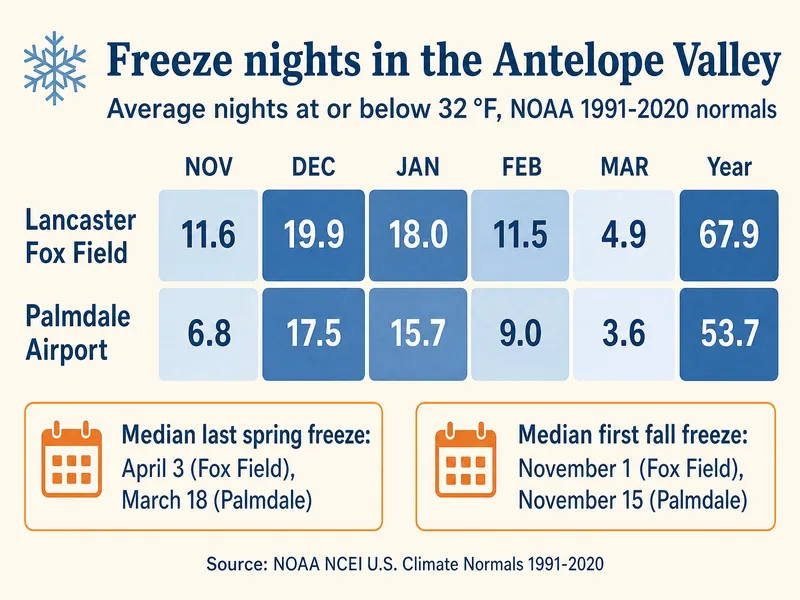
Yes: the valley floor freezes often enough that exposed pipes are at real risk most winters. In NOAA's 1991–2020 climate normals, the low drops to 32 °F or below on 67.9 nights in a typical year at Lancaster's Wm J Fox Field and on 53.7 at Palmdale Airport. Nights of 20 °F or colder average 9.4 a year at Fox Field and 2.5 at Palmdale Airport.
The freeze season is long. The median last freeze of spring at Fox Field falls on April 3 and the median first freeze of fall on November 1; at Palmdale Airport the dates are March 18 and November 15. These are averages for two airport stations, so a home in a low spot, on a slope or up toward the foothills can run colder or warmer. This guide does not give a single temperature at which pipes burst: it depends on the pipe, its exposure and how long the cold lasts.
| Station | Nov | Dec | Jan | Feb | Mar | Year |
|---|---|---|---|---|---|---|
| Lancaster Wm J Fox Field | 11.6 | 19.9 | 18.0 | 11.5 | 4.9 | 67.9 |
| Palmdale Airport | 6.8 | 17.5 | 15.7 | 9.0 | 3.6 | 53.7 |
Which pipes freeze first?
The pipes that freeze first are the ones outside the heated part of the house. The Red Cross lists outdoor hose bibs, swimming pool supply lines and sprinkler lines; supply pipes in unheated spaces such as attics, garages, crawl spaces and kitchen cabinets; and pipes that run against exterior walls with little or no insulation.
High-desert homes add a few of their own:
- Evaporative cooler lines. The small supply line that runs up to a roof cooler sits fully exposed through winter.
- Backflow assemblies. Irrigation and some service lines carry an above-ground backflow assembly, a cluster of valves and test cocks that holds water in the open air.
- Attic runs. A repipe or reroute through the attic puts lines above the insulation; the repipe guide covers how they should be protected.
- Garage water heater and softener lines. Exposed copper and plastic lines in a garage chill fast when the door stays open.
How do you prevent frozen pipes before a freeze?
To prevent frozen pipes, do the outdoor work before the first freeze in November, then add a few steps on the coldest nights. The Red Cross list, in order of when it matters:
- Before the season: drain pool and sprinkler supply lines as the maker or installer directs, and don't add antifreeze unless directed. Remove, drain and store hoses; close the inside valves that feed hose bibs and leave the outside bibs open to drain.
- Insulate: add insulation to attics and crawl spaces, and fit pipe sleeves or UL-listed heat tape or heat cable to exposed lines in garages and under cabinets.
- On freeze nights: keep garage doors closed if water lines run there, open kitchen and bathroom cabinet doors so warm air reaches the pipes, and let cold water drip from a faucet served by exposed pipes.
- Keep heat steady: hold the same thermostat setting day and night, and if leaving in cold weather, keep the heat on at no lower than 55 °F.
For the cooler, shut its supply valve and drain the line once the cooling season ends. For a backflow assembly, ask the irrigation installer or a certified backflow tester how it should be drained or insulated. Palmdale Water District runs a cross-connection program with annual tests for the assemblies it oversees, so check the rules for the account before taking one apart.
Do outdoor faucet covers work?
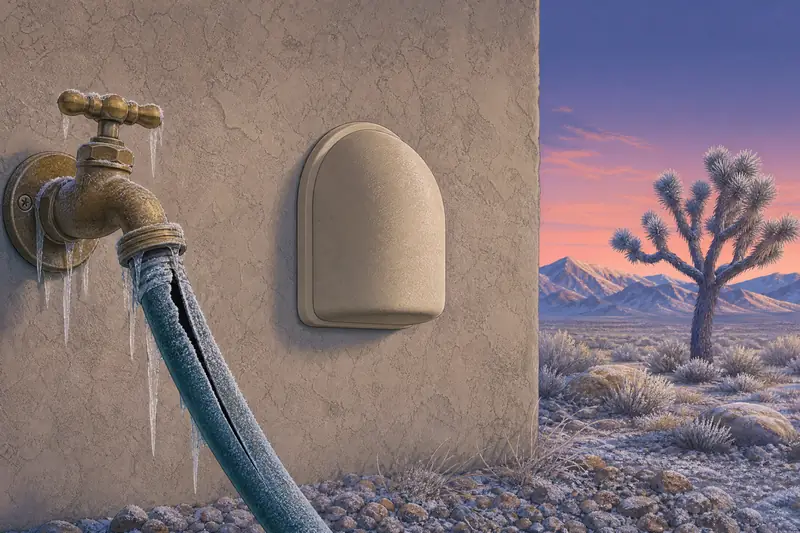
Outdoor faucet covers help, but only as the last layer: an insulated cover slows heat loss from the bib, while draining the line does the real protecting. A cover over a full, pressurized pipe on a 20 °F night can still freeze if the line behind it is exposed.
The Red Cross approach is to close the inside shutoff that feeds the bib, open the bib so the trapped water drains, and leave it open so any water left can expand without splitting the pipe. A cover then shields the drained bib from wind. A frost-free sillcock (a bib whose valve seat sits inside the wall) helps too, but only if the hose comes off so the stem can drain.
How do you winterize an outdoor faucet?
To winterize an outdoor faucet, remove the hose, shut the valve that feeds the bib from inside, open the bib to drain it, and fit an insulated cover. If there is no separate shutoff for the bib, a licensed plumber can add one.
Removing the hose matters for more than freezing. Palmdale Water District describes a hose bib used with a garden hose as one of the common cross-connection points in home plumbing, where a hose left in a bucket or a pool could siphon water back into the system. The California Plumbing Code calls for hose bibs to have a backflow preventer, as a City of Newport Beach inspection checklist notes (CPC 603.4.7).
How do you thaw frozen pipes safely?
To thaw a frozen pipe, open the faucet it feeds and warm the frozen section gently until full pressure returns. The Red Cross says a trickle from a faucet is the clue; likely spots are against exterior walls or where the water service enters the house.
Safe heat sources, per the Red Cross, are an electric heating pad wrapped around the pipe, an electric hair dryer, a portable space heater kept away from anything flammable, or towels soaked in hot water. Never use a blowtorch, kerosene or propane heater, charcoal stove or other open flame. Check every other faucet, because one frozen pipe often means others.
Know where the main shutoff is before you start, because a pipe that froze may already have split and will leak once it thaws. If that happens, the burst pipe guide covers the first hour. If the frozen spot can't be found or reached, or won't thaw, the Red Cross says to call a licensed plumber.
How we put this page together
This page is based on NOAA NCEI U.S. Climate Normals 1991–2020 for Lancaster Wm J Fox Field (USW00003159) and Palmdale Airport (USW00023182), the American Red Cross page on preventing and thawing frozen pipes, Palmdale Water District's Cross-Connection Control Program page, and a City of Newport Beach plumbing inspection checklist citing CPC 603.4.7. All checked in October 2026. Left out: record low temperatures and wind (not verified), any "pipes burst at X °F" claim, and product recommendations for covers or heat cable.
Common questions
Should faucets drip every night in winter?
Only on nights cold enough to threaten exposed pipes, and only the faucets those pipes serve. The Red Cross advice is a trickle of cold water from faucets fed by exposed lines; a steady drip on the hard-freeze nights is enough.
Do PEX pipes freeze?
Yes. Any pipe holding water can freeze if it is cold enough for long enough; plastic may tolerate it differently from copper, but fittings and valves can still crack. Insulate and drain exposed PEX the same way as copper.
Is a garage cold enough to freeze pipes?
It can be, especially with the door open. The Red Cross lists garages among the unheated spaces where pipes freeze, and advises keeping garage doors closed when water lines run there.
What about the evaporative cooler line?
Shut off and drain the cooler's supply line at the end of the cooling season. It runs exposed on the roof and is one of the first lines to freeze on a desert winter night.
How do you tell if a pipe split after it thaws?
Look and listen once the water is back on: wet drywall, a hissing sound, a meter that keeps turning with every fixture off. Close the main valve right away if any of these appear.
Is antifreeze safe to put in sprinkler or pool lines?
Not unless the maker or installer says so. The Red Cross warns that antifreeze is environmentally harmful and dangerous to people, pets, wildlife and landscaping; drain the lines instead.
More winter and pipe guides
More help: see our guide to Antelope Valley home water.