
Septic
Septic System Basics for Antelope Valley Homes
A septic system treats a home's wastewater on its own lot, and in the Antelope Valley that means most homes outside the sewered parts of Lancaster and Palmdale.

On this page
Key takeaways
- A septic system is a buried tank plus a soil dispersal area, a leach field or a seepage pit, as the EPA and LA County describe it.
- LA County's 2018 septic plan (the LAMP) estimated 16,955 conventional systems and 41 advanced ones in the Antelope-Fremont Valleys watershed of the county.
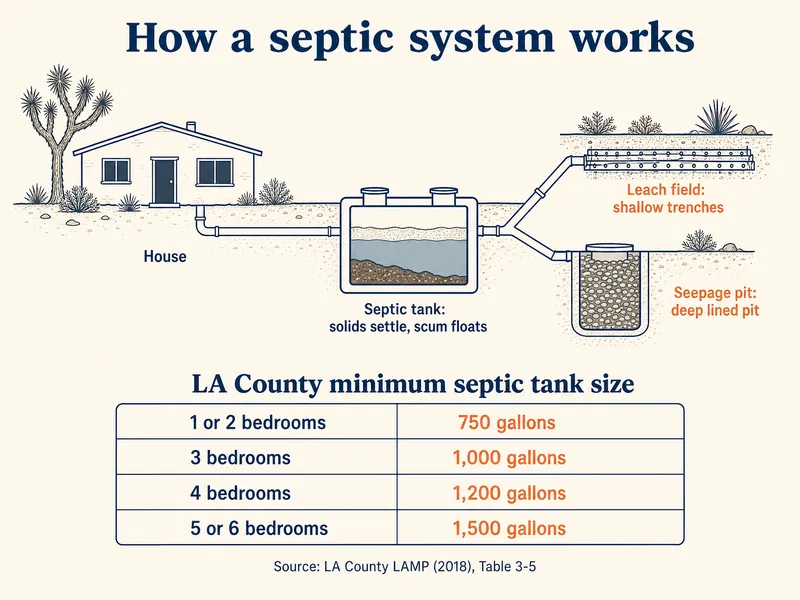
- The county sets minimum tank sizes by bedrooms: 750 gallons for 1 or 2, 1,000 for 3, 1,200 for 4 and 1,500 for 5 or 6 (LAMP, Table 3-5).
- Lancaster and Palmdale are among 11 cities with agreements letting LA County Public Health manage septic systems under the LAMP.
- The EPA puts repair or replacement of a failed conventional system at $5,000 to $15,000 nationally; advanced systems cost more.
- No agency source this guide read sets a rule, either way, on softener discharge to a septic system; ask the county before connecting one.
Septic in the county's part of the valley
- 16,955Conventional septic systems estimated in the Antelope-Fremont Valleys watershed (LAMP Table 2-2)LA County LAMP, 2018
- 53,148Septic systems in LA County's inventory as of January 28, 2016LA County LAMP, 2018
- 1,000 galMinimum septic tank size for a 3-bedroom house in LA CountyLA County LAMP, Table 3-5
- 3 ftUndisturbed soil required under the dispersal areaLA County LAMP, 2018
- 3–5 yearsHow often the EPA expects a home tank to be pumpedEPA SepticSmart
How does a septic system work?
A septic system holds household wastewater in a buried tank long enough for solids to separate, then lets the clarified liquid soak into the soil, which finishes the treatment. The EPA's explainer describes the tank as a watertight box of concrete, fiberglass or polyethylene: heavy solids sink as sludge, grease floats as scum, and a T-shaped outlet keeps both inside while the liquid, called effluent, flows out.
In LA County the effluent goes to one of two dispersal designs. The county's Local Agency Management Program (LAMP) defines a conventional system as a septic tank whose effluent is dispersed into a leach field or a seepage pit, relying on gravity and "the natural filtration capacity of the soil." A leach field spreads effluent through shallow gravel trenches; a seepage pit sends it down a deep lined hole. The seepage pit vs leach field page compares the two.
The soil is the treatment plant, so it has rules. The LAMP requires at least 3 feet of undisturbed soil under the dispersal area and minimum distances to groundwater. Homes where soil drains too fast or too slowly may need a non-conventional system (NOWTS) that adds a treatment unit before the effluent reaches the ground.
Which Antelope Valley homes are on septic?
Homes outside public sewer service are on septic, and in the Antelope Valley that covers a large share of the rural and edge-of-town lots. The LAMP says the County Sanitation Districts operate sewage treatment plants for portions of Lancaster and Palmdale, and that sewage disposal for the rest of the county's part of the watershed is by onsite systems. Its Table 2-2 estimated 16,955 conventional systems and 41 non-conventional ones in the Antelope-Fremont Valleys watershed, out of about 53,148 and 813 countywide.
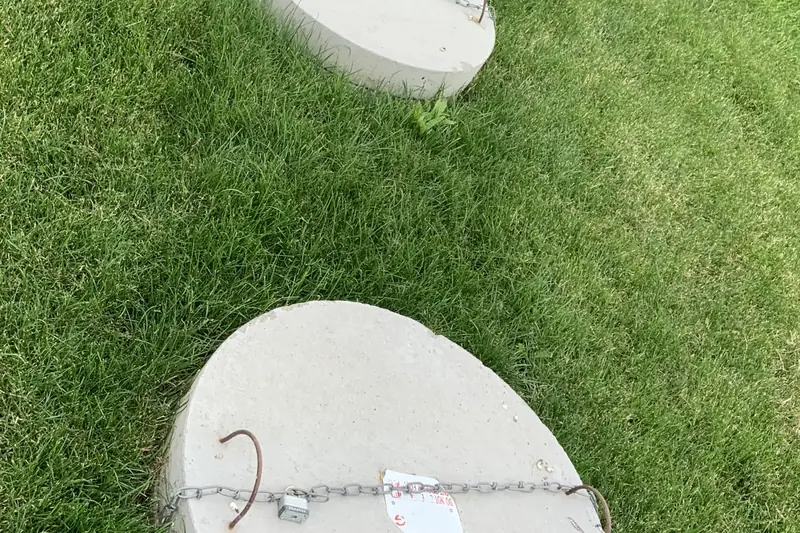
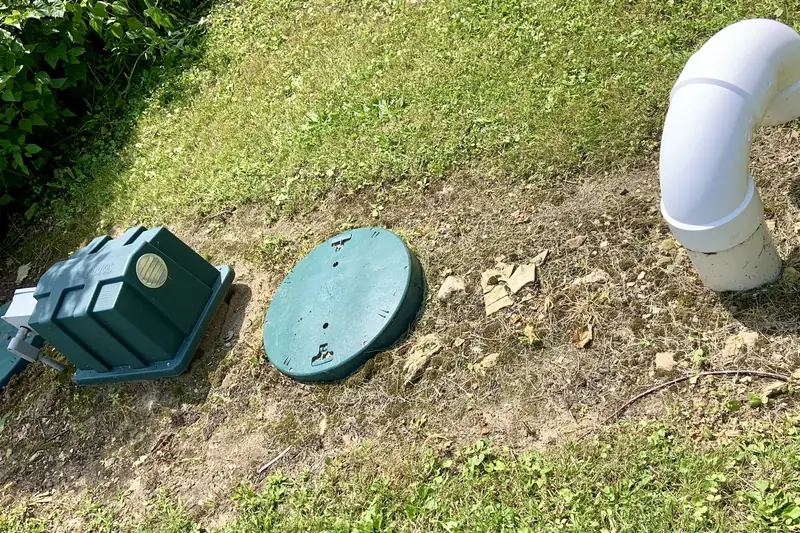
To check a specific house, look at the bills and the yard. The EPA's septic FAQ notes that a septic home shows a $0.00 sewer charge or gets no sewer bill, and that a black or green riser lid often sits about 10 feet from the house. Many septic homes also draw from a private well; the well water testing page explains what to test.
Sewer availability decides the question for new work. The LAMP says LA County accepts no plans to install, alter or repair a septic system on a property where a public sewer connection is available within 200 feet. Rosamond and other Kern County homes fall outside LA County's program; check with Kern County.
What size septic tank does a house need?
In LA County, the minimum tank size follows the number of bedrooms. The LAMP's Table 3-5 sets 750 gallons for a home with 1 or 2 bedrooms, 1,000 gallons for 3, 1,200 for 4 and 1,500 for 5 or 6, plus 150 gallons for each extra bedroom. Those sizes already allow for sludge storage and a kitchen garbage disposal.
The bedroom count matters because it stands in for flow. The LAMP assumes a single-family home produces about 250 gallons of wastewater a day, and the county's LAMP FAQ says adding a bedroom, or a room that could serve as one, or an accessory dwelling unit, means the septic system must be modified to current requirements. Plan any addition around the septic permit, not after it.
New tanks also carry equipment rules. The LAMP requires new or replacement tanks to be IAPMO-approved or engineer-certified, fitted with an effluent filter certified to NSF 46, and given watertight risers within 6 inches of grade.
| Bedrooms | Minimum tank (gallons) | Notes |
|---|---|---|
| 1 or 2 | 750 | Includes sludge storage and a garbage disposal |
| 3 | 1,000 | Same allowance |
| 4 | 1,200 | Largest home allowed a new conventional seepage pit |
| 5 or 6 | 1,500 | Add 150 gallons per extra bedroom |
What does a new septic system cost?
No LA County or Antelope Valley agency publishes installation prices, and LA County Public Health says in its LAMP FAQ that it does not receive cost information and cannot give accurate estimates. The only government range found is national: the EPA's page on why septic maintenance matters says repairing or replacing a malfunctioning conventional system can cost $5,000 to $15,000, and that alternative systems can cost more.
What drives the price here is mostly the site. A geologist or similar professional must evaluate percolation and depth to groundwater for a new or replacement system, the soil may push the design toward a NOWTS with a treatment unit and an annual inspection, and setbacks from buildings, property lines and wells limit where pits and trenches can go. The LAMP did spare homeowners one cost: without it, owners needing a non-conventional system would have needed a Regional Water Board discharge permit costing $1,044 a year with quarterly monitoring.
Can a water softener drain into a septic system?
No agency document this guide read gives a rule either way. The EPA SepticSmart pages, the State Water Board's OWTS Policy page and LA County's LAMP and FAQ do not address softener regeneration water, so this page makes no claim that brine harms or does not harm a septic tank.
What the sources do say is that every gallon sent down the drains ends up in the septic system, and that the EPA advises spreading water use out. Before plumbing a softener drain into a septic line, ask LA County Public Health's onsite wastewater program, and for a NOWTS check the treatment unit maker's manual. On city water a softener is a comfort choice rather than a necessity; the water softener decision guide sets out the local hardness numbers.
Who regulates septic systems in the Antelope Valley?
Three layers apply in the LA County part of the valley. The State Water Board's OWTS Policy, adopted in June 2012 and renewed in April 2023, sets the statewide framework. LA County Public Health carries it out through the LAMP, approved by the Regional Water Board in 2018 and in effect since November 1, 2018 for unincorporated areas and contracted cities, according to the county's LAMP page.
Lancaster and Palmdale are named in the LAMP among the 11 cities with agreements for LA County to manage septic systems. The valley drains to the Lahontan Region (Region 6), and the LAMP carries two rules specific to it: existing lots there stay limited to one single-family home per half acre (or 500 gallons per acre per day), and chlorine disinfection is used only when no other method is feasible. Rosamond, in Kern County, is outside this program. Contractor licensing and permits are covered on the plumbing code and permits page.

How we put this page together
Sources behind this page: three EPA SepticSmart pages (the "How Septic Systems Work" explainer, updated June 10, 2026, plus its septic FAQ and its maintenance-benefits page); the county's 2018 septic plan, read in the copy the Regional Board attached to its approval of that plan; the Public Health FAQ on the plan (revised in 2018) and the county's plan web page; and the State Water Board's OWTS Policy page. Each was opened again in October 2026. System counts are the plan's 2016-era estimates. Not included: local installation prices, Kern County septic rules (not verified), sewer district maps (the Sanitation Districts' site could not be loaded), and any claim about softener brine and septic tanks.
Common questions
Can a house in Lancaster have septic if the street has sewer?
Not for new work: LA County's LAMP says no septic installation, alteration or repair plans are approved where a public sewer connection is available within 200 feet. An existing working system on such a lot is a question for the county and the sanitation district.
Does LA County require upgrading an old septic system that still works?
No. The county's LAMP FAQ says no action is required for existing septic systems as long as they are not failing. Changes come with a failure, an added bedroom or a new unit.
Are cesspools still allowed in the Antelope Valley?
Only until something changes. The LAMP says existing cesspools at single-family homes may be used until they fail, show signs of contaminating water, or the owner remodels in a way that could add flow, and cesspools fall under the Regional Water Board rather than the county.
How big a lot does a new septic home need?
For lots created by new subdivisions, the LAMP ties density to rainfall: in areas averaging 0 to 15 inches a year, the allowance is one home per 2.5 acres. Existing Antelope Valley lots under the Lahontan Board keep the older limit of one home per half acre.
How long does a septic tank last?
The EPA says a concrete tank may last 50 years or more, pumps and controls often need replacing every 10 to 20 years, and a system more than 25 to 30 years old is near the point to plan an upgrade.
Can an owner-builder install a septic system?
LA County's LAMP FAQ says requests for owner-builder permits go to the Department of Building and Safety, which evaluates them. Install and repair work otherwise falls to licensed Class A, B, C-42 or C-36 contractors under the LAMP.
Related guides
More help: see our Antelope Valley water, wells and septic guide.