
Hard water & softeners
Water Softener Cost: Unit, Install and Running
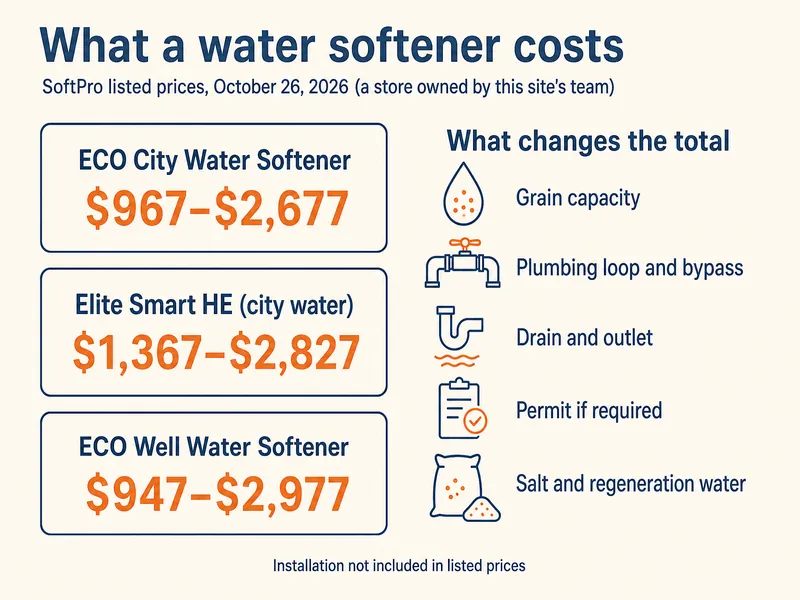
Water softener cost starts with the unit, about $950 to $1,600 for a softener alone at the listed prices checked in October 2026, then adds installation, a drain, salt and water for regeneration.
Disclosure: SoftPro Water Systems, a store owned by the same team as this site, sells the softeners, filters and well-water equipment we link to. Our water pages follow the water suppliers' latest consumer confidence reports and federal, state and county agency guidance, checked October 2026. Store descriptions are reported as the store's own claims. Ownership disclosure
View at SoftPro Water Systems
On this page
Key takeaways
- SoftPro Water Systems listed its ECO City Water Softener at $967 to $2,677 and its ECO Well Water Softener at $947 to $2,977 on October 26, 2026; the low ends are softener-only 32,000-grain units.
- Installation has no reliable public price list; in California, a job totaling $1,000 or more in labor and materials needs a licensed contractor under a state law (CSLB, AB 2622).
- Each regeneration uses about 50 gallons of water, according to Penn State Extension and University of Nebraska–Lincoln Extension.
- Salt use depends on household size, daily water use, softener capacity and hardness (University of Nebraska–Lincoln Extension).
- Valley city systems reported average hardness between 63 and 116 mg/L in their latest reports, so a softener there is a comfort purchase, not a required one.
- A private well adds a lab test first; the State Water Board says basic sampling "can cost from $100 to $400".
What drives the total
- $967SoftPro ECO City Water Softener, 32,000-grain softener only, listed price October 26, 2026SoftPro Water Systems (a store we own)
- 50 gallonsWater used per regeneration cycle (estimate)Penn State Extension
- $1,000Total job value ($1,000 or more) at which California law requires a contractor's license (AB 2622, from January 1, 2025)Contractors State License Board
- $100–$400Typical basic sampling cost for a private wellState Water Board GAMA program
How much does a water softener cost?
A water softener's unit price depends mostly on grain capacity and on what is bundled with it. At SoftPro Water Systems, a store owned by the same team as this guide, the ECO City Water Softener and Elite Smart HE (both for city water) were listed on October 26, 2026 at $967 to $1,447 and $1,367 to $1,587 respectively for the softener-only versions. The top of each range, up to $2,827, is a bundle with a whole-house carbon filter, which is a separate purchase decision.
Grain capacity is how much hardness the resin removes between regenerations. Bigger tanks cost more but regenerate less often, and the right size follows from your hardness and water use, not from the size of the house. Capacity and regeneration are covered step by step in how softeners work.
| Model and water type | 32,000 grain | 48,000 grain | 64,000 grain | Full listed range incl. bundles |
|---|---|---|---|---|
| ECO City Water Softener (city water) | $967 | $1,117 | $1,447 | $967–$2,677 |
| Elite Smart HE (city water; also a 40,000-grain size at $1,447) | $1,367 | $1,457 | $1,587 | $1,367–$2,827 |
| ECO Well Water Softener (well water) | $947 | $1,097 | $1,427 | $947–$2,977 |
| FORTRESS Salt-Free Conditioner (city water; not a softener) | – | – | – | $229–$1,259 |
Prices are the store's own list prices on that date and can change; SoftPro's site lists free shipping on systems within the US, excluding Alaska, Hawaii and Puerto Rico. For warranty terms, read the store's own warranty page rather than a summary.
What does water softener installation cost?
Installation cost has no dependable public figure: it depends on where the main line enters the house, whether a softener loop already exists and how far the unit sits from a drain and an outlet. This guide does not quote contractor price ranges, because none comes from a source that measured Antelope Valley jobs. What can be said is what a written quote should list.
A complete quote itemizes the bypass valve and connections on the main line, any new pipe to make a loop, the drain line for regeneration water, an electrical outlet if none is close, haul-away of an old unit, and any permit the city or county requires. Ask whether the kitchen cold tap and outside hose bibs will stay on unsoftened water; University of Nebraska–Lincoln Extension notes that homes often keep an unsoftened kitchen line for drinking and cooking and that softened water is not recommended for repeated use on plants and lawns.
Licensing matters for the total. Under AB 2622, a state law in force from January 1, 2025, an unlicensed person may take on only jobs under $1,000, counting "all costs associated with the project", and only if no permit is needed and no workers are hired. If the installer supplies the unit, the total will almost always pass that line, so ask for a license number and check it on CSLB's site; the hiring a plumber in California guide walks through that check, and California plumbing code and permits covers when a permit applies.
What does a softener cost to run each year?
The running cost is salt plus the water and electricity used for regeneration, and it scales with how hard the water is and how much the household uses. Nebraska Extension lists the drivers: "the number of people in the household, daily water usage, softener capacity, and water hardness". Each regeneration also sends roughly 50 gallons down the drain.
Penn State Extension's sizing method shows why hardness matters. It assumes 75 gallons per person per day and multiplies by hardness in gpg and the number of people. For a four-person home on Lancaster's District 40 well water at 5.7 gpg, that is 75 × 5.7 × 4 = 1,710 grains a day, so a softener rated at 32,000 grains would regenerate roughly every 18 to 19 days on paper. The same household on Leona Valley well water at 14.4 gpg would need 4,320 grains a day, close to weekly regeneration and about two and a half times the salt and regeneration water.
Real capacity also depends on the salt dose: the Water Quality Association's glossary ties an ion exchange unit's capacity to how much regenerant each cycle gets, and it rates salt efficiency in grains of hardness taken out per pound of salt used. Demand-initiated units regenerate only when the resin is actually spent, which Nebraska Extension expects to cut salt and water use overall. This guide does not put a dollar figure on salt or water, because local salt prices and water rates were not sourced.
Why do well water softeners cost more?
Well softeners cost more because well water is often harder and may carry iron that a city supply does not. The highest single District 40 well sample in Lancaster was 320 mg/L (18.7 gpg) in 2025, and Leona Valley's Cal Water wells came in at 247 mg/L (14.4 gpg) on average, so well households tend to need more capacity. Nebraska Extension adds that more than 5 ppm of iron makes a softener work less well, and that higher iron may call for pretreatment such as a greensand filter.
That is why the ECO Well listing tops out at $2,977 with an iron filter, against $947 for the softener alone. A well owner also pays for the lab test that decides the setup: the State Water Board puts basic sampling at $100 to $400. The well water testing and well water treatment guides cover what to test and what each result points to.
Is a salt-free system cheaper?
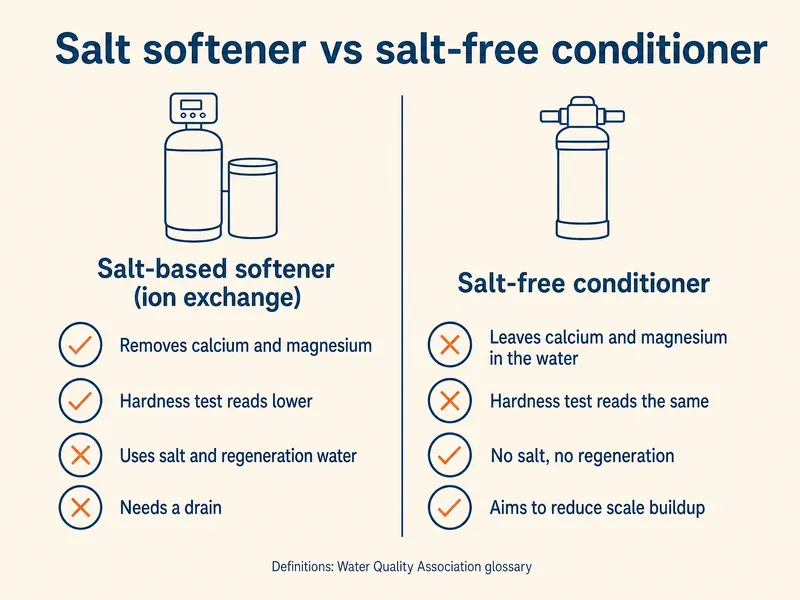
A salt-free conditioner usually costs less to buy and run, but it does a different job. SoftPro lists its FORTRESS Salt-Free Conditioner at $229 for the home cartridge model up to $1,259 for the commercial tank, and its Elite Salt Free Conditioner at $1,299, both labeled for city water. They use no salt and send no regeneration water down the drain.
The catch is that they leave calcium and magnesium in the water. The Water Quality Association's glossary describes these devices as counteracting "scale buildup of hard water minerals" without salt regeneration, not as removing hardness, and a hardness test shows no change after it. The salt-free water softener page explains when that trade makes sense.
Which costs are easy to miss?
The easy-to-miss costs are the ones that come after the unit: the drain and outlet, salt hauling, resin care and the bypass lines. Nebraska Extension says high iron or manganese can affect the resin's capacity, so it "may eventually need to be cleaned or replaced", and it wants the brine valve and float checked and cleaned yearly. The water softener maintenance checklist covers those tasks.
Two local questions belong on the list too. No verified local rule on salt-discharging softeners turned up for Lancaster, Palmdale, Quartz Hill or Rosamond, so ask the home's sanitation district before you order. And on city water, compare the total against simply cleaning scale: on moderately hard supply water a softener is a comfort purchase, as the guide to whether you need a softener explains.
Optional on city water
SoftPro Elite Smart HE City Water Softener
Lancaster and Palmdale city water is moderately hard in the suppliers' own water quality reports, so a softener there is a comfort choice for scale and spotting, not a need. If you want one, size a city-water softener to your household and check sizes and current prices at SoftPro Water Systems. See the hardness of your system.
View at SoftPro Water SystemsSoftPro Water Systems, a store owned by the same team as this site, sells the softeners, filters and well-water equipment we link to. Ownership disclosure
How we put this page together
Unit prices are SoftPro Water Systems' list prices read from its product listings on October 26, 2026 (softener-only and bundled variants; no "compare-at" prices). Running-cost drivers and the sizing arithmetic come from Penn State Extension (Water Softening, September 2025 update) and University of Nebraska–Lincoln Extension G1491 (revised 2014); capacity and salt-efficiency definitions from the Water Quality Association glossary; the $1,000 licensing line from CSLB's AB 2622 release; the well-testing range from the State Water Board's GAMA page; hardness from the 2025 supplier reports (District 40, Cal Water, Palmdale Water District, Quartz Hill, Rosamond). Checked October 2026. Left out: installation price ranges, salt and water bills in dollars, savings or payback claims and contractor quotes, because none was available from a primary source.
Common questions
How much does a water softener cost for a 2,000 sq ft house?
House size is not what sizes a softener; hardness and the number of people are. A four-person home on 5.7 gpg water uses about 1,710 grains a day by Penn State Extension's method, which a 32,000-grain unit handles comfortably; that size was listed from $947 to $1,367 depending on model in October 2026.
Is the most expensive softener bundle worth it?
The bundles add a whole-house carbon filter for chlorine taste and odor, which is a separate question from hardness. Decide on the softener from the hardness figure and on a filter from what bothers you about taste, and price them apart.
When does a softener installer need a California license?
When the job's total, labor and materials together, is $1,000 or more, or when it needs a building permit or the installer employs workers (CSLB, AB 2622, effective January 1, 2025). Check the license number on CSLB's site before paying a deposit.
Does a bigger softener cost more to run?
Not necessarily. A bigger resin bed regenerates less often for the same water use; salt use follows hardness, water use and the salt setting more than tank size. Demand-initiated controls regenerate only when the capacity is used up.
How much water does a softener waste in a year?
Each regeneration uses about 50 gallons (Penn State and Nebraska Extension). A softener regenerating every 18 days uses about 20 cycles a year, or roughly 1,000 gallons; one regenerating weekly uses about 2,600 gallons.
How large a deposit should a softener installer ask for?
CSLB's guidance is that a down payment "should not exceed 10 percent of the contract price". Pay the rest as work is done, and keep the written quote with every item listed.
Related guides
More help: see our guide to Antelope Valley home water.