
Hard water & softeners
Salt-Free Water Softener: What It Does and Doesn't
A salt-free water softener is really a conditioner: it aims to cut scale buildup without salt or a drain, but it leaves calcium and magnesium in the water, so the water is not softened.
Disclosure: SoftPro Water Systems, a store owned by the same team as this site, sells the softeners, filters and well-water equipment we link to. Our water pages follow the water suppliers' latest consumer confidence reports and federal, state and county agency guidance, checked October 2026. Store descriptions are reported as the store's own claims. Ownership disclosure
View at SoftPro Water Systems
On this page
Key takeaways
- The Water Quality Association defines a water softener as a device that brings hardness below 1 gpg; it files "salt-free softeners" under salt-free treatment devices that counteract scale instead.
- WQA's glossary says physical treatment devices do not lower total calcium or magnesium and have not been shown to produce soft water.
- The certification standard for softeners, NSF/ANSI 44, covers cation exchange units; this guide found no scale-reduction certification for the salt-free units discussed here.
- Antelope Valley city water averaged 63 to 116 mg/L (3.7 to 6.8 gpg) in the latest supplier reports, the moderately hard range where scale control, not full softening, is the usual goal.
- SoftPro Water Systems listed its FORTRESS conditioner at $229 to $1,259 and the Elite Salt Free model at $1,299 on October 26, 2026, both labeled for city water.
- A salt-based softener remains the tool for very hard water and wells; UF/IFAS Extension suggests considering one above 180 mg/L.
Salt-free in numbers
- <1 gpgHardness a device must reach to be called a water softenerWater Quality Association glossary
- $229SoftPro FORTRESS Salt-Free Conditioner, Home model, listed price October 26, 2026SoftPro Water Systems (a store we own)
- 0Regeneration cycles, salt or brine discharge for a salt-free conditionerWater Quality Association glossary
- 120 mg/LTop of the USGS moderately hard class (7.0 gpg)USGS Water Science School
What is a salt-free water softener?
A salt-free water softener is a scale-control device that works without salt or regeneration, and despite the name it does not soften water. The Water Quality Association's glossary describes it as equipment "using chemical, physical or any other means, to counteract scale buildup of hard water minerals (calcium and magnesium) without the use of salt for regeneration". It treats "salt-free water softener" and "salt-free water conditioner" as names for that same device.
Most units are a single tank or cartridge on the main line, with no brine tank, no drain and no electricity. Water flows through, and the minerals flow out with it. The WQA lists the processes this class of device uses as including "media-induced precipitation, magnetic, electronic, electrostatic, and electromagnetic technologies", which is a wide range of methods under one label.
Water softener vs water conditioner: what's the difference?
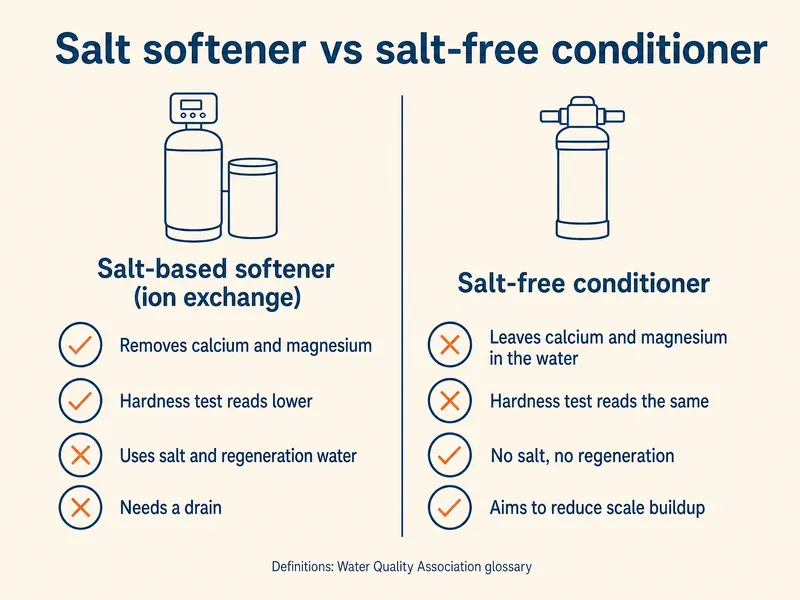
The difference is what happens to the hardness: a water softener removes calcium and magnesium, and a conditioner leaves them in. The WQA defines a softener as a device that reduces hardness "to less than 1 gpg", most commonly by ion exchange, as explained in how a water softener works. A conditioner aims to change how those minerals behave so less of them sticks to pipes and heaters.
That shows up on a test strip. Water from a working softener reads close to zero hardness; water from a conditioner reads the same as the water going in. WQA's entry for physical treatment devices says they "do not provide a reduction of total calcium or magnesium content of the treated stream", and adds that they have not been shown to produce soft water. So the honest comparison is softening versus scale control, not two ways of softening.
| Feature | Salt-based softener (ion exchange) | Salt-free conditioner |
|---|---|---|
| Calcium and magnesium | Removed, to under 1 gpg when working (WQA definition) | Left in the water (WQA) |
| Hardness test after treatment | Near zero | Same as before |
| Salt or potassium | Needed for each regeneration | None |
| Drain and regeneration water | About 50 gallons per regeneration (Penn State Extension) | None |
| Sodium added | About 8 mg/L per gpg removed (Nebraska Extension) | None from treatment |
| Certification standard | NSF/ANSI 44 for cation exchange softeners | None found for these units |
| Listed price at SoftPro, Oct 26, 2026 | ECO City $967 and up | FORTRESS $229–$1,259; Elite Salt Free $1,299 |
Does a salt-free softener work on hard water?
A salt-free conditioner may reduce how much scale forms, but it will not make hard water soft, and the evidence behind any particular unit is what its maker or seller can show. SoftPro describes its Elite Salt Free Conditioner as a unit that "effectively reduces scale buildup without the use of salt"; that is the store's own claim, and this guide found no third-party certification or published test for these models. The WQA definition itself says that, depending on the method, "other effects of soft water may also be observed", which is a careful "may".
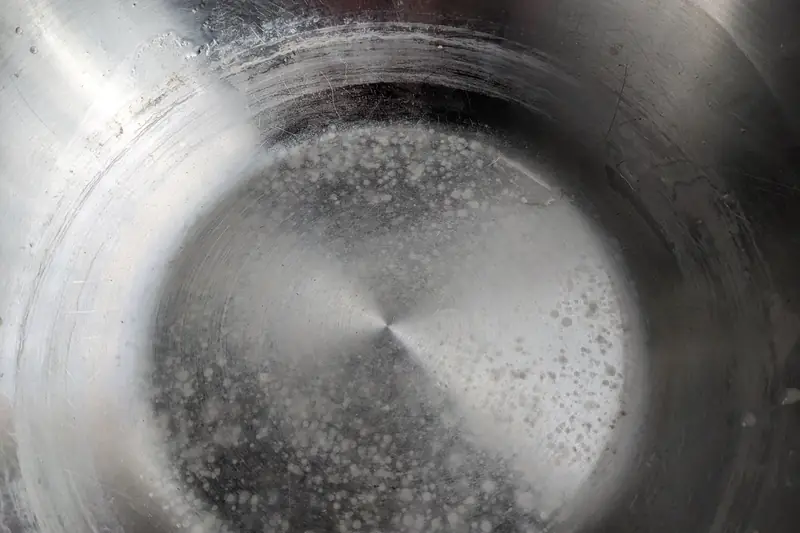
Because the minerals stay dissolved, anything that evaporates water still leaves them behind. Spots on glass and shower doors, the crust around a faucet aerator and the white residue in a swamp cooler come from water drying, and a conditioner does not take out what dries. The hard water stains guide covers cleaning those.
Where does a salt-free system make sense?
A salt-free system makes the most sense on moderately hard city water, where the goal is gentler scale control without salt, drain water or added sodium. Antelope Valley city supplies fit that profile in the latest reports: Palmdale Water District's treated surface water came in at 6.5 gpg in 2025, District 40's Lancaster wells averaged 5.7 gpg and Quartz Hill Water District 3.7 gpg. The Antelope Valley water hardness page has every system's figure.
It can also suit homes where a brine discharge is a concern or a drain is hard to reach. No verified local rule on salt discharge was found for the valley's cities; if that is the deciding factor, the sanitation district serving the home can answer it. A conditioner adds no sodium from treatment, though the water still carries the sodium already in the supply.
If you choose one, SoftPro sells the FORTRESS Salt-Free Conditioner (sold by SoftPro Water Systems, a store we own) in three sizes, listed on October 26, 2026 at $229 for the Home model (6 gallons per minute, about 1 to 2 bathrooms by the store's description), $529 for the Pro model (10 gallons per minute) and $1,259 for the Commercial tank, and the Elite Salt Free Conditioner (sold by SoftPro Water Systems, a store we own) at $1,299. The store labels both for city water.
When is a salt-based softener the better choice?
A salt-based softener is the better choice when the water is very hard, when it comes from a well, or when you want soft water rather than less scale. UF/IFAS Extension suggests considering a softener above 180 mg/L, and some Antelope Valley wells pass that: Cal Water's Leona Valley wells averaged 247 mg/L, and single District 40 well samples in Lancaster reached 320 mg/L in 2025.
Wells add other reasons. Well water can carry iron, manganese or sediment, which a softener with the right pretreatment can handle and a conditioner sold for city water is not meant for; SoftPro labels both of its salt-free models for city water only. A private well needs a lab test first, as the well water testing guide explains. The guide to deciding on a softener walks through the choice by hardness level.
How do you judge a salt-free system's claims?
Judge a salt-free system by what the claim says and what evidence comes with it. A claim to "soften" water or "remove hardness" conflicts with the WQA's definitions, because these devices leave calcium and magnesium in the water. A claim to "reduce scale" is plausible but needs a test report: ask the seller what standard or method was used, on what water and with what result.
Watch for certification logos that are not tied to the model. A badge strip on a product page is not the same as a listing: check the NSF and WQA directories for the exact model name. If no listing exists, treat the scale claim as the maker's own. Percentages of scale reduction are only as good as the test behind them, and this guide does not repeat any it could not trace.
Finally, compare against doing nothing. On water around 100 mg/L, regular descaling of fixtures and flushing the water heater as its manual directs may be enough. The water softener cost page shows what each option costs to buy.
A salt-free option
SoftPro FORTRESS Salt-Free Water Conditioner
Salt-free conditioners don't remove hardness; they are sold to reduce scale buildup, with no salt, brine or drain line. On moderately hard city water either route is optional. Compare sizes and current prices at SoftPro Water Systems. See when you can skip a softener.
View at SoftPro Water SystemsSoftPro Water Systems, a store owned by the same team as this site, sells the softeners, filters and well-water equipment we link to. Ownership disclosure
How we put this page together
Definitions come from the Water Quality Association's online glossary (entries for water softener, salt-free water treatment device, salt-free water conditioner and physical water treatment device), read October 2026. Softener mechanism and figures come from University of Nebraska–Lincoln Extension G1491 and Penn State Extension; hardness from the 2025-data supplier reports (Palmdale Water District, District 40, Quartz Hill Water District, Cal Water); the 180 mg/L threshold from UF/IFAS Extension. Product details and prices come from SoftPro's listings on October 26, 2026. Left out: scale-reduction percentages, because no certification or published test for these models was found, and maker or forum claims about magnets and electronic units.
Common questions
Do salt-free water softeners really work?
They can reduce scale for some waters, but they do not soften: the WQA notes that physical treatment devices have not been shown to produce soft water. How well a given unit controls scale depends on the method and on evidence its maker can show.
Will a salt-free conditioner stop spots on dishes and shower glass?
Probably not fully. Spots form when water dries and leaves its minerals behind, and a conditioner leaves the calcium and magnesium in the water.
Can a salt-free conditioner be used on well water?
SoftPro labels its FORTRESS and Elite salt-free units for city water only. A well needs a lab test first, and very hard water, iron or sediment usually points to a softener and filters instead.
Does a salt-free conditioner need maintenance?
Usually less than a softener, since there is no salt or regeneration, but cartridge or media replacement schedules vary by model. Follow the maker's manual for the unit you buy.
Is a salt-free system better for people watching sodium?
It adds no sodium from treatment, unlike a sodium-based softener, which adds about 8 mg/L per gpg removed according to Nebraska Extension. A potassium chloride softener or an unsoftened kitchen tap are other ways to avoid added sodium.
Are magnetic or electronic descalers the same thing?
The WQA groups magnetic, electronic and electromagnetic units with other physical treatment devices, the same class as many salt-free conditioners. The same caution applies: no reduction in total calcium or magnesium, so ask for test evidence.
Related guides
More help: see our Antelope Valley home water guide.