
Hard water & softeners
Do I Need a Water Softener in the Antelope Valley?
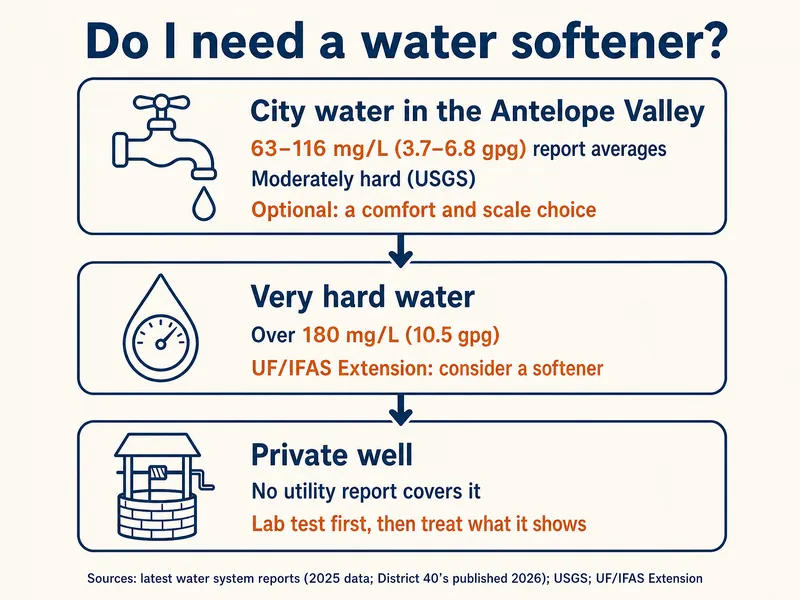
No, you do not need a water softener on Antelope Valley city water: it is moderately hard, so a softener is a comfort and scale choice. On a hard private well, test first; there it is often worth it.
Disclosure: SoftPro Water Systems, a store owned by the same team as this site, sells the softeners, filters and well-water equipment we link to. Our water pages follow the water suppliers' latest consumer confidence reports and federal, state and county agency guidance, checked October 2026. Store descriptions are reported as the store's own claims. Ownership disclosure
View at SoftPro Water Systems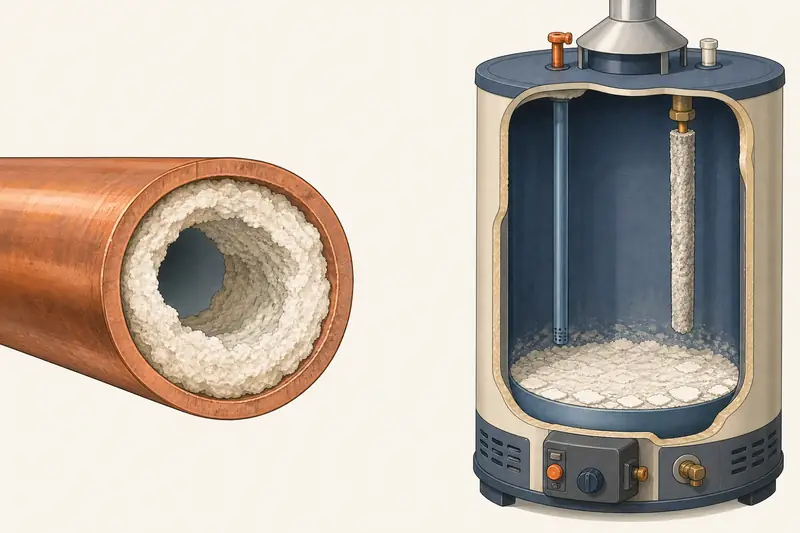
On this page
Key takeaways
- City and district water in Lancaster, Palmdale, Quartz Hill and Rosamond averaged about 63 to 116 mg/L (3.7 to 6.8 gpg) in the 2025 reports: "moderately hard" on the USGS scale.
- Penn State Extension says hardness below 7.0 gpg "will probably not cause major scaling and soap film", and every city average in the valley sits below that line.
- UF/IFAS Extension suggests considering a softener once water passes 180 mg/L (10.5 gpg); District 40's Lancaster wells reached 320 mg/L in single samples and Leona Valley's wells averaged 247 mg/L.
- Cal Water's 2025 Lancaster report says "hard water is generally not a health concern" and that some people buy a softener "for aesthetic reasons".
- A softener adds about 8 mg/L of sodium for each grain of hardness it removes (University of Nebraska–Lincoln Extension).
- A softener does not remove bacteria, nitrate, lead, arsenic or hexavalent chromium; a private well needs a lab test before any treatment is chosen.
Hardness behind the answer
- 111 mg/LPalmdale Water District treated surface water, average 6.5 gpg (2025 data)Palmdale Water District, 2025 report
- 98 mg/LAverage of Lancaster's District 40 wells, Regions 4 and 34, or 5.7 gpg (2025 data)LA County Waterworks District 40 report
- 7.0 gpgLevel below which Penn State Extension expects no major scaling or soap filmPenn State Extension
- 180 mg/LHardness above which UF/IFAS Extension suggests considering a softenerUF/IFAS Extension
Do I need a water softener on city water?
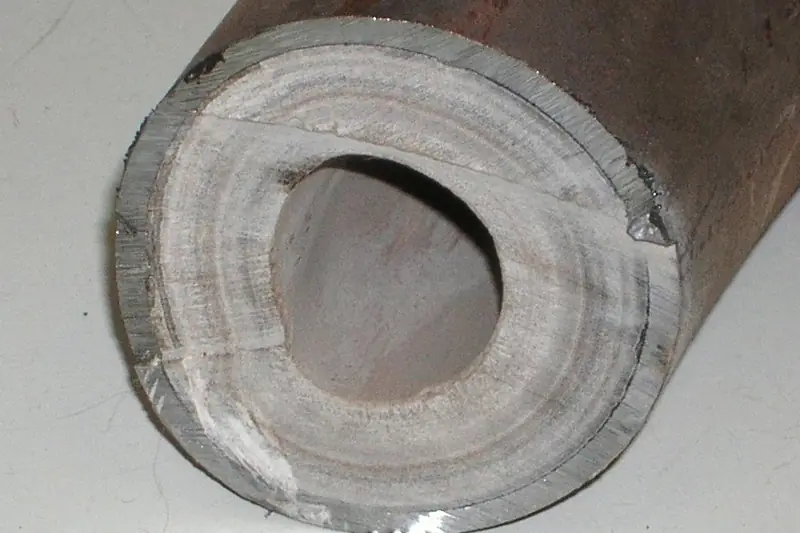
On Antelope Valley city water a softener is optional: the 2025 supplier reports put average hardness at about 63 to 116 mg/L (3.7 to 6.8 gpg), which the USGS classes as moderately hard. That level leaves some spotting on glass and a slow build of scale in kettles and water heaters, but it is not the kind of water that clogs a house in a few years. A softener on city water is a comfort and maintenance choice, not a need.
The numbers come from each supplier's own report. Palmdale Water District prints hardness in grains: 6.5 gpg for its treated surface water and 6.8 gpg for groundwater in the 2025 Consumer Confidence Report, which converts to 111 and 116 mg/L. District 40's Lancaster wells came in at an average of 98 mg/L in 2025, with AVEK's Quartz Hill plant water at 95. Quartz Hill Water District's own figure was the lowest, 63.3 mg/L, and Rosamond's was 99.5. The Antelope Valley water hardness page lists every system side by side, and who supplies my water helps you find yours.
Health is not a reason either way. Palmdale Water District's report states that "health authorities generally agree that the hardness of drinking water normally encountered has no adverse effect", and Cal Water's Lancaster report calls hard water "generally not a health concern". Anyone selling a softener as a health fix is going beyond what the agencies say.
| Source | gpg | mg/L | USGS class | Softener fit | Report and data year |
|---|---|---|---|---|---|
| Quartz Hill Water District, blended supply | 3.7 | 63.3 | Moderately hard | Optional, comfort only | QHWD 2025 CCR, 2025 data |
| Lancaster wells, District 40 (Regions 4, 34) | 5.7 | 98 | Moderately hard | Optional, comfort only | District 40 2026 report, 2025 data |
| Rosamond Community Services District | 5.8 | 99.5 | Moderately hard | Optional, comfort only | Rosamond CSD 2025 CCR, 2024 sample |
| Palmdale Water District wells | 6.8 | 116 | Moderately hard | Optional, comfort only | PWD 2025 CCR, 2025 data |
| Littlerock, Pearblossom and Sun Village wells (District 40) | 8.2 | 140 | Hard | Reasonable for scale control | District 40 2026 report, 2025 data |
| Leona Valley wells (Cal Water) | 14.4 | 247 | Very hard | Often worth it | Cal Water 2025 CCR, 2020 to 2025 data |
| A private well | unknown | unknown | Lab test needed | Test first | none |
How hard is too hard?
There is no legal limit for hardness; the useful lines come from extension services. Penn State Extension writes that "levels below 7.0 gpg will probably not cause major scaling and soap film", which is 120 mg/L. UF/IFAS Extension suggests considering a softener to protect plumbing and appliances once hardness tops 180 mg/L, or 10.5 gpg. Between those two lines, scale is noticeable and a softener is a matter of taste.
Hardness numbers come in two units. Water reports usually print mg/L (or "ppm", which means the same thing), while softener makers use grains per gallon (gpg). One grain per gallon equals 17.1 mg/L, so 98 mg/L is 5.7 gpg and 180 mg/L is 10.5 gpg. Palmdale Water District is the exception that prints gpg directly. See how to read a water quality report for where hardness hides in the tables.
Why do wells change the answer?
Wells change the answer because groundwater in the valley ranges far wider than the blended city supply. Single samples from District 40's Lancaster wells spanned 30 to 320 mg/L in 2025, around an average under 100, and Cal Water's Leona Valley wells averaged 247 mg/L (14.4 gpg), very hard on the USGS scale. A private well can sit anywhere in that range, and no utility report covers it.
That makes a lab test the first step on a well, before any equipment. The test should cover hardness and iron, which decide softener sizing, and the health items the State Water Board and EPA recommend checking each year, such as bacteria, nitrate and arsenic. The well water testing guide lists what to ask a state-accredited lab for, and the well water treatment guide covers what to do with the results. If the report shows hardness well above 180 mg/L, a softener often earns its place on a well.
What does a water softener fix?
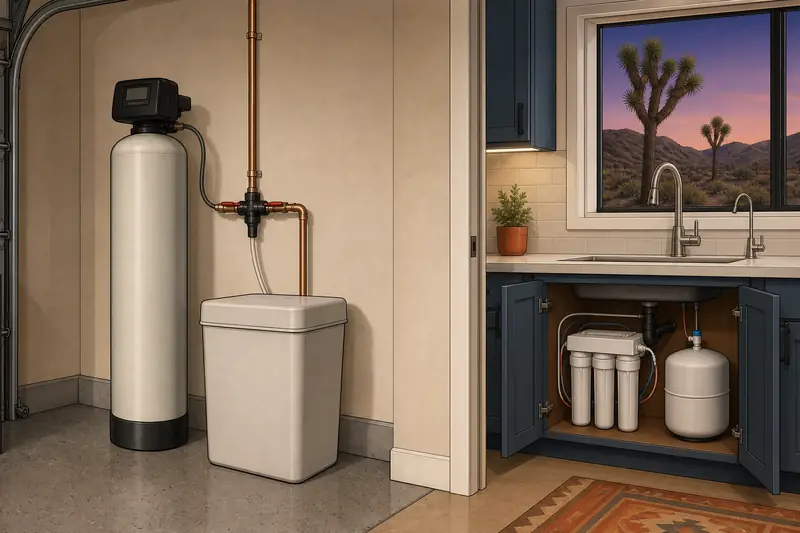
A water softener fixes the nuisance side of hardness: white scale in kettles, water heaters and showerheads, spots on glass and dishes, and soap that lathers poorly. It does this by ion exchange, swapping calcium and magnesium for sodium (or potassium) on a bed of resin beads, as the how a water softener works page explains. The University of Nebraska–Lincoln Extension says the process "can remove nearly all calcium and magnesium".
It is not a cure-all. The same Nebraska publication is plain that softening leaves bacteria, nitrate, lead, pesticides and sand in the water. It also does not treat arsenic or hexavalent chromium, the two contaminants Antelope Valley readers ask about most. Those need a system certified for that contaminant, chosen after a test.
What are the downsides of a softener?
The main downsides are sodium, salt and water use, upkeep and cost. Nebraska Extension puts the added sodium at about 8 mg/L for each gpg removed, so fully softening Lancaster well water at 5.7 gpg would add roughly 46 mg/L of sodium (5.7 × 8). People on a sodium-restricted diet are told to count that intake and talk to their physician; many homes keep an unsoftened cold line to the kitchen tap for drinking and cooking.
Each regeneration also sends water down the drain: Penn State estimates "about 50 gallons" per cycle. The Nebraska publication also advises against repeatedly watering plants, lawns or gardens with softened water because of the sodium, so outside taps are usually left on hard water. Some sanitation districts in California restrict salt-discharging softeners; this guide found no verified rule for Lancaster, Palmdale, Quartz Hill or Rosamond either way, so check with the sanitation district that serves the home before buying.
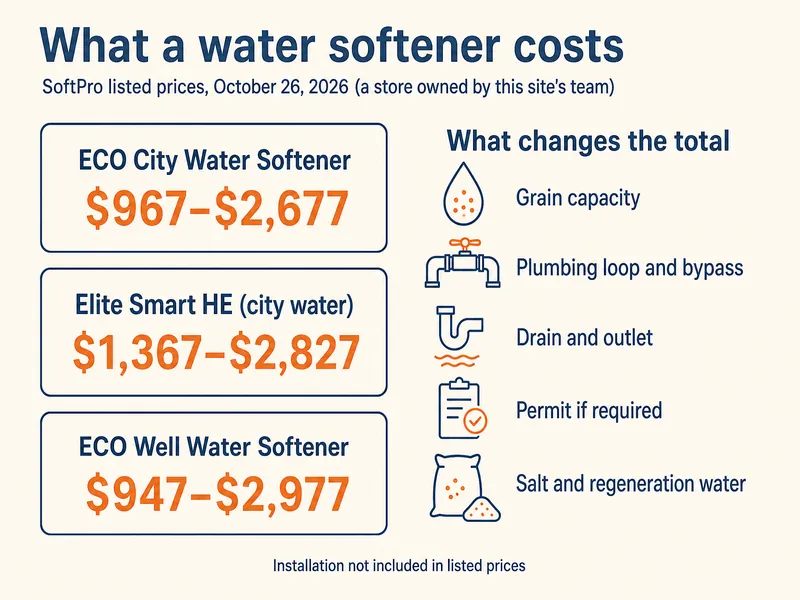
Then there is the price and the upkeep: a unit, installation, a drain connection, salt and occasional maintenance. The water softener cost page breaks that down and the maintenance checklist covers the yearly tasks.
What are the alternatives to a water softener?
The alternatives are living with moderately hard water, cleaning scale as it appears, a salt-free conditioner or a drinking-water filter. On water around 100 mg/L, regular cleaning with a mild acid such as vinegar handles most spotting; the hard water stains guide covers glass, faucets, toilets and swamp coolers. Flushing the water heater on the maker's schedule deals with sediment inside the tank.
A salt-free water softener (more accurately a conditioner) uses no salt and needs no drain, but it leaves calcium and magnesium in the water, so a hardness test reads the same afterward. If the real goal is better-tasting drinking water rather than less scale, an under-sink reverse osmosis unit is the closer fit; the reverse osmosis vs water softener page compares the two.
How do you decide from your own numbers?
Decide from your supplier's latest hardness figure, or a lab result if you are on a well, and from what bothers you. Under about 120 mg/L (7 gpg), as on every city system in the 2025 reports, a softener is optional; buy one only if spotting, scale cleaning or soap use bother you enough to pay for it. Between 120 and 180 mg/L, as in the Littlerock and Pearblossom wells at 140 mg/L, scale control is a reasonable reason to soften. Above 180 mg/L, which only shows up on some wells, a softener is often worth it.
If you go ahead, size it to the measured hardness and your household's water use, and test the water again after installation. SoftPro Water Systems, a store owned by the same team, lists the ECO City Water Softener and ECO Well Water Softener, for city water and wells respectively; both are optional purchases. Neither listing shows an NSF/ANSI 44 certification, so check a unit's certification on the NSF or WQA listings before relying on it.
Optional on city water
SoftPro ECO City Water Softener
Lancaster and Palmdale city water is moderately hard in the suppliers' own water quality reports, so a softener there is a comfort choice for scale and spotting, not a need. If you want one, size a city-water softener to your household and check sizes and current prices at SoftPro Water Systems. See the hardness of your system.
View at SoftPro Water SystemsSoftPro Water Systems, a store owned by the same team as this site, sells the softeners, filters and well-water equipment we link to. Ownership disclosure
How we put this page together
This page is based on the supplier reports for 2025 data: Palmdale Water District's 2025 Consumer Confidence Report, LA County Waterworks District 40's 2026 reports for Regions 4 and 34 and Regions 24, 27 and 33, Quartz Hill Water District's 2025 report, Rosamond CSD's 2025 report and Cal Water's 2025 Lancaster and Leona Valley reports. Thresholds and mechanism come from the USGS Water Science School, Penn State Extension (Water Softening, updated September 2025), UF/IFAS Extension (2021) and University of Nebraska–Lincoln Extension publication G1491 (revised 2014). Store details come from SoftPro's product listings, checked October 26, 2026. All sources were checked in October 2026. Left out: savings or payback figures, health claims about hard or soft water, contractor prices and forum anecdotes.
Common questions
Is Palmdale water hard enough to need a softener?
No. Palmdale Water District's 2025 report puts its water at 6.5 to 6.8 gpg (111 to 116 mg/L) on average, moderately hard on the USGS scale. A softener there reduces spotting and scale but is not needed.
Does a water softener make sense in a rental or a short stay?
Usually not on city water. At 63 to 116 mg/L the scale builds slowly, and a softener's purchase, plumbing and salt are hard to justify for a short stay. Cleaning fixtures and flushing the water heater on schedule covers most of the nuisance.
Is softened water safe to drink?
For most people, yes, but it carries extra sodium: about 8 mg/L per gpg removed, according to University of Nebraska–Lincoln Extension. People on a sodium-restricted diet should count it and ask their physician, and many homes leave the kitchen cold tap unsoftened.
Will a softener remove chromium 6 or arsenic from my water?
No. Ion exchange softeners target calcium and magnesium. Arsenic and hexavalent chromium need a device certified for that contaminant; for hexavalent chromium, start from the State Water Board's list of certified home devices.
Can a softener use potassium instead of salt?
Yes, many can run on potassium chloride, which avoids adding sodium. Nebraska Extension notes that potassium chloride is pricier, less widely stocked and needed in larger amounts per regeneration, so follow the softener maker's guidance.
Does Lancaster or Palmdale ban salt water softeners?
This guide found no verified ban or permit rule for Lancaster, Palmdale, Quartz Hill or Rosamond, and found no confirmation that none exists. Ask the sanitation district that serves the home before installing one.
How can a well owner find out the hardness?
Only a lab test tells. Use a lab accredited by the State Water Board's ELAP program and ask for hardness and iron alongside the yearly health tests.
Related guides
More help: see our home water guide for the Antelope Valley.