
Pipes & leaks
Sewer Line Replacement Cost and Camera Inspections
Sewer line replacement cost turns on the lateral's length and depth, the method (open trench or trenchless), and street work; a camera inspection comes first, because it shows whether a repair will do.
On this page
Key takeaways
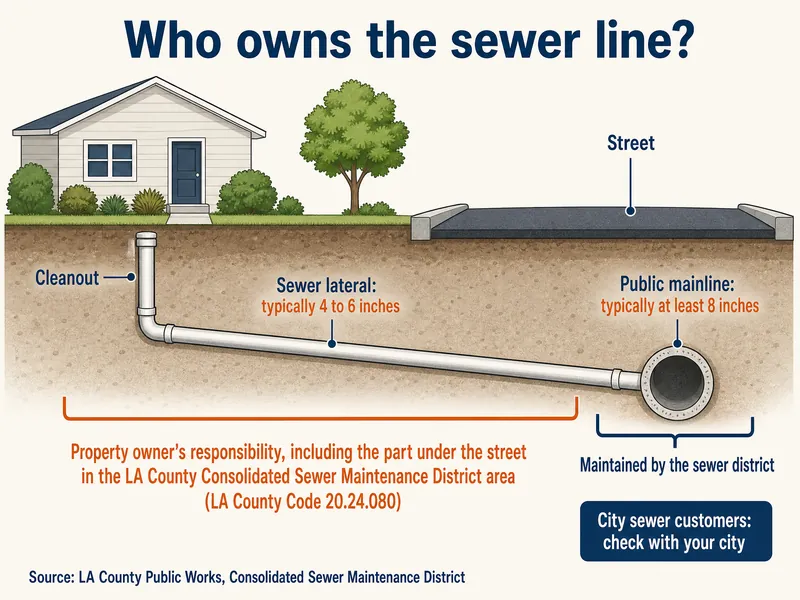
- In LA County's Consolidated Sewer Maintenance District, "the sewer laterals are entirely owned by the private property owner they serve", including the part under the street (LA County Public Works).
- County Code 20.24.080 requires owners to keep house laterals "in a safe and sanitary condition".
- Laterals typically run 4 to 6 inches in diameter; the district's mainline is typically at least 8 inches.
- The county itself runs CCTV (camera) inspections of sewers and mails notices when it finds roots or debris in a home's lateral.
- Clearing a stoppage needs no plumbing permit in LA County, but replacing pipe does (Title 28, Section 103.7).
- No agency publishes sewer replacement prices; this guide lists what drives the number instead.
Sewer lateral facts from LA County
- 4–6 inTypical diameter of a house sewer lateralLA County Public Works
- 8+ inTypical diameter of the district's public mainlineLA County Public Works
- 1953Laterals existing as of January 23, 1953, or built since, must be maintained by the owner (County Code 20.24.080)LA County Public Works
How much does sewer line replacement cost?
Sewer line replacement cost depends on how long and deep the lateral is, whether it can be replaced without digging a full trench, what lies on top of it (lawn, concrete, a driveway or a street), and whether the work reaches into the public right of way. This guide found no agency that publishes a price range, and national cost websites can't account for an Antelope Valley lot's depth, soil or street work.
Ask for written bids that all work from one set of camera findings. Each should state:
- Length and depth of pipe to be replaced, from the house cleanout to the connection at the main.
- Method: open trench, pipe bursting or lining, and why.
- Pipe material and size.
- Surface restoration: concrete, asphalt, landscaping, and who does it.
- Street work: any connection or digging in the public right of way and the extra permits it needs.
- Cleanout: whether a new two-way cleanout is included.
- Permits and inspections, and who pulls them.
Under CSLB's summary of AB 2622, an unlicensed person may take on only projects under $1,000 in total, with no hired workers and no building permit, so a permitted sewer job calls for a licensed contractor; see hiring a plumber in California for checking a license and reading a contract.
What does a sewer camera inspection show?
A sewer camera inspection shows the inside of the lateral on video: roots coming through joints, cracks, offset or separated joints, sags ("bellies") where water pools, grease buildup, and collapsed sections. It also measures where each problem is, so a contractor can dig or line only where needed.
LA County uses the same tool on public sewers. Its Consolidated Sewer Maintenance District says that through routine maintenance or its "Condition Assessment Program CCTV inspection project," crews find homes whose laterals have roots or debris and send the owners a notice. If one arrives, follow the steps in the letter, which the county says are meant to prevent a backup into the home or an overflow in the main.
Ask for the video file and a written summary with footage marks for each defect. The video is the basis for comparing quotes, and some owners have it reviewed by a second contractor before agreeing to a full replacement.
Trenchless or open trench: which costs less?
Neither method always costs less: trenchless sewer replacement avoids digging up the whole yard, which saves on restoration, but it needs a pipe in suitable condition and grade, while open trench works on almost any line and costs more to put the surface back. The camera footage decides which methods are possible.
| Method | How it works | Fits best when | Limits |
|---|---|---|---|
| Open trench | Dig along the line, replace the pipe, backfill | Collapsed pipe, sags, shallow lines under lawn | Most surface damage; concrete and landscaping to restore |
| Pipe bursting | A new pipe is pulled through, splitting the old one outward | Full replacement under a driveway or slab | Needs access pits at each end; not for every soil or pipe |
| Lining (cured-in-place) | A resin-soaked liner hardens inside the old pipe | Cracks and root entry in pipe that still holds its shape | Doesn't fix sags or collapsed sections; slightly smaller bore |
| Spot repair | Dig and replace one section | One broken joint or short damaged run | Other weak spots remain |
Desert soil can add digging cost where hard layers such as caliche sit near the surface, and a line under a concrete driveway costs more to restore than one under gravel. Neither changes the decision rule: use the camera to choose the least invasive method that actually fixes the defects found.
When is a sewer line repair enough?
A repair is enough when the camera shows one or two defects in pipe that is otherwise sound: a single root intrusion at a joint, one cracked section, or a short offset. Full replacement makes sense when defects run the length of the line, the pipe has collapsed or bellied, or it has needed clearing again and again.
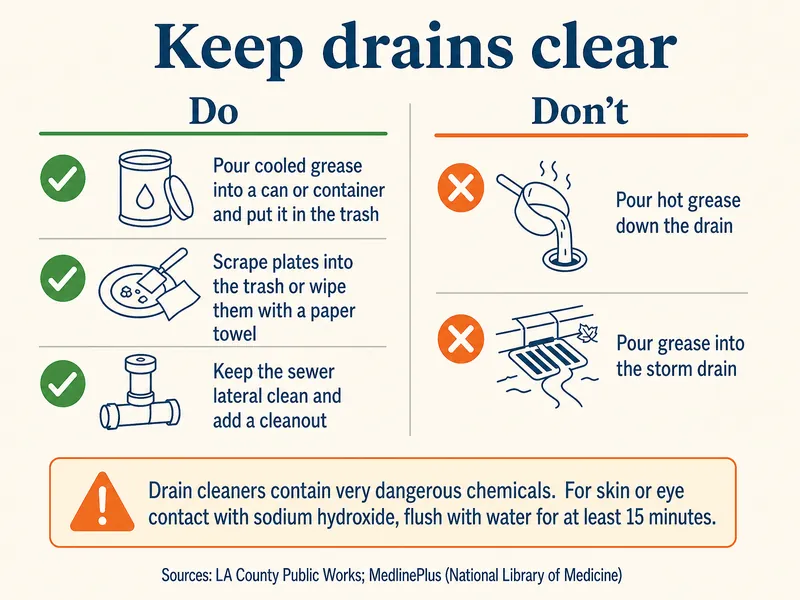
Roots and grease are the problems owners can slow down. LA County's homeowner page lists three habits: maintain the lateral through cleaning, repair and replacement; keep fats, oils and grease out of drains, because they "harden and stick to the inside of the sewer pipes"; and install a backflow preventer and cleanout on the lateral. The drain cleaning guide covers clearing roots and grease.
Who owns the sewer line to the main?
The property owner owns the sewer line all the way to the main in LA County's sewer maintenance district, not just the part in the yard. The county says the laterals "extend from the building to the mainline within the street (or within an easement at the rear of your home)," and that the owner "is responsible for the entire length of the lateral," including the portion "under the asphalt and street landscaping."
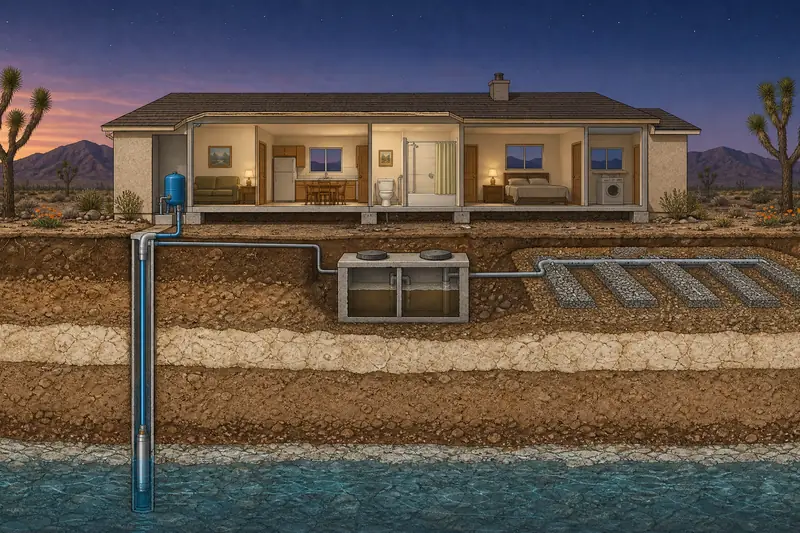
The county's sewer maintenance districts serve unincorporated areas plus 37 cities, over 500,000 parcels in all. A home in Lancaster or Palmdale may fall under a city's own sewer rules instead: the diagram above shows the county district's rule, and city sewer customers should check with their city's public works department before assuming who maintains what. Homes outside any sewer area are on septic; the septic system basics page covers those.
Some homes also need a backwater valve. LA County says properties whose lowest fixture drain sits lower than the upstream manhole of the public sewer need one to keep a backup in the main from coming up through the house, and that the valve needs regular maintenance.
Do you need a permit to replace a sewer line?
Yes: swapping out the lateral counts as replaced plumbing, so the local building office must issue a permit first. LA County Public Works lists "new, expanded, or replaced plumbing items" among the work that generally needs a permit, while Title 28, Section 103.7 exempts only clearing stoppages and repairing leaks without replacing pipe.
Work in the street adds another layer. The county's sewer maintenance pages list a separate "Tap & Saddle Installation Permit" for connections to its mainlines, and digging in a public road may need its own permit from whoever owns the road. To find the right counter for an address, start with California plumbing code and permits.
How we put this page together
This page is based on LA County Public Works' Consolidated Sewer Maintenance District customer information and homeowner pages (including County Code 20.24.080), its Building and Safety permit pages and the Title 28 permit exemptions, and CSLB's AB 2622 announcement. Checked in October 2026. Left out: sewer replacement, lining and camera inspection prices (no agency source), City of Lancaster and City of Palmdale lateral rules (not confirmed from the cities' own pages), and Sanitation District service boundaries.
Common questions
How deep is a house sewer line?
It varies with the lot's slope and the distance to the main, since the line has to fall steadily toward the street. The camera inspection and the contractor's locator give the depth along the run.
Can tree roots be cleared without replacing the line?
Yes, a cable machine or water jetting cuts roots out, but they grow back through the same joints. Repeated root clearing is a sign to price lining or a spot repair.
What is a sewer cleanout?
A capped pipe that gives access to the lateral for clearing and camera work, usually near the house or the property line. LA County recommends installing one on the lateral.
Will homeowners insurance pay to replace a sewer line?
Policies generally exclude wear and tear, and the California Department of Insurance lists it among perils generally not covered. Ask the insurer what the policy says about underground service lines before a problem starts.
What should an owner do with a county lateral notice?
Follow the actions in the letter. LA County sends these when its maintenance crews or camera program find roots or debris in a lateral that could back up into the home or the main.
Is a sewer camera inspection worth it before buying a house?
For an older home it is a common step, because the buyer takes over responsibility for the whole lateral. Ask the seller for any past video or clearing records.
More on pipes and drains
More help: see our guide to Antelope Valley home water.