
Septic
Seepage Pit vs Leach Field Explained
A seepage pit sends septic tank effluent down a deep lined hole, while a leach field spreads it sideways through shallow trenches; LA County allows both under different soil and groundwater rules.
On this page
Key takeaways
- California's OWTS Policy, as quoted in LA County's 2018 septic plan, defines a seepage pit as a drilled or dug hole 3 to 6 feet across, lined or gravel-filled.
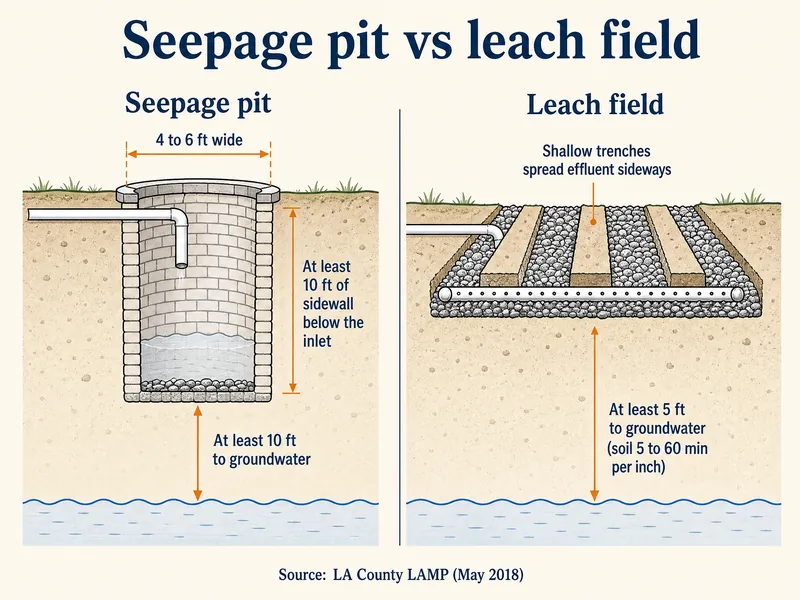
- LA County's design rules call for pits 4 to 6 feet in diameter with at least 10 feet of sidewall below the inlet pipe.
- The bottom of a seepage pit must sit at least 10 feet above groundwater; a conventional leach field in soil percolating at 5 to 60 minutes per inch needs 5 feet.
- A new home with more than 4 bedrooms that uses a seepage pit needs an advanced treatment system (NOWTS), per the county's LAMP FAQ.
- The EPA says a drainfield more than 25 to 30 years old may be near the end of its useful life.
- Pumping more than twice in 6 months is treated by LA County as a failed dispersal system, not a full tank.
Seepage pit design numbers
- 3–6 ftSeepage pit diameter in the state definition quoted by LA CountyLA County LAMP, 2018
- 10 ftMinimum effective sidewall below the pit's inlet pipeLA County LAMP, 2018
- 5xPit volume must be at least five times the tank volume divided by the absorption rateLA County LAMP, 2018
- 4 bedroomsLargest new home allowed a conventional seepage pit without an advanced systemLA County Public Health LAMP FAQ
What is a seepage pit?
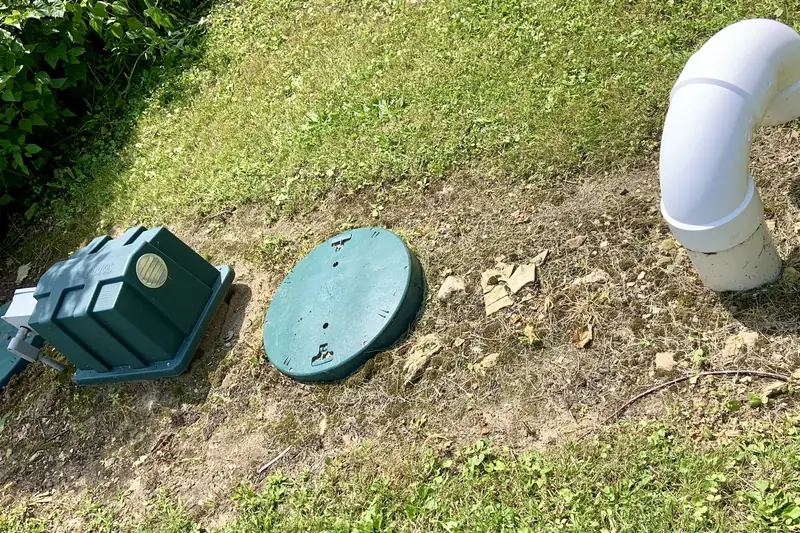
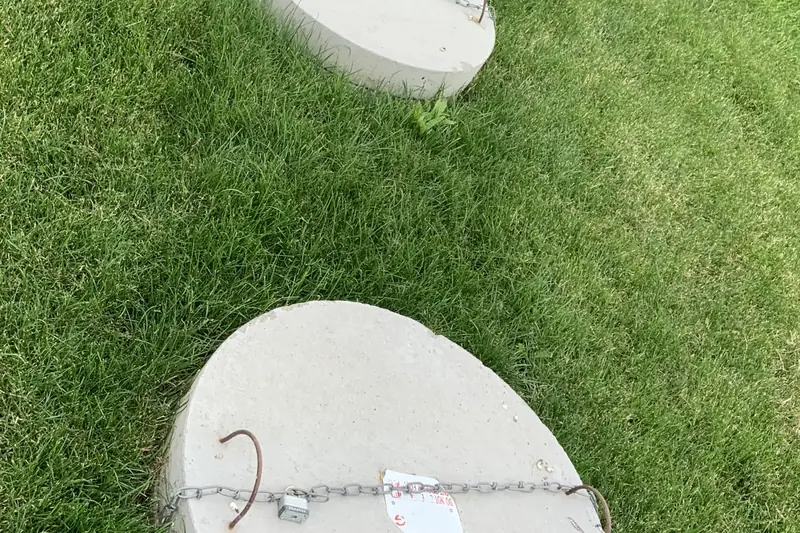
A seepage pit is a deep, covered hole that takes the liquid leaving a septic tank and lets it seep into the surrounding soil through its walls and floor. California's OWTS Policy definition, repeated in LA County's Local Agency Management Program (LAMP), describes "a drilled or dug excavation, three to six feet in diameter, either lined or gravel filled, that receives the effluent discharge from a septic tank."
LA County's own design section is more specific. It describes one or more circular excavations 4 to 6 feet in diameter, lined inside with 6 inches of gravel and sewer brick or concrete liners, with a minimum effective sidewall of 10 feet below the inlet pipe. A variant called a gravel-packed pit is filled with washed gravel of 3/4 to 2 1/2 inches up to the cap, and every seepage pit rule applies to it as well.
A seepage pit is not a cesspool. The LAMP draws the line plainly: a cesspool has no septic tank in front of it and is not authorized under the state policy, while a seepage pit only ever receives effluent that has already passed through a tank.
How is a seepage pit different from a leach field?
The difference is direction and depth. A leach field, which the EPA calls a drainfield, spreads effluent through perforated pipe in shallow gravel trenches so it soaks into a wide, near-surface patch of soil. A seepage pit puts the same volume into a small footprint and relies on deeper soil layers to take it.
That trade shows up in the rules. In LA County, a conventional leach field needs soil that percolates between 5 and 60 minutes per inch and at least 5 feet between the bottom of the trenches and groundwater; in faster soil (1 to under 5 minutes per inch) the separation rises to 20 feet. Seepage pits are tested a different way, in gallons absorbed per square foot of wall per day, and need 10 feet of separation to groundwater. Trenches must be at least 4 feet apart, and pits must be sized to hold at least five times the septic tank volume divided by the rate absorbed in the percolation test.
| Feature | Seepage pit | Leach field (conventional) |
|---|---|---|
| Shape | Circular pit, 4 to 6 ft across, 10 ft+ sidewall below inlet | Gravel trenches at least 4 ft apart |
| Soil test | 0.83 to 5.12 gallons per square foot per 24 hours | 5 to 60 minutes per inch |
| Depth to groundwater | At least 10 ft below the pit bottom | At least 5 ft (20 ft in soil at 1 to under 5 minutes per inch) |
| Distance from buildings | 8 ft | 8 ft |
| Distance from a neighboring property line | 8 ft | 5 ft |
| New-home limit | Conventional only up to 4 bedrooms or a 1,200-gallon tank | Set by soil, setbacks and lot density |
Why are seepage pits common in LA County?
LA County's rules allow seepage pits mainly where there is not enough surface area for trenches. The LAMP permits a new pit on an existing conventional system when it is needed for the future expansion area, the soil passes the percolation test, and "inadequate surface area exists for leach lines or a leach field." On a small or crowded lot, a hole a few feet wide fits where 4-foot-spaced trenches do not.
For new homes the county is stricter. A new house may use a seepage pit with a conventional tank only if it is a single dwelling of up to 4 bedrooms or a 1,200-gallon tank, meets every setback, and the soil profile includes no bedrock; larger homes need a NOWTS that treats the effluent first. The county's LAMP FAQ also confirms that existing seepage pits are allowed and may be replaced when they fail.
The county documents read for this page do not count how many Antelope Valley homes use pits rather than trenches, so this guide does not estimate it. Ask LA County Public Health for the permit and as-built drawing to learn which one a particular lot has; the septic system basics page covers where those records come from.
What are the signs a seepage pit is failing?
The clearest sign is a tank that keeps filling because the pit or field is no longer taking water. LA County's FAQ defines a failed system as one that lets sewage back up into the house, reach the ground surface, discharge somewhere other than intended, contaminate water, or that "requires frequent pumping to prevent one of the above conditions," and it counts more than two pumpings in six months as frequent. Pumping that often, it explains, can mean the soil below the dispersal system is clogged.
The EPA's list of warning signs on its malfunctions page applies to pits and fields alike: drains backing up or running slowly, gurgling plumbing, damp spots or standing water over the tank or dispersal area, sewage odors outside, and unusually green grass there in dry weather.
When a system fails in LA County, Public Health requires the owner to have it inspected by a licensed, qualified septic contractor to decide between repair and replacing the dispersal system. The septic inspection page describes what that evaluation covers.
How long does a leach field or seepage pit last?
The EPA gives the only agency lifespan figure found: when a drainfield is more than 25 to 30 years old, the biomat that forms at the bottom of its trenches can thicken until the soil no longer takes the water, and a system that age should be planned for an upgrade before it fails. The EPA's septic FAQ gives no separate figure for seepage pits, and neither do the LA County documents, so this page does not invent one.
Upkeep stretches the life of either design. The EPA says solids that escape a tank overdue for pumping migrate into the dispersal area and clog it, and that heavy water use on a single day can flood it. Keeping roof drains away, not driving over the area, and pumping on schedule (see septic tank pumping) protect the soil, which is the part that wears out.
What does leach field replacement cost?
No agency publishes a seepage pit or leach field replacement price for the Antelope Valley, and LA County Public Health says it does not receive cost information. The nearest government figure is the EPA's national range of $5,000 to $15,000 to repair or replace a malfunctioning conventional system, with alternative systems costing more, from its page on maintaining a septic system.
Local rules shape the bill. A replacement dispersal system must meet current LAMP requirements, a geologist or similar professional evaluates the soil and groundwater depth, and if the lot cannot meet the percolation, setback or separation rules, the county says a NOWTS is most likely required, which adds a treatment unit and a yearly inspection. Where space for trenches is missing and pit percolation tests come in slower than 0.83 gallons per square foot per day, the LAMP says the property is not suitable for either a conventional or a non-conventional system. Ask for written quotes that itemize soil testing, permits, the dispersal work and any treatment unit.
How we put this page together
What this comparison rests on: LA County's Local Agency Management Program (May 2018), specifically its definitions, Table 3-2 on groundwater separation, Table 3-4 on setbacks, its seepage pit design section and its prohibitions, read from the copy attached to the Regional Board's 2018 approval; the Public Health FAQ on that program; and the EPA SepticSmart explainer, malfunctions page, maintenance page and septic FAQ. Rechecked October 2026. Not used: seepage pit prices or lifespans from contractor sites (none from an agency exists), a count of Antelope Valley pits (not published in these sources), and Kern County design rules for Rosamond (not verified).
Common questions
Can a failed seepage pit be replaced with another pit?
Often, yes. LA County's FAQ says existing seepage pits are allowed and may be replaced when they fail, but the replacement must meet current LAMP rules, including the 10-foot groundwater separation and the percolation range.
How deep is a typical seepage pit in LA County?
The LAMP sets a minimum, not a typical depth: at least 10 feet of effective sidewall below the inlet pipe, with the bottom at least 10 feet above groundwater. Total depth depends on the percolation test and the tank size the pit must serve.
Can two seepage pits be connected one after the other?
No. The LAMP says multiple seepage pits must receive effluent from a distribution box rather than being connected in series.
Why does fast-draining desert soil need extra treatment?
LA County's FAQ explains that when wastewater percolates too fast, the soil pores do not filter out fecal bacteria and nitrate is not reduced, so a NOWTS adds treatment before the effluent reaches the ground.
Does a seepage pit need a septic tank in front of it?
Yes. Under the LAMP's definitions a seepage pit receives effluent from a septic tank or treatment unit; a pit that takes raw sewage with no tank is a cesspool, which the state policy does not authorize and the Regional Water Board phases out.
How close can a seepage pit be to the house?
LA County's setback table lists 8 feet from buildings or structures and 8 feet from a property line next to private property, measured in the clear.
Related guides
More help: see our guide to Antelope Valley home water.