
Hiring & permits
Hiring a Plumber in California: A Checklist
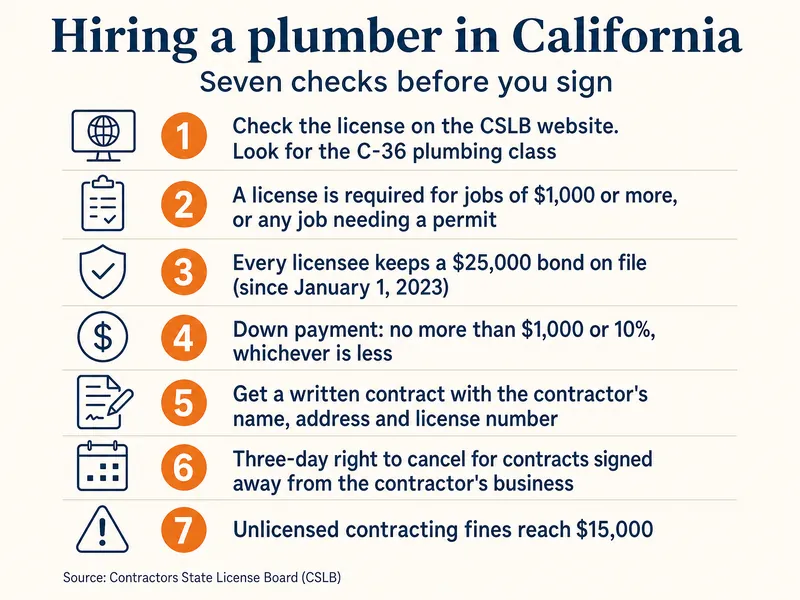
Hiring a plumber in California starts with the license: any job of $1,000 or more needs a contractor licensed by the CSLB, usually in the C-36 plumbing class, with a $25,000 bond on file.
On this page
Key takeaways
- Since January 1, 2025, a California contractor's license is required for any job of $1,000 or more in labor, materials and all other items, or any job needing a permit or hired workers (CSLB, AB 2622).
- The CSLB's C-36 plumbing classification covers water and gas piping from the owner's side of the meter, water heaters, backflow preventers, water conditioning equipment and regulating valves.
- Every licensed contractor must keep a $25,000 contractor's bond on file (since January 1, 2023), for consumers harmed by defective work or license law violations.
- CSLB's contract guide caps a home improvement down payment at $1,000 or 10 percent of the contract price, whichever is less.
- Penalties for unlicensed contracting include administrative fines of up to $15,000 and up to six months in jail.
- The Bureau of Labor Statistics puts the 2025 national median wage for plumbers, pipefitters and steamfitters at $30.67 an hour; that is what workers earn, not what customers are billed.
California rules for hiring a plumber
- $1,000Job total at which a CSLB license becomes required (from January 1, 2025)CSLB
- $25,000Contractor's bond every licensee must keep on fileCSLB
- $15,000Maximum administrative fine for unlicensed contractingCSLB
- $30.67National median hourly wage of plumbers, pipefitters and steamfitters, 2025 (wages, not billed rates)U.S. Bureau of Labor Statistics
How do you check a California plumber's license?
To check a California plumber's license, enter the license number or business name in the Contractors State License Board's online license check, then confirm four things: the license is active, it includes the C-36 plumbing class, a contractor's bond is on file, and workers' compensation insurance is listed if the business has employees.
Match the name and address on the license to the name on the bid: the contract must show the contractor's name, business address and license number. If a salesperson rather than the contractor wrote the bid, the contract must also carry that person's home improvement salesperson registration number, which the same CSLB tool can check.
Do this before any money changes hands. A license check takes a few minutes and is the single most useful step in hiring.
What is a C-36 plumbing contractor?
A C-36 plumbing contractor is a CSLB license class for plumbing work. The CSLB defines it as providing "a means for a supply of safe water, ample in volume and of suitable temperature for the purpose intended and the proper disposal of fluid waste from the premises."
The class lists specific work, including:
- Water and gas piping "from the property owner's side of the utility meter to the structure."
- "Installation of any type of equipment to heat water," including solar water heating.
- On-site waste disposal systems and complete removal of waste from the premises.
- Maintenance and replacement of health and safety devices such as gas earthquake valves, backflow preventers, "water conditioning equipment and regulating valves."
So water heaters, softeners, pressure regulators and repipes all fall inside C-36. For a plumbing job, look for C-36 among the classes listed on the license.
| Situation | Rule | Source |
|---|---|---|
| Job under $1,000 total, no permit, no hired workers | An unlicensed person may do it, and ads must say they are not licensed | CSLB, AB 2622 |
| Job of $1,000 or more, or any permit, or any hired workers | License in the right class required | CSLB, AB 2622 |
| Down payment on a home improvement contract | Not more than $1,000 or 10 percent of the price, whichever is less | CSLB Contracting for Success |
| Service and repair contract (customer-requested, $750 or less, paid on completion) | A single service charge, with trip and inspection fees counted inside it | CSLB Contracting for Success |
| Contract signed away from the contractor's business | Three-day right to cancel notice required | CSLB Contracting for Success |
| Repair after a declared state or local emergency | Seven-day right to cancel notice required | CSLB Contracting for Success |
What does a plumber cost per hour?
Plumber cost per hour is not published by any agency for California or the Antelope Valley, so this guide gives no rate. What a homeowner pays combines labor, a trip or service charge, materials, permits and overhead, and companies price these differently: some charge by the hour, others a flat price per job.
The only government figure is a wage, not a price. The U.S. Bureau of Labor Statistics reports a 2025 median pay of $30.67 an hour ($63,800 a year) for plumbers, pipefitters and steamfitters nationwide. A company's billed rate covers that wage plus vehicles, insurance, the bond, licensing, training and profit, so it is always higher.
The better question for a bid is "what is the total for this job?" For small repairs, California's service and repair contract rules limit the customer to one service charge, trip and inspection fees included, according to CSLB's guide.
How should you compare plumbing bids?
Compare plumbing bids on the same written scope, line by line, rather than on the bottom number. Two or three bids for a larger job (a water heater, a repipe, a sewer line) are enough to see where prices differ and why.
For each bid, check:
- Scope: what is included and excluded, written as specifically as the job allows.
- Materials and equipment: brand, model, size and pipe type.
- Permit: who pulls it, and whether inspection is included.
- Payment schedule: down payment within the legal limit, progress payments tied to work completed.
- Cleanup and restoration: drywall, concrete, landscaping.
- Warranty: what the contractor covers on labor, separate from the maker's warranty.
- License and bond: checked on the CSLB site, in the name on the bid.
For specific jobs, the repipe cost guide, sewer line guide and water heater replacement cost guide list what each quote should itemize.
What should a plumbing contract include?
A California home improvement contract must include the contractor's name, business address and license number, a description of the work and the significant materials and equipment, the contract price, the payment schedule, and the cancellation notice that applies. CSLB's Contracting for Success guide lists the required parts.
Other notices to look for:
- Down payment: no more than $1,000 or 10 percent of the contract price, whichever is less, and no payment for work or materials before the work is done or the materials delivered.
- Insurance notices: whether the contractor carries commercial general liability insurance, and a workers' compensation statement.
- Mechanics' lien warning: explains that unpaid subcontractors or suppliers can record a lien on the property, and how to protect against it.
- Right to cancel: three business days for most contracts signed away from the contractor's place of business.
- A completely filled-in copy signed by both parties before work starts.
Smaller jobs can use a simpler service and repair contract when all four CSLB criteria are met, including a price of $750 or less and no payment until the work is complete.
What are the red flags when hiring a plumber?
The biggest red flags are no license number, a license that doesn't match the name on the bid or lacks the C-36 class, a demand for a large payment up front, and pressure to skip the permit. Each one removes a protection the law gives the homeowner.
Watch for:
- Cash-only deals and big deposits. A down payment above $1,000 or 10 percent breaks the state's limit on home improvement down payments.
- "No permit needed" on replacement work. In LA County, replacing pipes, water heaters or other plumbing items needs a permit; only leak repairs and clearing stoppages without replacing parts are exempt. The code and permits page explains who issues them.
- Splitting a job into pieces under $1,000 to avoid the license rule.
- Becoming an "owner-builder" at a consultant's urging. CSLB warns that anyone who talks a homeowner into acting as their own general contractor "may be doing you no favor": the owner then takes on responsibility for taxes, workers' compensation and the work's integrity.
- Door-to-door offers after a storm or emergency. For repairs after a declared emergency, the contract must give a seven-day right to cancel.
Report unlicensed activity or a contract problem to the CSLB.
How we put this page together
This page is based on CSLB's AB 2622 press release (December 30, 2024), its C-36 Plumbing classification text, its bond requirements page, its Contracting for Success guide to home improvement contracts, its owner-builder caution notice, and the U.S. Bureau of Labor Statistics Occupational Outlook Handbook entry for plumbers, pipefitters and steamfitters (2025 median pay). Checked in October 2026. Left out: plumber hourly and call-out rates (no agency source), named companies or rankings, and online review scores.
Common questions
Does a handyman need a license for plumbing work in California?
Only if labor and materials together come to $1,000 or more, the job needs a permit, or it uses hired workers, under the state law AB 2622. Under that line an unlicensed person may do the work, but must say in any ad that they are not licensed.
Can a plumber ask for full payment up front?
Not on a home improvement contract: the down payment is limited to $1,000 or 10 percent of the price, whichever is less, and later payments shouldn't run ahead of the work done or materials delivered.
What does the contractor's bond actually cover?
CSLB says the $25,000 bond is for consumers damaged by defective construction or other license law violations, and for employees owed wages. It is a limited fund, not full insurance for a large loss.
How can a homeowner check for complaints against a plumber?
Start with the CSLB license check, which shows whether the license is active and what bond and insurance are on file; the CSLB also takes complaints about licensed and unlicensed contractors.
Is a verbal quote enough for a small repair?
A written contract protects both sides. For small customer-requested jobs of $750 or less paid on completion, CSLB's service and repair contract format applies, with a single service charge.
Does a softener or water heater installer need a C-36 license?
CSLB's C-36 class includes water heating equipment and water conditioning equipment, and jobs of $1,000 or more need a license in the appropriate class.
Related guides
More help: see our home page on Antelope Valley home water.