
Pipes & leaks
Water Pressure Regulator: High, Low and Hammer
A water pressure regulator is the bell-shaped valve on the main line that cuts street pressure down for the house; California's plumbing code requires one where pressure exceeds 80 psi.
On this page
Key takeaways
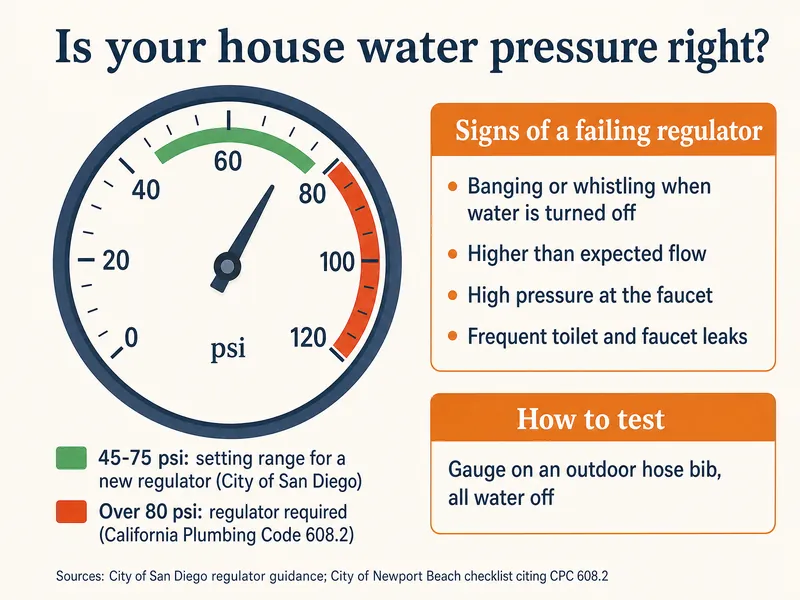
- California Plumbing Code section 608.2 requires a pressure regulator when water pressure exceeds 80 psi, as a City of Newport Beach inspection checklist notes.
- The City of San Diego's regulator guidance says a new regulator should be set between 45 and 75 psi.
- San Diego lists the signs of a failing regulator: banging or whistling in the pipes when water shuts off, unusually strong flow, high pressure at faucets, and frequent toilet and faucet leaks.
- A pressure gauge on an outdoor hose bib is the standard home test; San Diego notes gauges sell for "a nominal cost" at hardware stores.
- Replacing a regulator is replacing a plumbing item, which needs a permit in LA County (LA County Public Works); CSLB's C-36 plumbing class covers "regulating valves".
Pressure numbers from code and agency sources
- 80 psiPressure above which a regulator is required (CPC 608.2)City of Newport Beach inspection checklist
- 45–75 psiRange to which a new regulator should be setCity of San Diego
- 15 minutesMinimum leak-free pressure test for new water piping (CPC 609.4)City of Newport Beach inspection checklist
What does a water pressure regulator do?
A water pressure regulator (also called a pressure reducing valve, or PRV) lowers the pressure of water coming from the street main to a steady level the house plumbing and appliances are built for. San Diego's guidance describes it as reducing incoming pressure from the city mains to "a lower, more functional pressure in the home to match fixture and appliance ratings."
The regulator sits on the main line after the meter, usually near where the pipe enters the house. San Diego lists the common spots: in the garage, on the side of the house, in a box or buried just before the pipe enters, or near the water heater. It looks like a brass bell with an adjusting screw and lock nut on top. It is part of the house plumbing, on the owner's side of the meter.
What water pressure should a house have?
A house should have water pressure at or below 80 psi, the level above which the California Plumbing Code requires a regulator (CPC 608.2, as cited in Newport Beach's checklist). San Diego's guidance sets new regulators between 45 and 75 psi, which is a practical target for most homes.
Pressure from the main depends on where a house sits in the water system: homes downhill from a tank or reservoir see higher street pressure than those uphill. The valley has several separate public water systems, so two neighbors on different suppliers can see different numbers; this supplier lookup matches addresses to systems.
| Static reading at a hose bib | What it suggests | Source for the threshold |
|---|---|---|
| Over 80 psi | Regulator missing, failed or set too high; code calls for one | CPC 608.2 (Newport Beach checklist) |
| 45–75 psi | Within the range San Diego advises for a new regulator | City of San Diego |
| Below 45 psi | Low for comfort; check valves, the regulator and pipes before blaming the supply | City of San Diego range |
| Swings up overnight | Possible thermal expansion in a closed system; see expansion tanks | CPC 608.3 (copy brief) |
How do you test your water pressure?
To test water pressure, screw a pressure gauge onto an outdoor hose bib near the regulator, make sure no water is running anywhere in the house, open the bib fully and read the gauge. San Diego's guidance suggests exactly this: "Use a pressure gauge on a hose bib attached to the house," with gauges sold at hardware stores for a nominal cost.
Take a second reading late at night or early in the morning, when neighbors' use is low and street pressure is highest. A gauge with a "max" needle (a lazy hand that stays at the peak) catches spikes from thermal expansion or a creeping regulator. If the reading is above 80 psi, the regulator is missing, failing or set too high.
What causes low water pressure in a house?
Low water pressure in a house usually comes from something on the owner's side: a partly closed valve, a clogged aerator or showerhead, a failing regulator, or old pipe narrowed by rust and scale. If every fixture is weak, start at the main valve and the regulator; if one fixture is weak, start at that fixture.
Work through it in this order:
- Check the main valve is fully open, especially after recent plumbing work.
- Clean aerators and showerheads; mineral deposits from moderately hard Antelope Valley water collect in their screens. The hard water stains guide covers descaling.
- Test the pressure at a hose bib. A low reading with the main open points to the regulator or the supply.
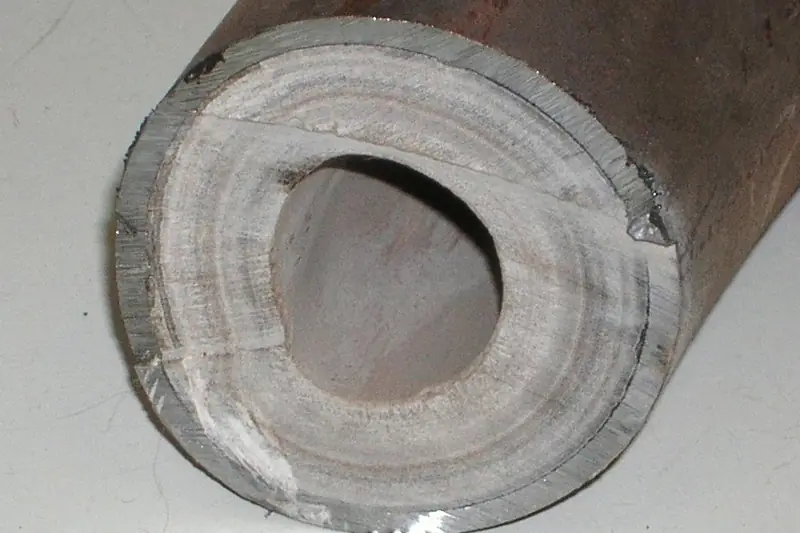
- Look at the pipe. Galvanized steel rusts from the inside as its zinc coating wears; EPA's definition of a galvanized service line is iron or steel dipped in zinc to prevent corrosion. The repipe guide covers replacement.
- On a well, pressure comes from the pump and pressure tank, not a regulator; see the well pressure tank guide.
If neighbors on the same street also have low pressure, ask the water district; the problem may be on the supply side.
What causes water hammer?
Water hammer is the bang in the pipes when a valve closes quickly and moving water stops suddenly, sending a pressure surge back through the line. Washing machine and dishwasher valves close fast, so they are common triggers, and the bang is louder when house pressure is high.
San Diego lists "banging or high pitched whistling sound coming from the pipes usually when the water is being turned off" among the signs of a damaged regulator. So the first check for water hammer is the same gauge test: if pressure is over 80 psi, fix the regulator before anything else. Loose pipe straps that let lines rattle, and missing water hammer arrestors at quick-closing valves, are the other usual causes; a licensed plumber can add arrestors and secure the pipe.
When does a pressure regulator need replacing?
A pressure regulator needs replacing when it can no longer hold pressure at the set level: the gauge reads over 80 psi or keeps creeping up, adjusting the screw changes nothing, or the signs San Diego lists (banging, whistling, strong flow, frequent leaks) keep coming back. This guide found no agency source for a typical regulator life span, so it gives none.
Two code points travel with a new regulator. First, ask whether the new regulator will keep household pressure from flowing back to the main: the code's section 608.3, quoted in San Bernardino County's water heater handout, wants an expansion tank whenever some device on the line blocks heated, expanding water from pushing back toward the street; the expansion tank guide explains it. Second, replacing a regulator is replacing a plumbing item, which needs a permit in unincorporated LA County. The work falls under the CSLB's C-36 plumbing classification, which lists "regulating valves" among its items.
How we put this page together
Sources: Newport Beach's plumbing inspection list for copper repipes, citing California Plumbing Code sections 608.2 and 609.4, the City of San Diego Public Utilities pressure reducing valve guidelines (March 2018), EPA's October 2024 service line inventory summary for its definition of galvanized pipe, LA County Public Works permit pages, the CSLB C-36 classification text, and the CPC 608.3 excerpt in a San Bernardino County water heater handout. Checked in October 2026. Left out: regulator prices and life spans (no agency source), and maker-specific adjustment steps.
Common questions
Can a homeowner adjust a pressure regulator?
Most regulators have an adjusting screw and lock nut, and San Diego's guidance describes owners adjusting pressure into the 45 to 75 psi range. Make small turns, re-test at a hose bib each time, and stop if the screw has no effect.
Is 100 psi water pressure dangerous?
It is above the 80 psi level at which the plumbing code calls for a regulator, and high pressure strains fixtures, valves and appliance hoses. San Diego links high pressure to frequent toilet and faucet leaks.
Why did pressure drop after a new regulator?
A new regulator may be set lower than the old, failing one let through. Re-test and adjust within the 45 to 75 psi range San Diego gives.
Does the water district fix the regulator?
The regulator is on the owner's side of the meter, so it is part of the house plumbing. The district can say whether street pressure in the area is unusually high or low.
Can high pressure cause a slab leak?
High pressure adds stress to every joint, and San Diego's guidance links lower pressure with fewer leaks. It is one factor among several; the slab leak guide covers the others.
Does a regulator need a permit?
Replacing one is a replaced plumbing item, which needs a permit in unincorporated LA County. Cities such as Lancaster and Palmdale issue their own plumbing permits.
Related guides
More help: see our home water guide for the Antelope Valley.