
Hiring & permits
California Plumbing Code and Permits Explained
The California Plumbing Code is Part 5 of Title 24; its 2025 edition took effect January 1, 2026, and the city or county building department for the address enforces it and issues plumbing permits.
On this page
Key takeaways
- The California Plumbing Code is Part 5 of the California Building Standards Code (Title 24); the 2025 edition was published July 1, 2025 and took effect January 1, 2026.
- The code text can be read free online through its publisher, IAPMO.
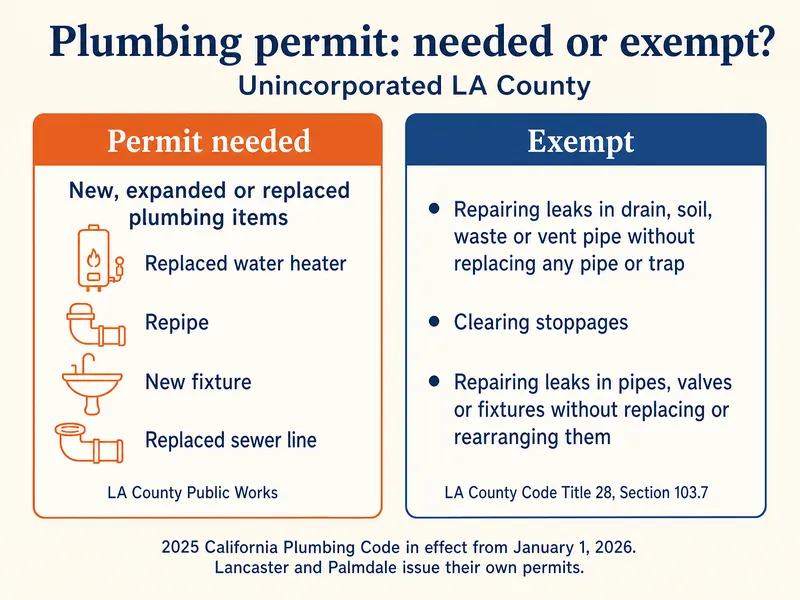
- In unincorporated LA County, "new, expanded, or replaced plumbing items" generally need a permit (LA County Public Works); clearing stoppages and repairing leaks without replacing parts are exempt under County Code Title 28, Section 103.7.
- The City of Palmdale takes all permit applications through its Accela Citizen Portal; Lancaster homes go to the City of Lancaster, and unincorporated areas to LA County Public Works.
- A permit is issued only to a licensed contractor, to the property owner in certain cases, or to an agent for either, according to LA County Public Works.
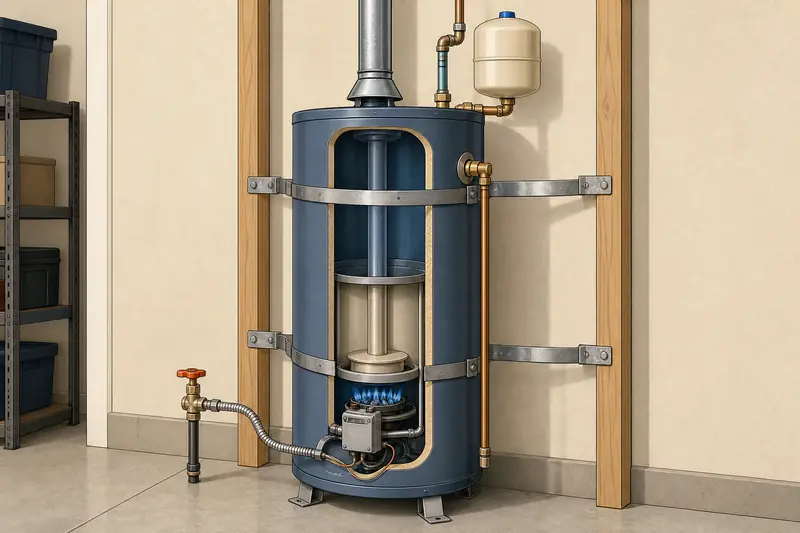
- California law (Health and Safety Code section 19211) requires water heaters to be braced, anchored or strapped against earthquakes; the plumbing code sets where the straps go.
Code and permit facts
- Jan 1, 2026Effective date of the 2025 California Plumbing Code (Title 24, Part 5)California Building Standards (CBSC)
- 12 monthsTime to start work before an LA County permit expires; work may not lapse more than 180 days afterLA County Public Works
- 80 psiPressure above which a regulator is required (CPC 608.2), per a city inspection checklistCity of Newport Beach
- $1,000Job size at which a CSLB contractor's license is requiredCSLB
What is the California Plumbing Code?
The California Plumbing Code (CPC) is the state's set of minimum rules for water supply, drainage, venting, water heaters and fuel gas piping in buildings, published as Part 5 of the California Building Standards Code, Title 24 of the California Code of Regulations. The state's building standards agency, known as CBSC, adopts a new edition every three years: the 2022 edition took effect January 1, 2023, and the 2025 edition on January 1, 2026.
IAPMO publishes the California edition, and the CBSC code page links to a free online view. Cities and counties can adopt local amendments on top of it, and LA County publishes its version as County Code Title 28. Which edition governs a given job, and how, is the local building department's call, so ask when applying.
A few CPC rules come up often on homeowner jobs, as cited in a City of Newport Beach plumbing inspection checklist: a regulator where pressure exceeds 80 psi (608.2), a shutoff valve after the meter (605.2), a 15-minute leak-free pressure test of new piping (609.4), and backflow protection on hose bibs (603.4.7). The repipe guide lists more.
Who enforces the plumbing code in the Antelope Valley?
The plumbing code is enforced by the building department for the address: the city for homes inside Lancaster or Palmdale, LA County Public Works for unincorporated areas, and Kern County for Rosamond. This guide is not any of these offices; check each one's own site for current forms and fees.
| Area | Building department | How to apply |
|---|---|---|
| City of Palmdale | City of Palmdale Building and Safety | All permit applications through the city's Accela Citizen Portal; inspections scheduled online |
| City of Lancaster | City of Lancaster Building and Safety | See the city's site, cityoflancasterca.org |
| Unincorporated LA County (for example Quartz Hill, Littlerock, Pearblossom, Lake Los Angeles, Acton) | LA County Public Works, Building and Safety (Antelope Valley office) | EPIC-LA online portal or the district office for the address |
| Rosamond and other Kern County areas | Kern County | Kern County's own permit offices |
Some work needs a second agency. LA County Public Works notes that installing a private septic system needs Health Department approval before the building permit is issued, and Palmdale requires a construction and demolition waste plan with permit applications under the CalGreen code. Water and sewer connections may also need the water district or sewer agency's sign-off; the who supplies my water page lists the suppliers.
When do you need a plumbing permit?
A plumbing permit is needed whenever plumbing is added, enlarged or swapped out: a new water heater, a repipe, a new sewer lateral, an extra fixture, a different pressure regulator. That is how LA County Public Works frames it on its permit page.
Title 28, Section 103.7 spells out what does not. In unincorporated LA County, no plumbing permit is needed for:
- Repairing leaks in drain, soil, waste or vent pipe, as long as no trap or pipe is replaced.
- Clearing stoppages, or repairing leaks in pipes, valves or fixtures, when the repair does not replace or rearrange valves, pipes or fixtures.
Skipping a required permit has costs later. LA County Public Works says work done without a required permit "is illegal construction," and lists the risks: lower resale value, extra cost to permit or demolish the work, "denial of insurance claims, possible civil or criminal prosecution," and uncertainty about safety and quality.
Can a homeowner do their own plumbing in California?
Yes, a homeowner can do plumbing on their own home in many cases, as an "owner-builder," but the work still needs any required permit and inspection. LA County Public Works says a permit can be issued to a licensed contractor, "to the property owner in certain cases," or to an authorized agent, and that most construction projects require qualified, licensed contractors.
The CSLB urges caution. Its owner-builder notice says that signing a permit application as an owner-builder means taking "full responsibility for all phases of your project and its integrity," possibly including taxes, workers' compensation and liability for anyone hired. Once someone else is paid for a job of $1,000 or more, or one that needs a permit, they must be licensed; see hiring a plumber in California for the license lookup.
How do Lancaster and Palmdale permits work?
Homes inside Lancaster or Palmdale city limits get plumbing permits from the city, not the county. Palmdale's Building and Safety page says all permit applications go through the Accela Citizen Portal, plan reviews are done electronically, and inspections are scheduled online.
For Lancaster, use the City of Lancaster's own building and safety pages at cityoflancasterca.org for applications, fees and inspection scheduling; this guide did not verify the city's current forms. For a home outside both cities, LA County Public Works' Antelope Valley building and safety office and its EPIC-LA portal handle permits. In unincorporated LA County, a permit expires if work hasn't started within 12 months of issue or lapses for more than 180 days, with 180-day extensions available on written request.
What does the code say about water heaters and softeners?
For water heaters, the code sets strapping, venting, relief valve and expansion rules, and state law adds a seismic requirement. California Health and Safety Code section 19211 requires water heaters to be braced, anchored or strapped to resist earthquake motion. The CPC excerpts in a San Bernardino County handout put the straps "within the upper 1/3 and the lower 1/3" of the heater's height, with the lower strap at least 4 inches above the controls (CPC 507.2).
The same handout covers three more points. In a garage, a gas unit's burner and igniter sit 18 or more inches off the floor (unless the heater is a flammable-vapor-ignition-resistant model) and need protection from cars (507.13). If a check valve or similar device keeps expanding hot water from backing out to the street, an expansion tank goes in (608.3). And the relief valve's drain line runs to the outdoors at full outlet size (608.5). The water heater earthquake straps guide and expansion tank guide go further.
For water softeners, this guide found no CPC section to quote, so it gives no code rule. Two related points are sourced: the CSLB's C-36 plumbing class includes "water conditioning equipment," and replacing a plumbing item generally needs a permit in LA County. Whether a softener's brine discharge is allowed is a sewer agency question: check with the sanitation district that serves the home. The softener decision guide covers whether one is worth it on Antelope Valley water.
How we put this page together
This page is based on the CBSC's Title 24 code page (2022 and 2025 editions), LA County Public Works' building permit pages and list of work exempt from permits (County Code Title 28, Section 103.7), the City of Palmdale Building and Safety page, CSLB's owner-builder notice, C-36 classification and AB 2622 announcement, a City of Newport Beach plumbing inspection checklist, and the San Bernardino County water heater handout quoting CPC 507.2, 507.13, 608.3 and 608.5. Checked in October 2026. Left out: permit fees (not confirmed for any office), the City of Lancaster's current permit process (its site could not be loaded), Kern County details, quoted text of Health and Safety Code section 19211, and any softener-specific code rule.
Common questions
Does replacing a water heater need a permit?
Yes, in unincorporated LA County a replaced plumbing item needs a permit, and the inspection checks strapping, venting and the relief valve drain. Lancaster and Palmdale homes get the permit from their city.
Which edition of the plumbing code applies to a job?
The building department for the address decides which edition applies; the 2025 California Plumbing Code has been the current state edition since January 1, 2026.
Can a handyman pull a plumbing permit?
LA County issues permits to licensed contractors, property owners in certain cases, or their authorized agents. Any job needing a permit requires a licensed contractor if someone is hired to do it.
What happens if past work was done without a permit?
LA County Public Works says unpermitted work can affect resale value, lead to costs to permit or remove it, and risk denied insurance claims. The building department for the address can explain how to permit work after the fact.
Where can the plumbing code be read for free?
IAPMO, the code's publisher, hosts a free online view of the California Plumbing Code; the CBSC code page links to each edition.
Does a septic system need a building permit?
A new private septic system needs Health Department approval before LA County issues the building permit. The septic basics page covers the county's onsite wastewater rules.
Related guides
More help: see our home page on Antelope Valley home water.