
Septic
Septic Inspection: What It Covers and Costs
A septic inspection opens the tank, measures its layers and checks the leach field or seepage pit; the EPA advises one at least every 3 years for a household system, generally once a year for alternative systems, and before buying a septic home.
On this page
Key takeaways
- The EPA lists 14 steps in a typical inspection, from reviewing permits and pumping records to checking the drainfield for surfacing water.
- EPA guidance: inspect a household system at least every 3 years, and alternative systems with pumps or floats generally once a year.
- LA County has no rule requiring a septic evaluation when a home is sold, but its LAMP FAQ calls a buyer's inspection contingency good practice; some lenders require one.
- For a certification inspection of an existing system, LA County's 2018 septic plan accepts contractors holding a Class A, C-42 or C-36 license; a Class B license alone does not qualify.
- Owners of advanced (NOWTS) systems in LA County need a yearly inspection and an annual Public Health Permit.
- No agency publishes an inspection price for the Antelope Valley; the scope you order sets the bill.
Inspection intervals and scope
- 14Steps in the EPA's description of a typical septic inspectionEPA septic FAQ
- 3 yearsLongest interval between inspections for an average household systemEPA SepticSmart
- 1 yearInspection interval for advanced (NOWTS) systems in LA CountyLA County Public Health LAMP FAQ
What does a septic inspection cover?
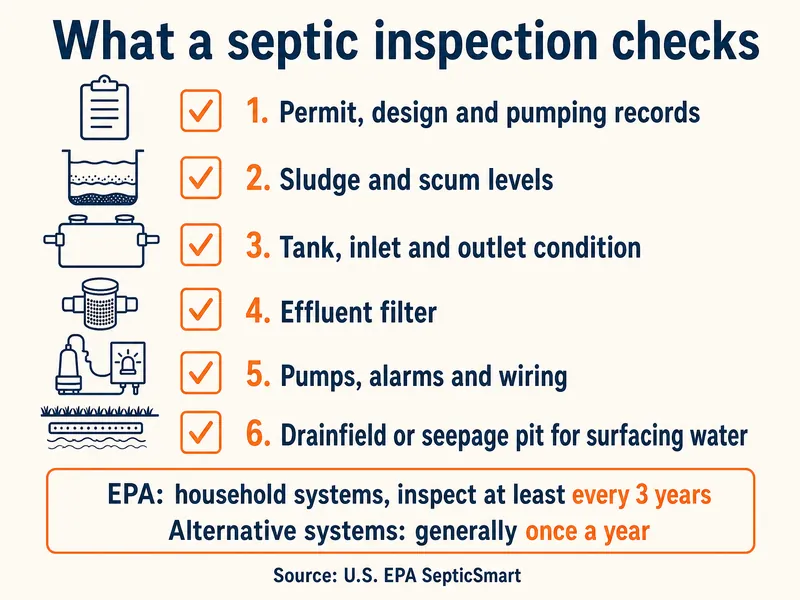
A full septic inspection checks the paperwork, the tank and the dispersal area, not just whether the toilets flush. The EPA's description of a typical inspection, in its septic FAQ, starts with the permit, design and installation records and the pumping and maintenance history, then moves to the hardware: opening every tank (septic tank, pump tank, distribution box), measuring sludge and scum to decide whether pumping is due, and checking the effluent filter if one is installed.
The inspector then looks for trouble. The EPA list includes low liquid levels that suggest a leak, staining above the outlet pipe that shows past backups, corrosion of the tank and its inlet and outlet pipes, and the condition of pumps, controls and wiring. Out in the yard it covers standing water or uneven drainage over the leach field, the distribution box, and sometimes a camera run down the pipes or digging into part of the drainfield to look for ponding.
Ask before booking which of these steps are included. A visual walk-around with a lid lifted is not the same job as a pumped tank, a camera run and a probe of the dispersal area, and the written report should say which was done.
When should you get a septic tank inspection?
Schedule one at least every three years, or about once a year for an alternative system, and whenever something changes. The EPA's care page sets the outer limit at "at least every three years" for an average household system, and says alternative systems with electrical float switches, pumps or mechanical parts should be inspected more often, generally once a year.
Other triggers are local. LA County's LAMP FAQ says adding a bedroom, a room that could serve as one, or an accessory dwelling unit means the septic system must be expanded to current rules, so an evaluation belongs at the start of that project. After a fire, the county evaluates the system as part of the rebuilding permit. And any of the failure signs below is a reason not to wait for the calendar.
Owners of a non-conventional system (NOWTS) have a fixed schedule. The county's FAQ says these must be inspected every year, by a private contractor certified by the system's maker, with the results submitted to Public Health under an annual permit.
Should you inspect the septic system before buying a house?
Yes, and in LA County the buyer has to ask for it, because the county does not require one. Its LAMP FAQ states that the county "does not have a requirement for a septic system to be evaluated at the time of sale," that some lenders may require it before they approve financing, and that it is good practice for the buyer to make an evaluation a condition of the offer, so problems surface before closing rather than after.
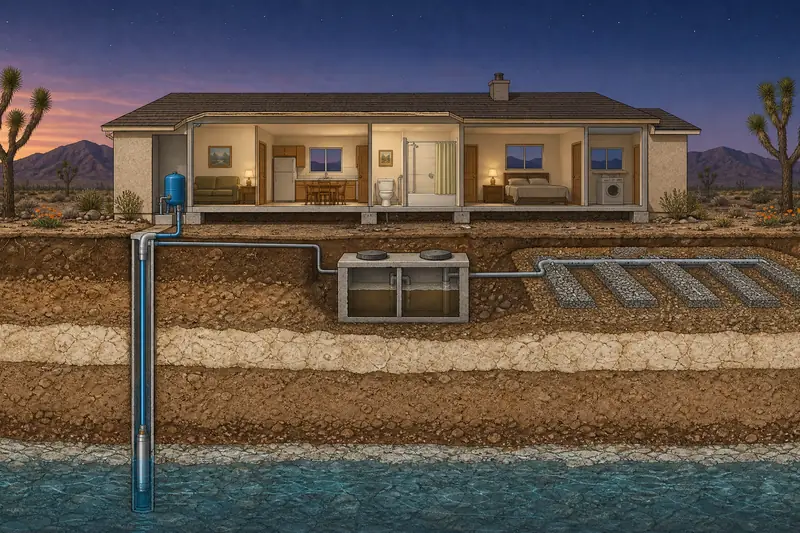
For an Antelope Valley property, the useful pre-purchase package goes beyond the tank. Ask the seller for the permit and as-built drawing, which shows whether the dispersal area is a leach field or a seepage pit, and for pumping receipts. Ask the inspector to pump the tank so its walls and outlet can be seen, and to confirm the number of bedrooms the system was permitted for matches the house. If the home has a private well too, add a lab test; the well water testing page lists what to request.
| Situation | Guidance | Source |
|---|---|---|
| Routine, conventional household system | At least every 3 years | U.S. EPA SepticSmart |
| System with pumps, floats or a treatment unit | Generally once a year | U.S. EPA SepticSmart |
| NOWTS in LA County | Annual inspection by a maker-certified contractor, results to Public Health | LA County LAMP FAQ (2018) |
| Home sale in LA County | Not required by the county; some lenders require it | LA County LAMP FAQ (2018) |
| Bedroom or ADU addition | System must be expanded to current rules | LA County LAMP FAQ (2018) |
What are the signs of septic failure?
Sewage where it should not be is the core sign. LA County's definition of a failed system covers sewage backing up into the house, reaching the ground surface, discharging somewhere unintended or contaminating water, plus any system that needs pumping more than twice in six months to keep those things from happening.
Earlier warnings show up inside first. The EPA lists slow drains in tubs, showers and sinks, gurgling in the plumbing, sewage smells near the tank or dispersal area, wet spots or standing water over them, and grass that is unusually lush and green there during dry weather. The EPA also notes that an odor alone can come from a blocked or poorly placed vent rather than a failure, which is one reason a diagnosis needs someone on site. When the county identifies a failing system, it requires the owner to have it inspected by a licensed, qualified septic contractor; the septic system basics page explains what replacement can involve.
What does a septic inspection cost?
No Antelope Valley or LA County agency publishes an inspection price, and the EPA's septic pages give none, so this guide does not print a number. The county's Public Health department adds that cost data on septic work never reaches its plan reviewers.
The price follows the scope. A records review and lid check is the smallest job; pumping the tank so its walls and outlet can be examined adds the pumping charge (see septic tank pumping); locating buried lids, a camera run through the lines and digging test holes in the leach field or beside a seepage pit each add time. When the system has to be uncovered to confirm the tank and dispersal sizes, the LAMP says the contractor must notify Public Health at least one business day ahead so the county can observe. Get a written quote listing each step and whether a written report comes with it.
Who can inspect a septic system in LA County?
For a formal certification inspection of an existing system, LA County's Local Agency Management Program names three license classes: General Engineering Contractor (Class A), Sanitation System Contractor (C-42) and Plumbing Contractor (C-36). Its qualifications table states that contractors holding only a General Building Contractor (Class B) license are not qualified to perform that inspection, even though Class B can install and repair systems.
LA County Public Health does not certify contractors or keep a list of approved ones, its LAMP FAQ says, and it advises homeowners to judge the experience of whoever they hire. Check any license on the Contractors State License Board's license lookup before work starts, and for a NOWTS confirm the inspector is certified by the unit's maker. The county itself does field inspections and record searches for assessments of existing systems, according to its onsite wastewater program page. The hiring a plumber in California page covers contracts and down payments.
How we put this page together
Built from: the EPA's septic FAQ section on inspections and its care page (updated August 17, 2026); LA County Public Health's FAQ on its septic plan, its onsite wastewater program page, and the plan itself (May 2018), including Table 4-3 on practitioner qualifications; and the CSLB license lookup. All opened in October 2026. Omitted: inspection prices (no agency source), point-of-sale inspection rules from other states, Kern County requirements for Rosamond (not verified), and any ranking of local inspectors.
Common questions
How long does a septic inspection take?
None of the agency sources gives a time. It depends on how many of the EPA's steps are included, whether lids must be dug up, and whether the tank is pumped during the visit.
Does a home inspector check the septic system?
A general home inspection is not the septic certification inspection LA County's plan describes, which calls for a Class A, C-42 or C-36 contractor. Ask the home inspector what, if anything, they check, and book the septic evaluation separately.
Should the tank be pumped before or during the inspection?
During, in most cases. The EPA's inspection steps include measuring sludge and scum before deciding whether to pump, and looking for staining above the outlet; an emptied tank then lets the inspector see its walls and pipes.
What records should a seller hand over?
The septic permit and as-built drawing, pumping receipts with dates, any repair invoices, and for a NOWTS the annual inspection reports and Public Health Permit. The EPA suggests asking the local permitting authority for copies if the seller has none.
Can LA County Public Health inspect a septic system for a buyer?
The county does field inspections and record searches for assessments of existing systems, but it does not replace a hired contractor's evaluation and does not recommend contractors.
Does a septic inspection test the well water too?
No. A septic inspection looks at the wastewater system; well water needs a separate sample sent to a state-accredited (ELAP) lab.
Is a passed inspection a promise the system will keep working?
No. It records the condition on the day of the visit; the EPA notes that drainfields more than 25 to 30 years old can be near the end of their useful life even when they still drain.
Related guides
More help: see our home water guide for the Antelope Valley.