
Tap water
Water Quality Report: How to Read Your CCR
A water quality report, or consumer confidence report (CCR), is the yearly summary your supplier must send by July 1; read each line by comparing the detected range and average with the MCL and the PHG.
On this page
Key takeaways
- Community water systems must deliver a consumer confidence report every year by July 1, according to the U.S. EPA.
- In California, the 2025 report covers January 1 to December 31, 2025 and was due to customers by July 1, 2026 (State Water Board).
- The MCL is the enforceable limit; the PHG, set by the California EPA, is the level with no known or expected health risk and is often far lower.
- "ND" means below the reporting limit, not proof of zero.
- Reports print ppm (mg/L) and ppb (µg/L): 1 ppm equals 1,000 ppb.
- California's consumer acceptance range for total dissolved solids runs from 500 mg/L (recommended) to 1,000 mg/L (upper), under Title 22, section 64449.
What is a water quality report?
A water quality report is the yearly summary a public water system sends its customers, listing where the water comes from and what was found in it. Its formal name is the consumer confidence report, or CCR. The EPA requires community water systems to deliver one, and in California the State Water Board says preparing it is required by Health and Safety Code section 116470.
The report covers the previous calendar year. A 2025 report, delivered by mid-2026, describes water sampled from January 1 to December 31, 2025, though some results are older because the state lets systems test slow-changing contaminants less than once a year. Palmdale Water District's 2025 report states this in its notes, and LA County's District 40 reports date each row with its sampling year.
What must a consumer confidence report include?
A consumer confidence report must name the water's source, summarize the risk of contamination of that source, and list the regulated contaminants detected, according to the EPA's list of required contents. It must also explain the health effects of any contaminant found in violation of a standard and what the system is doing about it.
The same EPA page lists an educational statement for vulnerable people about Cryptosporidium, information on nitrate, arsenic or lead where they may be a concern, and contact numbers for the system and EPA's hotline. In California, systems with more than 10,000 service connections also prepare a separate public health goal report every three years, according to the State Water Board's CCR page.
What do MCL, PHG and ND mean?
MCL is the maximum contaminant level, the highest level of a contaminant allowed in drinking water; PHG is the public health goal, the level below which there is no known or expected risk to health; and ND means not detected. Those are the definitions printed in Palmdale Water District's 2025 report, which adds that primary MCLs are set as close to the PHGs as is economically and technologically feasible.
The gap between the two is often large. Arsenic's MCL is 10 µg/L and its PHG 0.004 µg/L; hexavalent chromium's MCL is 10 µg/L and its PHG 0.02 µg/L. A result between the PHG and the MCL meets the standard. ND means the lab found nothing at or above the detection limit for reporting (DLR), the smallest amount that can be measured and reported, which the State Water Board sets.
| Term | Meaning in the report | Example from a 2025 Antelope Valley report |
|---|---|---|
| MCL | Highest level allowed in drinking water; primary MCLs protect health | Arsenic 10 µg/L |
| PHG | Level with no known or expected health risk, set by the California EPA | Arsenic 0.004 µg/L |
| MCLG | The federal equivalent of a PHG, set by the U.S. EPA | Printed in parentheses or brackets beside the PHG |
| ND | Not detected: below the reporting limit (DLR) | Palmdale groundwater arsenic average: ND |
| RAA | Running annual average of the previous four quarters | Palmdale chlorine RAA 1.0 mg/L |
| MRDL | Highest disinfectant level allowed | Chlorine 4.0 mg/L |
| AL | Action level that triggers treatment or other steps | Lead 15 µg/L, copper 1.3 mg/L |
| Secondary MCL | Limit for taste, odor or appearance, not health | TDS 1,000 mg/L (upper level) |
How do you read a water quality report table?
Read a water quality report table one row at a time: find the contaminant, check its unit, then compare the range and the average with the MCL in the same row. If the highest result is under the MCL, that contaminant met the standard that year. Then look at the PHG column to see how far the result sits from the health goal.
Take the arsenic row for Palmdale's groundwater in its 2025 report: MCL 10, PHG 0.004, range ND to 3, average ND, all in µg/L. Every result was under the limit, and most wells had none detectable. Check the compliance column too, and read its footnotes. Cal Water's Lancaster report has an "In Compliance" column that reads "Yes" for hexavalent chromium even though wells reached 11 µg/L; its footnote ties this to the system's size and an October 1, 2028 compliance date. Quartz Hill Water District's table, by contrast, marks the same contaminant "Violation: Yes" while its text gives a 2027 date.
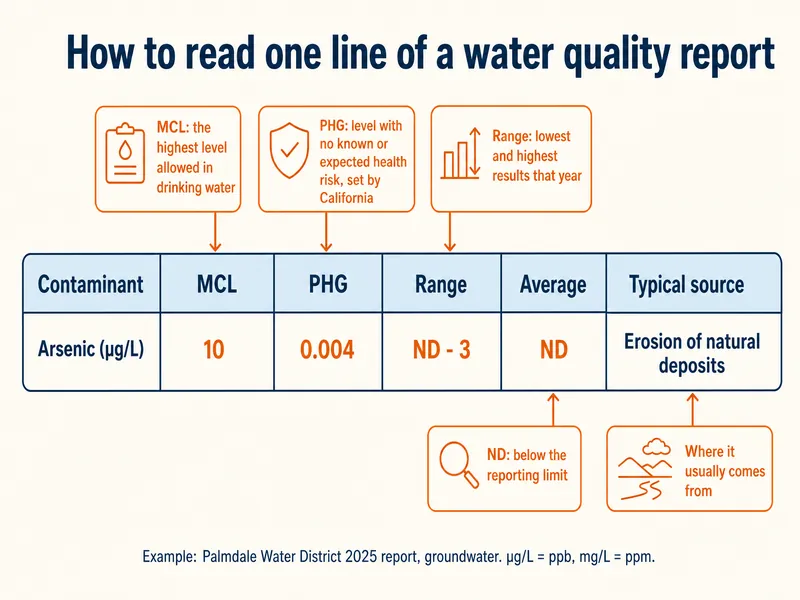
Watch the units. Reports print ppm (parts per million, the same as mg/L) for minerals such as nitrate and fluoride, and ppb (parts per billion, µg/L) for trace metals such as arsenic and lead. Some columns split results by source, such as District wells and AVEK's plants in Lancaster's report, so your tap gets a blend of the two.
What does TDS in water tell you?
TDS, or total dissolved solids, measures all the minerals and salts dissolved in the water, and it is a taste and appearance measure rather than a health one. California's secondary standards table gives TDS a recommended level of 500 mg/L, an upper level of 1,000 mg/L and a short-term level of 1,500 mg/L (Title 22, section 64449). Lower than 500 is described as desirable; up to 1,000 is acceptable where better water is not reasonably available.
That is why reports print different TDS limits. District 40's Lancaster report lists 500 mg/L beside well results of 170 to 740 mg/L (average 369), while Cal Water's Lancaster report lists 1,000 mg/L beside 280 to 390 mg/L (average 335). Palmdale's 2025 report lists 1,000 mg/L, with averages of 250 mg/L for surface water and 254 mg/L for groundwater. TDS includes hardness minerals, which the Antelope Valley water hardness page covers system by system.
Where do you find your report?
Your report is on your water supplier's website, usually under "water quality", and systems must send it to customers by July 1. If you don't know your supplier, check the water bill or enter the address in the state's drinking water service area finder. The guide to who supplies your water links every Antelope Valley supplier's latest report.
LA County posts all of its Waterworks District reports on one water quality and reports page, and the State Water Board's page notes that many California CCRs are also on EPA's website. A rented home or apartment gets the same report as any other address on that system. For Palmdale's report in plain language, see Palmdale water quality.
What should you do if a result worries you?
If a result worries you, first check whether it is above the MCL or only above the PHG, then read what the report says about it. A result above the PHG but under the MCL meets the standard; one above the MCL comes with an explanation from the system and, for a violation, a public notice like Rosamond CSD's September 2026 chromium 6 notice.
Next, ask the supplier: every report lists a contact for questions. If you want to treat your water, choose a device certified for that contaminant; the State Water Board's registered device directory can be searched by contaminant. For lead, which mostly comes from home plumbing, only a test at your own tap shows what your pipes add. The hexavalent chromium page works through one contaminant in detail.
What a water quality report must tell you
- July 1Yearly deadline for community water systems to deliver the CCRU.S. EPA
- 500 mg/LCalifornia's recommended level for total dissolved solids (upper level 1,000 mg/L)Title 22 CCR section 64449
- 0.004 µg/LPublic health goal for arsenic, against an MCL of 10 µg/LPalmdale Water District 2025 CCR
- 369 mg/LAverage TDS in District 40's Lancaster wells, 2025 data (range 170 to 740)LA County Waterworks District 40
How we put this page together
This page is based on EPA's CCR page for consumers (updated November 21, 2025), the State Water Board's CCR page (updated October 13, 2026), California's secondary standards in Title 22, section 64449 (via Cornell's Legal Information Institute), and the definitions and tables in Antelope Valley reports: Palmdale Water District's 2025 report, the 2026 District 40 report for Lancaster (2025 data), the 2025 Cal Water report for its Lancaster system and Rosamond CSD's September 2026 notice, opened on October 26, 2026. Left out: water scores and grades from third-party websites, health advice beyond what the reports and agencies state, and phone numbers printed in the reports.
Common questions
Is a consumer confidence report the same as a water test of my home?
No. A CCR summarizes samples the system took across its sources and distribution system, while a home test reflects one tap, including what household plumbing adds.
Why are some results in a water quality report several years old?
The state allows systems to test some slow-changing contaminants less than once a year, so a 2025 report can carry 2023 or 2024 results with their sampling year printed beside them.
What does "90th percentile" mean for lead?
Lead and copper are sampled at homes, and the report gives the result that 90% of samples fell at or below. District 40's Lancaster figure was 1.8 µg/L in 2025, against a 15 µg/L action level.
What is an unregulated contaminant in a CCR?
It is a substance without an MCL that the system monitors, often under EPA's unregulated contaminant monitoring rule; Palmdale's 2025 report lists several PFAS compounds this way. Hardness and sodium are also often listed as unregulated.
What is a notification level?
A notification level is a State Water Board guideline that, if exceeded, triggers public notification, according to Palmdale's report definitions. District 40's 2026 Lancaster report says one well exceeded a PFAS notification level but not the response level.
Why does my report show two sets of results?
Many Antelope Valley systems blend their own wells with water bought from AVEK, and the report tests each source separately. District 40's Lancaster report, for example, has columns for District wells and for AVEK's Quartz Hill plant.
What is MRDL on a water report?
MRDL is the maximum residual disinfectant level, the most disinfectant allowed in the water. Every Antelope Valley system in this guide uses chlorine, with an MRDL of 4.0 mg/L.
Related guides

More help: see our home water guide for the Antelope Valley.