
Wells
Arsenic in Well Water: Testing and Treatment
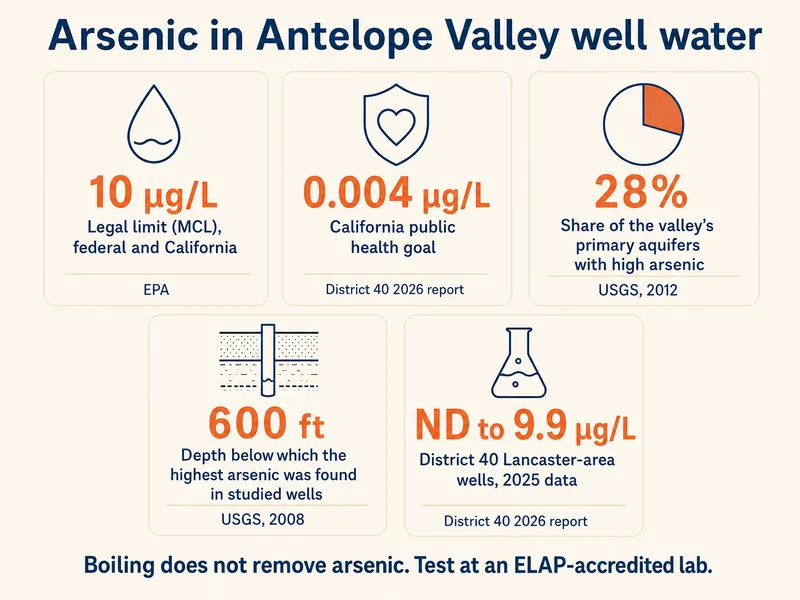
Arsenic in well water is a known Antelope Valley issue: the USGS found it high in 28% of the basin's primary aquifers, so a private well needs a lab test against the 10 µg/L limit.
On this page
Key takeaways
- USGS publication FS 2012-3033 found arsenic above health benchmarks in 28% of the Antelope Valley's primary aquifers, more than any other trace element it measured.
- A 2008 USGS study in the valley found the highest arsenic in the deepest parts of public wells, 600 feet or more below the surface; sealing those sections cut arsenic by an average of 84%.
- The drinking water limit is 10 µg/L in federal and California law; California's public health goal is 0.004 µg/L.
- Public systems nearby report meeting the arsenic standard: District 40's Lancaster-area wells show not detected to 9.9 µg/L in its 2026 report.
- Boiling does not remove arsenic, and neither do softeners or carbon filters alone.
- The State Water Board warns that many devices certified for arsenic V do little for arsenic III, so the test and the device have to match.
Arsenic by the numbers
- 10 µg/LArsenic MCL, federal and California; systems had to comply by January 23, 2006EPA
- 0.004 µg/LCalifornia public health goal for arsenic, as listed in District 40's 2026 reportLA County Waterworks District 40
- 28%Share of Antelope Valley primary aquifers with high arsenicUSGS FS 2012-3033
- 84%Average drop in arsenic after the deepest well sections were sealed offUSGS FS 2008-3043
Why is there arsenic in Antelope Valley well water?
Arsenic in Antelope Valley well water is natural: it comes from the rocks and sediments that hold the groundwater, not from a spill. The CDC lists "natural deposits in the earth" as the main source of arsenic in wells, and EPA training material on the arsenic rule says it typically enters water through "the weathering and dissolution of arsenic-bearing rocks, minerals, and ores". The USGS calls the valley's arsenic "naturally occurring".
How much ends up in a given well depends on the aquifer and the depth. The USGS basin study of 56 wells, published in 2012, found arsenic high in 28% of the primary aquifers, the part of the system used for public supply. An earlier USGS project with LA County's waterworks, described in publication FS 2008-3043, found the high levels "concentrated in the deepest portions of the wells," 600 feet or more down. After the deep sections of five wells were sealed, arsenic fell by an average of 84% while yield fell by only 24%.
A private well is not in either study. One drilled to a different depth, or into a different part of the basin, can read well above or well below its neighbors, so the only reliable number is the one from your own lab test.
What is the legal limit for arsenic in drinking water?
The legal limit for arsenic in drinking water is 10 µg/L, the same in federal and California rules. EPA adopted that maximum contaminant level in 2001, and public systems had to meet it by January 23, 2006, according to EPA's chemical contaminant rules page. California's public health goal, the level with no expected health risk over a lifetime, is far lower at 0.004 µg/L, as listed in local water reports.
Those limits bind public water systems, not private wells. The State Water Board's domestic well page recommends that well owners hold their water to the same levels. Water reports print arsenic in "ppb", which is the same as µg/L.
| System | Source tested | Range | Average | Report (data year) |
|---|---|---|---|---|
| District 40, Regions 4 and 34 (Lancaster) | District wells | ND to 9.9 | 3.9 | 2026 report (samples through 2025) |
| District 40, Regions 4 and 34 | Water Bank supply | 4.8 | 4.8 | 2026 report (2025) |
| Cal Water, Lancaster system | Wells | 3.2 to 3.7 | 3.5 | 2025 CCR (2023 to 2025) |
| Palmdale Water District | Groundwater | ND to 3 | ND | 2025 CCR (2025) |
| Quartz Hill Water District | System results | 2 to 24 | 6.3 | 2025 CCR (2025) |
| AVEK, LA County system | Treatment plants | ND | ND | 2025 annual report |
Every system in that table reports meeting the arsenic standard. Quartz Hill Water District's 2025 report lists an average of 6.3 µg/L with a range of 2 to 24, marks no violation, and adds in a footnote: "While your drinking water meets the federal and state standard for arsenic, it does contain low levels of arsenic." That says the treated, blended water reaching these customers meets the standard; it says nothing about an unmonitored private well on the same aquifer. Palmdale's figures come from its 2025 report, Cal Water's from its Lancaster system report.
How do you test well water for arsenic?
Test well water for arsenic at a laboratory accredited by the State Water Board's ELAP program, using the bottles and instructions the lab provides. Arsenic has no color, smell or taste at these levels, so a sample is the only way to know. The State Water Board lists arsenic among the inorganic chemicals a well owner should test for, alongside uranium and total dissolved solids, and recommends testing once a year.
If the first result is near or above 10 µg/L, ask the lab about speciation, which separates arsenic III from arsenic V. That split matters for treatment, because the two forms behave differently in filters. The State Water Board advises that if you suspect arsenic, "you should not use the water until it is tested". After any treatment goes in, test the treated water too.
Does boiling or a filter remove arsenic?
Boiling does not remove arsenic; it concentrates it slightly as water evaporates. The CDC puts it simply: "Boiling will not remove chemicals from water." Dartmouth's arsenic research program, Arsenic and You, adds that carbon-based pitcher filters do not remove it either, though some pitchers are certified for arsenic.
Whole-house softeners and sediment filters are not arsenic treatment. UNL Extension's treatment overview lists the methods that work as reverse osmosis, distillation and iron- or manganese-based adsorbent media, and the CDC adds ultrafiltration and ion exchange. Arsenic and You suggests treating at one tap for most levels and the whole house only for very high ones. Whichever you choose, look the exact model up in California's registered device database, which can be searched by contaminant.
Does reverse osmosis remove arsenic?
Reverse osmosis removes arsenic V well but arsenic III poorly unless the water is oxidized first. EPA lists RO among its best available technologies for arsenic, with removal above 95%, but its arsenic rule training notes that all those technologies "are for arsenic V" and that "Pre-oxidation may be required to convert arsenic III to arsenic V." Deep groundwater with little oxygen tends to carry more arsenic III, the same material explains.
The State Water Board says the same thing from the consumer side: "Arsenic 3 is much more difficult to remove from the water", and many devices certified for arsenic V give "a minimal reduction" of arsenic III. So the steps are: test, find out which form is present, choose a unit certified for arsenic (with an oxidizing stage if arsenic III is significant), and retest. How an under-sink RO unit is plumbed and maintained is covered on the RO and softener comparison.
What about nitrate in well water?
Nitrate is the other common well contaminant to check alongside arsenic, with a limit of 10 mg/L measured as nitrogen. Local reports carry the same health language: nitrate above 10 mg/L "is a health risk for infants of less than six months of age". The USGS basin study found nitrate above benchmarks in the valley, and the CDC lists fertilizer, septic systems that are not working correctly and animal waste as sources.
Public systems nearby report nitrate well under the limit: District 40's Lancaster-area wells ranged from not detected to 5.4 mg/L in 2025, and Palmdale Water District's groundwater from not detected to 6 mg/L. A private well near a septic system or old farmland can differ. Treatment options are reverse osmosis, ion exchange and distillation (CDC); boiling makes nitrate more concentrated, not less. The State Water Board advises against using well water suspected of high nitrate to mix infant formula until it has been tested. For a home on septic, the septic system basics page explains how a working system protects the well, and well water treatment puts arsenic and nitrate stages in order with the rest.
How we put this page together
This page is based on USGS publications FS 2012-3033 (Antelope Valley groundwater quality, 2012) and FS 2008-3043 (arsenic study with LA County); EPA's chemical contaminant rules page and its 2002 arsenic rule training slides; the CDC's page on chemicals in tap water (January 30, 2025); the State Water Board's GAMA domestic well page, ELAP page and device registration page (June 2025 update); UNL Extension EC703; Dartmouth's Arsenic and You program; and the latest reports from LA County Waterworks District 40 (2026, 2025 data), Palmdale Water District (2025), Cal Water's Lancaster system (2025) and AVEK (2025). Checked in October 2026. Left out: health effects beyond what these agencies state, private well results (none are published), and any product recommendation: readers should match a certified model to their own lab result.
Common questions
Is Lancaster tap water high in arsenic?
The Lancaster-area systems report arsenic below the 10 µg/L limit: District 40's wells range from not detected to 9.9 µg/L with a 3.9 µg/L average, and Cal Water's Lancaster wells average 3.5 µg/L. Those figures are for the public systems, not private wells.
Can arsenic get into a well from a nearby septic system?
The sources on this page describe Antelope Valley arsenic as naturally occurring in the aquifer. Septic systems are a listed source of nitrate and bacteria, which is one more reason a well near a septic tank gets the full yearly panel.
Does deepening a well lower arsenic?
Not necessarily. In the USGS study of public wells in the valley, the highest arsenic sat in the deepest sections, 600 feet or more down, and sealing those sections lowered it. A well contractor with C-57 licensing can discuss depth for a specific site.
Is it safe to shower in water with arsenic above the limit?
The agencies cited here set the limit for drinking water. For questions about other household use, ask LA County Public Health or Kern County Environmental Health, which advise well owners on results above a limit.
Does a water softener remove arsenic?
No. Softeners exchange hardness minerals for sodium. Arsenic needs a method such as reverse osmosis, adsorptive media or distillation in a unit certified for arsenic.
How often should a well with arsenic treatment be retested?
At least once a year, and soon after installation. The State Water Board recommends periodic testing of treated water because performance falls if cartridges are not replaced on schedule.
What is the difference between arsenic III and arsenic V?
They are two chemical forms. EPA material says arsenic III dominates where groundwater has little oxygen, and it is harder to remove; arsenic V is what most certified devices are tested against.
More on wells
More help: see our Antelope Valley water, wells and septic guide.