
Wells
Well Pressure Tank and Pump: How They Work
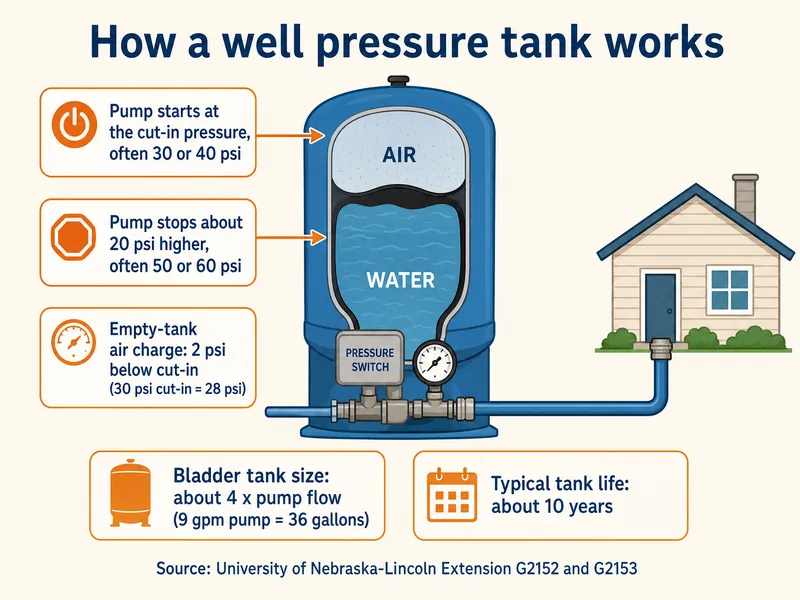
A well pressure tank stores water under air pressure so the pump starts less often; with the tank empty, its air charge should sit 2 psi below the pump's start pressure.
On this page
Key takeaways
- A pressure tank stores water under pressure, cuts the number of pump starts and covers demand peaks, per University of Nebraska-Lincoln Extension NebGuide G2152.
- The pump typically starts at 20 to 40 psi and stops at 40 to 60 psi; the stop setting is usually about 20 psi above the start.
- With the tank drained, its air charge should be 2 psi below the start pressure: 28 psi for a 30 psi start, per UNL Extension NebGuide G2153.
- A pump that runs a few seconds and shuts off usually means the tank has lost its air.
- UNL Extension puts a pressure tank's life at about 10 years, with some lasting 30.
- In California, well and pump work falls under the CSLB's C-57 well drilling license.
Pressure tank numbers
- 2 psiEmpty-tank air charge below the pump's start (cut-in) pressureUNL Extension G2153
- 4 × gpmBladder tank size rule: pump flow times four (9 gpm pump = 36-gallon tank)UNL Extension G2152
- 30 psiMinimum pressure water softeners, treatment units, washers and dishwashers needUNL Extension G2152
- 10 yearsTypical life of a pressure tank (some last 30)UNL Extension G2153
How does a well pressure tank work?
A well pressure tank works by squeezing air: water pumped into the tank compresses a pocket of air, and that air pushes water out to the taps when the pump is off. UNL Extension's NebGuide G2152 explains that water cannot be compressed but air can, so "the more the air is compressed, the greater the water pressure." When pressure reaches the stop setting, typically 40 to 60 psi, the pump shuts off; as water is used and pressure falls to the start setting, typically 20 to 40 psi, it starts again.
The pressure switch, usually at or near the tank, makes those decisions. G2152 calls it "the brain of the system". Most homes built since about 1970 use a bladder or diaphragm tank, where the water sits in a rubber bladder and never touches the air, so the air does not slowly dissolve away the way it does in an old galvanized tank. Those older tanks need an air volume control or they become waterlogged.
Some newer systems skip the big tank. A variable-speed (VFD) pump changes its speed to hold a near-constant pressure and, according to G2152, usually needs only a 1 to 2 gallon tank. These systems start less often and use less energy, but their electronics call for someone trained on them.
What size well pressure tank do you need?
Size a bladder or diaphragm pressure tank at about four times the pump's flow rate in gallons per minute. G2152 gives the example of a 9 gpm pump needing a 36-gallon tank, and notes that a typical home pump delivers 5 to 10 gpm. Old galvanized tanks are sized at ten times the flow, because far less of their volume is usable.
The number on the label is total volume, not usable water. Only part of a tank's volume comes out between the stop and start pressures, a figure called drawdown, and it shrinks as the pressure range rises.
| Tank total volume | 20 to 40 psi | 30 to 50 psi | 40 to 60 psi |
|---|---|---|---|
| 14 gallons | 5.1 gal | 4.3 gal | 3.7 gal |
| 20 gallons | 6.5 gal | 5.5 gal | 5 gal |
| 32 gallons | 12 gal | 10 gal | 8.5 gal |
| 45 gallons | 18 gal | 15 gal | 12 gal |
| 62 gallons | 21 gal | 19 gal | 17 gal |
When a tank is replaced, G2153 says the new one should store at least as much usable water as the old one, matched at the same switch setting, and to choose the next size up if household demand has grown. A low-yield well can need extra storage, because a bladder tank is nearly empty when the pump restarts.
What is short cycling?
Short cycling is a pump that turns on and off every few seconds instead of running for a steady stretch. NebGuide G2153 describes it directly: if the pump "runs only a few seconds and then shuts off", pressure is building too fast, "meaning there is not enough air in the pressure tank." The air is the buffer that slows the pressure change between starts.
The usual causes are a lost air charge or a failed bladder. G2152 explains that a tank without enough air becomes waterlogged, so "the pump runs nearly every time water is used." Fewer starts is the whole point of the tank: G2152 says the stored reserve makes the pump start and stop less often, "prolonging the life of the pump", and that more energy goes into starting a pump than into keeping it running.
How do you check a pressure tank's air charge?
Check a pressure tank's air charge with the tank completely empty of water, using an ordinary tire gauge on the air valve at the top. G2153 lays out the order: turn off power to the pump, open faucets until the system gauge reads zero, then measure. The reading should be 2 psi below the pump's start setting, which is printed on the pressure switch lid or inside its cover; for a 30 psi start, that means 28 psi.
If water is still in the tank after the pressure is drained, the bladder may have failed and the tank may need replacing, G2153 says. If the charge holds, air is added with a compressor to the target and the cap goes back on; a reading a week later shows whether the tank is leaking down. Some makers void the tank warranty if anyone but a licensed professional removes the valve cap.
Leave the pressure switch itself alone. G2153 is blunt that homeowners "should not attempt to adjust the pressure switch, as it is connected to electric power and could cause a serious injury." Checking tank air is a low-risk job with the power off; changing switch settings is electrical work for a professional.
What are the signs of a failing well pump?
The common signs of a well pump problem are no water, weak or sputtering flow, a pump that never shuts off, and rapid on-off cycling. NebGuide G2153 sorts them like this:
- No water at all: check that the house has power on other circuits, then the breaker or fuse for the pump circuit. If that does not fix it, the pump, wiring or controls need a professional.
- Little or no water, especially during heavy use: the pump may be set too high, so the water level drops below it. G2153 notes that in drought years groundwater can fall far enough to leave a pump uncovered.
- Pump runs continuously: a check valve may be stuck open, or a line between the well and the house may be broken. With all water shut off, a gauge that holds steady means no leak; a dropping gauge points to a leak or a bad check valve. A soggy patch in the yard, away from the septic field, can mark the break.
- Pump runs a few seconds, then stops: the tank has lost its air, as described above.
The CDC suggests checking a well for mechanical problems every spring, and the EPA recommends periodic inspection of the exposed parts of the well. After any pump or tank work, retest for bacteria, using the panel laid out in the well testing guide. Mineral scale can also wear pumps and valves, and the well water treatment page explains when a softener or sediment filter is worth adding.
What does well pump replacement cost?
Well pump replacement cost depends on the pump type, how deep it is set, and what else has to change; no government or university source with current local prices was found, so this guide gives the cost drivers rather than a range. A submersible pump has to be pulled out of the well for any repair (G2152), and the deeper the setting, the more pipe and wire come up with it.
Ask for a written quote that itemizes these parts:
- Pump and motor: submersible or jet, the horsepower and flow rate, and whether it is a conventional or variable-speed system.
- Setting depth: the length of drop pipe and wire, and whether the pump height is being changed to account for a falling water level.
- Tank and controls: a new pressure tank sized by the four-times-flow rule, the pressure switch, gauge and check valves.
- Electrical work: a new control box or VFD controller, and any panel work.
- Disinfection and testing: a follow-up bacteria test, and shock chlorination if that test comes back positive.
Check the contractor's license on the CSLB site; the C-57 well drilling classification covers installing and repairing "water wells and pumps". The hiring a plumber in California page explains CSLB checks and payment rules that apply to any contractor, and all the well and septic topics are on the guides page.
How we put this page together
Sources: the Nebraska Extension (UNL) NebGuides G2152 (distribution system, issued July 2012) and G2153 (operation and maintenance of mechanical components, 2012), whose drawdown table comes from the MidWest Plan Service Private Water Systems Handbook; the CSLB's C-57 classification page; and the well-owner pages of the CDC (2024) and EPA (2026). Everything was checked in October 2026. The Nebraska guides are general and describe a cold-climate state; the pressure, sizing and troubleshooting principles apply anywhere, while frost-protection details were left out. Also left out: pump and tank prices (no primary source), brand recommendations and forum advice.
Common questions
What pressure should a well pressure tank be set to?
With the tank drained of water, set the air charge 2 psi below the pump's start pressure, which is listed on the pressure switch cover. A 40 psi start means 38 psi of air; a 30 psi start means 28 psi.
Can a well pressure tank be too big?
A larger tank gives more water between pump starts, which is good for the pump. The limits are space, cost and, for very large systems, the pump supplier's advice; UNL Extension says to ask the supplier when a pump delivers more than 25 gpm.
Why does the water pressure drop to almost nothing before the pump kicks on?
A bladder tank is designed to be nearly empty when pressure reaches the start setting. If flow drops sharply or sputters before the pump starts, the air charge may be wrong or the start setting too low; have the charge checked with the tank drained.
How long does a well pump last?
UNL Extension gives about 10 years for a pressure tank, and says a properly working tank prolongs pump life by reducing starts. The sources reviewed for this page did not give a reliable lifespan for pumps themselves.
Does a water softener need a certain well pressure?
Yes. UNL Extension says water treatment units, softeners, washers and dishwashers need at least 30 psi, and most fixtures need at least 10 psi. Many treatment units also list a minimum pump flow rate.
Who can replace a well pump in California?
Well and pump installation and repair falls under the CSLB's C-57 well drilling classification. Check any license number on the CSLB website before work starts.
Should the well be disinfected after a pump replacement?
Because the CDC counts work on the well itself among the triggers for a new test, run a bacteria test before drinking the water again. If it comes back positive, shock chlorination is the usual next step, then another test.
More on wells
More help: see our home water guide for the Antelope Valley.