
Pipes & leaks
Burst Pipe: What to Do in the First Hour
Burst pipe? Shut off the main water valve first, then drain the lines, photograph the damage, start drying within 24 to 48 hours, and report the claim to the insurer promptly.
On this page
Key takeaways
- California plumbing code calls for a full-way shutoff valve on the house side of each water meter (CPC 605.2, as cited in a City of Newport Beach inspection checklist); find it before anything breaks.
- EPA says to dry water-damaged areas and items within 24 to 48 hours to prevent mold growth, and to keep indoor humidity below 60 percent.
- The California Department of Insurance lists "sudden & accidental water damage" as typically covered and seepage, leaks and "losses to house vacant for 60 days or more" as generally not covered (CDI residential guide).
- CDI's claims guide says to make temporary repairs to prevent further damage, keep receipts, and hold off on extensive permanent repairs until the adjuster has seen the damage.
- A patch that keeps the old pipe needs no county permit, while a new section of pipe does (County Code Title 28, Section 103.7).
The first hour, by the numbers
- 24–48 hoursTime to dry wet materials before mold usually startsEPA
- 60%Indoor relative humidity to stay below while drying outEPA
- 60 daysVacancy after which losses are generally not covered, per CDI's list of typical exclusionsCalifornia Department of Insurance
What should you do first when a pipe bursts?
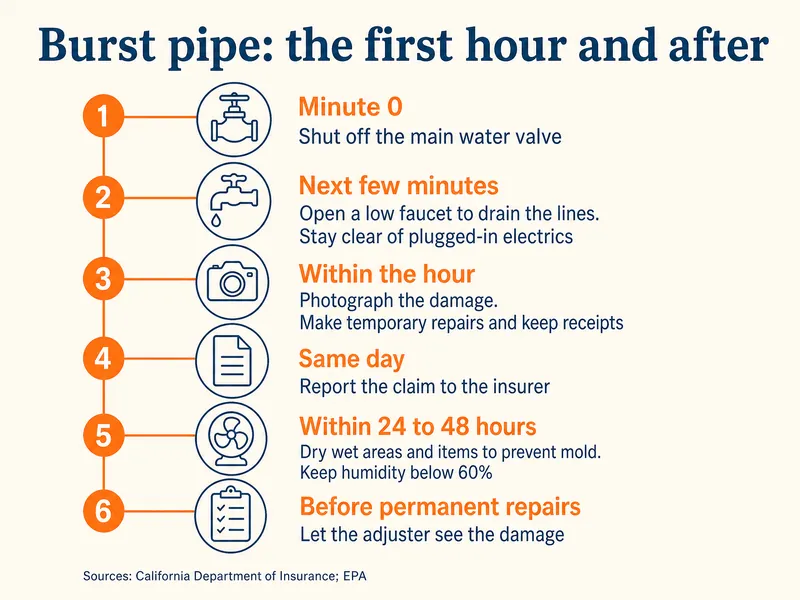
The first thing to do when a pipe bursts is to stop the water at the main shutoff valve, then open a low faucet to drain what is left in the lines. Every minute of flow adds water to floors, walls and the slab, and a supply pipe keeps feeding the break at full pressure until the valve is closed.
Then work through the rest in order:
- Shut the main valve (where the line enters the house, or at the meter box if the house valve won't turn).
- Open a faucet at the lowest point, and an outdoor bib, to drain the pipes.
- Stay clear of electricity: don't wade through water near outlets or appliances that are plugged in.
- Move belongings out of the wet area and lift furniture off wet carpet.
- Photograph everything before cleanup starts.
- Call the insurer to report the loss.
- Arrange the repair with a licensed plumber.
Where is the main water shut off valve?
The main water shut off valve is usually where the water line enters the house, often on an outside wall facing the street, in the garage, or near the water heater. California plumbing code requires a full-way valve on the discharge side of each water meter that controls all the outlets, according to the City of Newport Beach checklist (CPC 605.2), so a house also has a valve just past the meter, in the meter box near the street.
The pressure regulator is often close by. The City of San Diego's regulator guidance lists the usual spots as in the garage, on the side of the house, in a box or buried in the ground just before the pipe enters the house, or near the water heater. Find the valve, test that it turns, and show everyone in the house where it is.
How do you shut off water to the house?
To shut off water to the house, turn the main valve's handle clockwise until it stops (a round wheel handle), or a quarter-turn until the lever sits across the pipe (a ball valve). Then open a faucet to confirm the flow has stopped.
If the house valve is stuck, the next stop is the valve on the customer side of the meter in the meter box; a meter key or adjustable wrench usually turns it. Leave the utility's own valve and the meter alone, and if the box valve won't budge, ask the water district for help. Palmdale Water District, District 40, Quartz Hill Water District, Rosamond CSD and Cal Water each serve different parts of the valley; the who supplies my water page shows which one serves a given address.
A tank water heater holds a full tank of water under pressure, so a break on the hot side keeps leaking after the main is closed. Close the cold supply valve on top of the heater too, and for a gas unit set the control to "vacation" or "pilot" as the maker's label describes.
How do you limit water damage after a burst pipe?
To limit water damage after a burst pipe, remove standing water fast and dry everything within 24 to 48 hours. EPA's mold guide says that if wet or damp materials are dried within 24 to 48 hours after a leak, "in most cases mold will not grow." It also advises keeping indoor humidity below 60 percent, ideally 30 to 50 percent.
The California Department of Insurance says the same in claims terms: after a loss, "make temporary repairs to prevent further damage," and policies "may not cover ensuing damage" if reasonable steps weren't taken to secure the property. Keep receipts for fans, dehumidifier rental, tarps and plastic sheeting, because insurers reimburse reasonable protection costs. CDI also warns to beware of contractors who push large spending on temporary repairs.
If the water sat for a while before anyone noticed, mold may already be growing. CDI's guide says cleaning it up yourself may spread spores, and to contact the claims adjuster right away if mold is suspected after a leak.
Does homeowners insurance cover a burst pipe?
Homeowners insurance usually covers water damage from a burst pipe when the break was sudden and accidental, while the cost of the broken pipe itself and damage from a slow leak often are not covered. In CDI's two-column list of perils, a sudden and accidental escape of water sits on the covered side; slow seepage, mold, upkeep problems and homes left empty for two months or longer sit on the excluded side.
| Situation | Typical treatment | What to check in the policy |
|---|---|---|
| Pipe bursts suddenly and floods a room | Water damage usually covered | Deductible, limits on mold, tear-out wording |
| Slow leak behind a wall for months | Generally not covered | Exclusions for seepage, leaks and maintenance |
| Freeze break in a house vacant 60+ days | Generally not covered | Vacancy clause and its exact wording |
| Mold after a covered water loss | May be covered if caused by a covered peril | Mold sublimits |
| Flood from outside water | Not covered by a homeowners policy | Separate flood policy |
Report the loss promptly; CDI says to immediately report any water damage claim to the agent or company. Leaving town for a long stretch in winter? Read the vacancy clause, and follow the frozen pipe prevention steps before leaving.
How is a burst pipe repaired?
A burst pipe is repaired by cutting out the split section and joining in new pipe, or by replacing a longer run if the pipe is old or has failed before. The repair itself is often small; the drywall, flooring and drying around it usually take longer.
Wait for the adjuster before tearing out finished surfaces beyond what drying requires, because CDI advises against extensive permanent repairs before the claim is assessed. County rules draw the permit line at the pipe itself: a patch that leaves the pipe in place is exempt under Title 28, Section 103.7, but a new length of pipe is permitted work; the code and permits page explains which office covers Lancaster, Palmdale and county areas. If the break was in a line under the slab, the slab leak guide covers reroutes and repairs.
How we put this page together
Sources: two California Department of Insurance publications (the homeowners coverage guide and the February 2025 claims guide), EPA's A Brief Guide to Mold, Moisture and Your Home, the county's Title 28 permit exemptions as posted by LA County Public Works, a City of Newport Beach plumbing inspection checklist citing CPC 605.2, and the City of San Diego's pressure regulator guidance. Checked in October 2026. Left out: water damage restoration prices, any statement that a specific policy covers a specific loss, and contractor recommendations.
Common questions
Should the water heater be turned off after a pipe bursts?
If the break is on the hot side, close the heater's cold supply valve so the tank stops feeding the leak. A heater that may run dry should be set to its vacation or pilot setting, following the maker's label.
Can a burst pipe be fixed with tape or a clamp?
A repair clamp or wrap can slow a leak until a proper repair, but it is temporary. Keep the receipt, since CDI treats reasonable temporary repairs as part of the claim.
Who pays if the break is on the street side of the meter?
The water district maintains its own pipes and meter. If water is coming up near the meter box or the street, report it to the district that serves the address.
How long do walls take to dry out?
EPA's target is 24 to 48 hours for drying wet materials to prevent mold. Thick or layered materials may need fans, dehumidifiers or removal to meet it.
Is it safe to stay in the house?
Usually, once the water is off and nobody is near wet electrical outlets. If ceilings sag, wiring got wet, or mold appears, step out and ask the insurer about additional living expenses.
Will insurance pay for the plumber?
Policies differ, and CDI's guides describe coverage for sudden water damage rather than for worn-out parts. Ask the adjuster what the policy pays for before the repair starts.
More on pipes and leaks

More help: see our Antelope Valley water, wells and septic guide.